In Example 11.1.4 and Exercises 11.1. 4–11.1. 22 we saw that the eigenfunctions of Problem 5 are orthogonal on \([-L,L]\) and the eigenfunctions of Problems 1–4 are orthogonal on \([0,L]\). In this section and the next we introduce some series expansions in terms of these eigenfunctions. We’ll use these expansions to solve partial differential equations in Chapter 12.
Theorem 11.2.1
Suppose the functions \(\phi_1,\) \(\phi_2,\) \(\phi_3,\) …\(,\) are orthogonal on \([a,b]\) and
Let \(c_1,\) \(c_2,\) \(c_3,\)… be constants such that the partial sums \(f_N(x)=\sum_{m=1}^N c_m\phi_m(x)\) satisfy the inequalities
for some constant \(M<\infty.\) Suppose also that the series
converges and is integrable on \([a,b]\). Then
Proof Multiplying (11.2.2) by \(\phi_n\) and integrating yields
It can be shown that the boundedness of the partial sums \(\{f_N\}_{N=1}^\infty\) and the integrability of \(f\) allow us to interchange the operations of integration and summation on the right of (11.2.4), and rewrite (11.2.4) as
(This isn’t easy to prove.) Since
(11.2.5) reduces to
Now (11.2.1) implies (11.2.3).∎
Theorem 11.2.1 motivates the next definition.
Definition 11.2.2
Suppose \(\phi_1,\) \(\phi_2\), …, \(\phi_n\),… are orthogonal on \([a,b]\) and \(\int_a^b\phi_n^2(x)\,dx\ne0\), \(n=1\), \(2\), \(3\), …. Let \(f\) be integrable on \([a,b],\) and define
Then the infinite series \(\sum_{n=1}^\infty c_n\phi_n(x)\) is called the Fourier expansion of \(f\) in terms of the orthogonal set \(\{\phi_n\}_{n=1}^\infty\), and \(c_1\), \(c_2\), …, \(c_n\), … are called the Fourier coefficients of \(f\) with respect to \(\{\phi_n\}_{n=1}^\infty\). We indicate the relationship between \(f\) and its Fourier expansion by
You may wonder why we don’t write
rather than (11.2.7). Unfortunately, this isn’t always true. The series on the right may diverge for some or all values of \(x\) in \([a,b]\), or it may converge to \(f(x)\) for some values of \(x\) and not for others. So, for now, we’ll just think of the series as being associated with \(f\) because of the definition of the coefficients \(\{c_n\}\), and we’ll indicate this association informally as in (11.2.7).
Fourier Series
We’ll now study Fourier expansions in terms of the eigenfunctions
of Problem 5. If \(f\) is integrable on \([-L,L]\), its Fourier expansion in terms of these functions is called the Fourier series of \(f\) on \([-L,L]\). Since
and
we see from (11.2.6) that the Fourier series of \(f\) on \([-L,L]\) is
where
Note that \(a_0\) is the average value of \(f\) on \([-L,L]\), while \(a_n\) and \(b_n\) (for \(n\ge1\)) are twice the average values of
on \([-L,L]\), respectively.
Convergence of Fourier Series
The question of convergence of Fourier series for arbitrary integrable functions is beyond the scope of this book. However, we can state a theorem that settles this question for most functions that arise in applications.
Definition 11.2.3
A function \(f\) is said to be piecewise smooth on \([a,b]\) if:
\(f\) has at most finitely many points of discontinuity in \((a,b)\);
\(f'\) exists and is continuous except possibly at finitely many points in \((a,b)\);
\(f(x_0+)=\lim_{x\to x_0+}f(x)\) and \(f'(x_0+)=\lim_{x\to x_0+}f'(x)\) exist if \(a\le x_0<b\);
\(f(x_0-)=\lim_{x\to x_0-}f(x)\) and \(f'(x_0-)=\lim_{x\to x_0-}f'(x)\) exist if \(a< x_0\le b\).
Since \(f\) and \(f'\) are required to be continuous at all but finitely many points in \([a,b]\), \(f(x_0+)=f(x_0-)\) and \(f'(x_0+)=f'(x_0-)\) for all but finitely many values of \(x_0\) in \((a,b)\). Recall from Section 8.1 that \(f\) is said to have a jump discontinuity at \(x_0\) if \(f(x_0+)\ne f(x_0-)\).
The next theorem gives sufficient conditions for convergence of a Fourier series. The proof is beyond the scope of this book.
Theorem 11.2.4
If \(f\) is piecewise smooth on \([-L,L]\), then the Fourier series
of \(f\) on \([-L,L]\) converges for all \(x\) in \([-L,L];\) moreover\(,\)
Since \(f(x+)=f(x-)\) if \(f\) is continuous at \(x\), we can also say that
Note that \(F\) is itself piecewise smooth on \([-L,L]\), and \(F(x)=f(x)\) at all points in the open interval \((-L,L)\) where \(f\) is continuous. Since the series in (11.2.8) converges to \(F(x)\) for all \(x\) in \([-L,L]\), you may be tempted to infer that the error
can be made as small as we please for all \(x\) in \([-L,L]\) by choosing \(N\) sufficiently large. However, this isn’t true if \(f\) has a discontinuity somewhere in \((-L,L)\), or if \(f(-L+)\ne f(L-)\). Here’s the situation in this case.
If \(f\) has a jump discontinuity at a point \(\alpha\) in \((-L,L)\), there will be sequences of points \(\{u_N\}\) and \(\{v_N\}\) in \((-L,\alpha)\) and \((\alpha,L)\), respectively, such that
and
Thus, the maximum value of the error \(E_N(x)\) near \(\alpha\) does not approach zero as \(N\to\infty\), but just occurs closer and closer to \((\)and on both sides of \()\) \(\alpha\), and is essentially independent of \(N\).
If \(f(-L+)\ne f(L-)\), then there will be sequences of points \(\{u_N\}\) and \(\{v_N\}\) in \((-L,L)\) such that
This is the Gibbs phenomenon. Having been alerted to it, you may see it in Figures 11.2.2–11.2.4, below; however, we’ll give a specific example at the end of this section.
Example 11.2.1
Find the Fourier series of the piecewise smooth function
on \([-2,2]\) (Figure 11.2.1). Determine the sum of the Fourier series for \(-2\le x\le 2\).
Solution Note that wen’t bothered to define \(f(-2)\), \(f(0)\), and \(f(2)\). No matter how they may be defined, \(f\) is piecewise smooth on \([-2,2]\), and the coefficients in the Fourier series
are not affected by them. In any case, Theorem 11.2.4 implies that \(F(x)=f(x)\) in \((-2,0)\) and \((0,2)\), where \(f\) is continuous, while
and
To summarize,
We compute the Fourier coefficients as follows:
If \(n\ge1\), then
and
Therefore
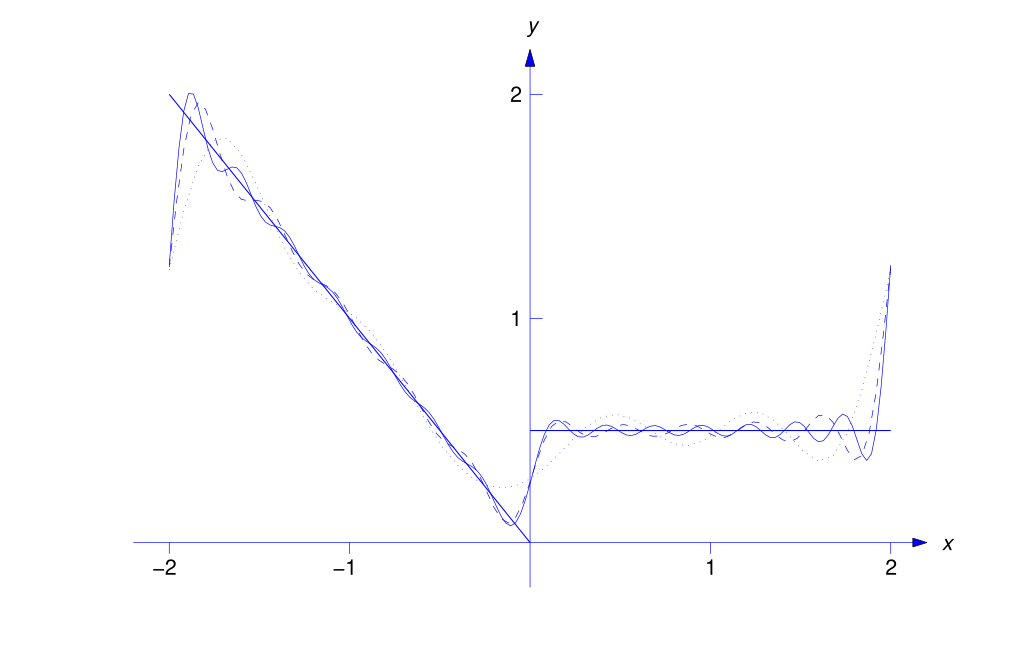
Figure 11.2.2 shows how the partial sum
approximates \(f(x)\) for \(m=5\) (dotted curve), \(m=10\) (dashed curve), and \(m=15\) (solid curve).
Even and Odd Functions
Computing the Fourier coefficients of a function \(f\) can be tedious; however, the computation can often be simplified by exploiting symmetries in \(f\) or some of its terms. To focus on this, we recall some concepts that you studied in calculus. Let \(u\) and \(v\) be defined on \([-L,L]\) and suppose that
Then we say that \(u\) is an even function and \(v\) is an odd function. Note that:
The product of two even functions is even.
The product of two odd functions is even.
The product of an even function and an odd function is odd.
Example 11.2.2
The functions \(u(x)=\cos \omega x\) and \(u(x)=x^2\) are even, while \(v(x)=\sin \omega x\) and \(v(x)=x^3\) are odd. The function \(w(x)=e^x\) is neither even nor odd.
You learned parts (a) and (b) of the next theorem in calculus, and the other parts follow from them (Exercise 1).
Theorem 11.2.5
Suppose \(u\) is even and \(v\) is odd on \([-L,L].\) Then\(:\)
Example 11.2.3
Find the Fourier series of \(f(x)=x^2-x\) on \([-2,2]\), and determine its sum for \(-2\le x\le 2\).
Solution Since \(L=2\),
where
and
We simplify the evaluation of these integrals by using Theorem 11.2.5 with \(u(x)=x^2\) and \(v(x)=x\); thus, from (11.2.9),
From (11.2.10),
From (11.2.11),
Therefore
Theorem 11.2.4 implies that
Figure 11.2.3 shows how the partial sum
approximates \(f(x)\) for \(m=5\) (dotted curve), \(m=10\) (dashed curve), and \(m=15\) (solid curve). ∎
![Approximation of f(x)=x^2-x by partial sums of its Fourier series on [-2,2]](/differentialEquations/figures/fig110203.svg)
Theorem 11.2.5 ilmplies the next theorem follows.
Theorem 11.2.6
Suppose \(f\) is integrable on \([-L,L].\)
If \(f\) is even\(,\) the Fourier series of \(f\) on \([-L,L]\) is
\[ F(x)=a_0+\sum_{n=1}^\infty a_n\cos{n\pi x\over L}, \]where
\[ a_0={1\over L}\int_0^Lf(x) \,dx \mbox{\quad and \quad} a_n={2\over L}\int_0^L f(x)\cos{n\pi x\over L}\,dx,\quad n\ge1. \]If \(f\) is odd\(,\) the Fourier series of \(f\) on \([-L,L]\) is
\[ F(x)= \sum_{n=1}^\infty b_n \sin{n\pi x\over L}, \]where
\[ b_n={2\over L}\int_0^L f(x)\sin{n\pi x\over L}\,dx. \]
Example 11.2.4
Find the Fourier series of \(f(x)=x\) on \([-\pi,\pi]\), and determine its sum for \(-\pi\le x\le \pi\).
Solution Since \(f\) is odd and \(L=\pi\),
where
Therefore
Theorem 11.2.4 implies that
Figure 11.2.4 shows how the partial sum
approximates \(f(x)\) for \(m=5\) (dotted curve), \(m=10\) (dashed curve), and \(m=15\) (solid curve).
![Approximation of f(x)=x by partial sums of its Fourier series on [-,]](/differentialEquations/figures/fig110204.svg)
Example 11.2.5
Find the Fourier series of \(f(x)=|x|\) on \([-\pi,\pi]\) and
determine its sum for
\(-\pi\le x\le\pi\).
Solution Since \(f\) is even and \(L=\pi\),
Since \(f(x)=x\) if \(x\ge0\),
and, if \(n\ge1\),
Therefore
However, since
the terms in (11.2.12) for which \(n=2m\) are all zeros. Therefore we only to include the terms for which \(n=2m+1\); that is, we can rewrite (11.2.12) as
However, since the name of the index of summation doesn’t matter, we prefer to replace \(m\) by \(n\), and write
Since \(|x|\) is continuous for all \(x\) and \(|-\pi|=|\pi|\), Theorem 11.2.4 implies that \(F(x)=|x|\) for all \(x\) in \([-\pi,\pi]\).
Example 11.2.6
Find the Fourier series of \(f(x)=x(x^2-L^2)\) on \([-L,L]\), and determine its sum for \(-L\le x\le L\).
Solution Since \(f\) is odd,
where
Therefore
Theorem 11.2.4 implies that \(F(x)=x(x^2-L^2)\) for all \(x\) in \([-L,L]\).
Example 11.2.7 (Gibbs Phenomenon)
The Fourier series of
on \([-1,1]\) is
(Verify.) According to Theorem 11.2.4,
thus, \(F\) (as well as \(f\)) has unit jump discontinuities at \(x=\pm\frac{1}{2}\). Figures 11.2.5-11.2.7 show the graphs of \(y=f(x)\) and
for \(N=10\), \(20\), and \(30\). You can see that although \(F_{2N-1}\) approximates \(F\) (and therefore \(f\)) well on larger intervals as \(N\) increases, the maximum absolute values of the errors remain approximately equal to \(.09\), but occur closer to the discontinuities \(x=\pm\frac{1}{2}\) as \(N\) increases.
Using Technology
The computation of Fourier coefficients will be tedious in many of the exercises in this chapter and the next. To learn the technique, we recommend that you do some exercises in each section “by hand,” perhaps using the table of integrals at the front of the book. However, we encourage you to use your favorite symbolic computation software in the more difficult problems.
11.2 Exercises
-
Prove Theorem 11.1.5.
In Exercises 2-16 find the Fourier series of \(f\) on \([-L,L]\) and determine its sum for \(-L\le x\le L\). Where indicated by C , graph \(f\) and
on the same axes for various values of \(m\).
-
C \(L=1\); \(f(x)=2-x\)
Show answer
\(F(x)=\dst2+{2\over\pi}\sum_{n=1}^\infty{(-1)^n\over n}\sin n\pi x\); \(F(x)= \left\{\begin{array}{cl} 2,&\phantom{-}x=-1,\\2-x,&-1<x<1,\\2,&\phantom{-}x=1 \end{array}\right.\)
-
\(L=\pi\); \(f(x)=2x-3x^2\)
Show answer
\(F(x)=\dst-\pi^2-12\sum_{n=1}^\infty{(-1)^n\over n^2}\cos nx -4\sum_{n=1}^\infty{(-1)^n\over n}\sin nx\);
\(F(x)= \left\{\begin{array}{cl} -3\pi^2,&\phantom{-}x=-\pi,\\2x-3x^2,&-\pi<x<\pi,\\ -3\pi^2,&\phantom{-}x=\pi \end{array}\right.\)
-
\(L=1\); \(f(x)=1-3x^2\)
Show answer
\(F(x)=-\dst{12\over\pi^2}\sum_{n=1}^\infty(-1)^n{\cos n\pi x\over n^2}\); \(F(x)=1-3x^2\) \(-1\le x\le 1\)
-
\(L=\pi\); \(f(x)=|\sin x|\)
Show answer
\(F(x)=\dst{2\over\pi}-{4\over\pi}\sum_{n=1}^\infty{1\over4n^2-1}\cos2nx\); \(F(x)=|\sin x|\), \(-\pi\le x\le\pi\)
-
C \(L=\pi\); \(f(x)=x\cos x\)
Show answer
\(F(x)=\dst-{1\over2}\sin x+2\sum_{n=2}^\infty(-1)^n {n\over n^2-1}\sin nx\);; \(F(x)=x\cos x\), \(-\pi\le x\le\pi\)
-
\(L=\pi\); \(f(x)=|x|\cos x\)
Show answer
\(F(x)=\dst-{2\over\pi}+{\pi\over2}\cos x-{4\over\pi} \sum_{n=1}^\infty{4n^2+1\over(4n^2-1)^2}\cos 2nx\);
\(F(x)=|x|\cos x\), \(-\pi\le x\le\pi\)
-
C \(L=\pi\); \(f(x)=x\sin x\)
Show answer
\(F(x)=\dst1-{1\over2}\cos x-2\sum_{n=2}^\infty {(-1)^n\over n^2-1}\cos nx\); \(F(x)=x\sin x\), \(-\pi\le x\le\pi\)
-
\(L=\pi\); \(f(x)=|x|\sin x\)
Show answer
\(F(x)=\dst{\pi\over2}\sin x-{16\over\pi} \sum_{n=1}^\infty{n\over(4n^2-1)^2}\sin 2nx\); \(F(x)=|x|\sin x\), \(-\pi\le x\le\pi\)
-
\(L=1\); \(f(x)= \left\{\begin{array}{cl} 0,&-1<x<{1\over2},\\[6pt] \cos\pi x,&-{1\over2}<x<{1\over2},\\[6pt] 0,&\phantom{-}{1\over2}<x<1 \end{array}\right.\)
Show answer
\(F(x)=\dst{1\over\pi}+{1\over2}\cos\pi x-{2\over\pi}\sum_{n=1}^\infty {(-1)^n\over4n^2-1}\cos2n\pi x\); \(F(x)=f(x)\), \(-1\le x\le1\)
-
\(L=1\); \(f(x)= \left\{\begin{array}{cl} 0,&-1<x<{1\over2},\\[6pt] x\cos\pi x,&-{1\over2}<x<{1\over2},\\[6pt] 0,&\phantom{-}{1\over2}<x<1 \end{array}\right.\)
Show answer
\(F(x)=\dst{{1\over4\pi}\sin\pi x-{8\over\pi^2}\sum_{n=1}^\infty (-1)^n{n\over(4n^2-1)^2}\sin2n\pi x}\);
\(\dst{-{1\over4\pi}\sum_{n=1}^\infty {(-1)^n\over n(n+1)}\sin(2n+1)\pi x}\) \(F(x)=f(x)\), \(-1\le x\le1\)
-
\(L=1\); \(f(x)= \left\{\begin{array}{cl} 0,&-1<x<{1\over2},\\[6pt] \sin\pi x,&-{1\over2}<x<{1\over2},\\[6pt] 0,&\phantom{-}{1\over2}<x<1 \end{array}\right.\)
Show answer
\(F(x)=\dst{1\over2}\sin\pi x-{4\over\pi}\sum_{n=1}^\infty (-1)^n{n\over4n^2-1}\sin2n\pi x\); \(F(x)= \left\{\begin{array}{cl} \phantom{-}0,&-1\le x<{1\over2},\\ -{1\over2},&\phantom{-}x=-{1\over2},\\ \phantom{-}\sin\pi x,&-{1\over2}<x<{1\over2},\\ \phantom{-}{1\over2},&\phantom{-}x={1\over2},\\ \phantom{-}0,&\phantom{-}{1\over2}<x\le1\\ \end{array}\right.\)
-
\(L=1\); \(f(x)= \left\{\begin{array}{cl} 0,&-1<x<{1\over2},\\[6pt] |\sin\pi x|,&-{1\over2}<x<{1\over2},\\[6pt] 0,&\phantom{-}{1\over2}<x<1 \end{array}\right.\)
Show answer
\(F(x)=\dst{1\over\pi}+{1\over\pi}\cos\pi x-{2\over\pi} \sum_{n=2}^\infty{1\over n^2-1}\left(1-n\sin{n\pi\over2}\right) \cos n\pi x\);
\(F(x)= \left\{\begin{array}{cl} 0,&-1\le x<{1\over2},\\ {1\over2},&\phantom{-}x=-1,\\ |\sin\pi x|,&-{1\over2}<x<{1\over2},\\ {1\over2},&\phantom{-}x=1,\\ 0,&\phantom{-}{1\over2}<x\le1 \end{array}\right.\)
-
\(L=1\); \(f(x)= \left\{\begin{array}{cl} 0,&-1<x<{1\over2},\\[6pt] x\sin\pi x,&-{1\over2}<x<{1\over2},\\[6pt] 0,&\phantom{-}{1\over2}<x<1 \end{array}\right.\)
Show answer
\(F(x)=\dst{1\over\pi^2}+{1\over4\pi}\cos\pi x+{2\over\pi^2}\sum_{n=1}^\infty (-1)^n{4n^2+1\over(4n^2-1)^2}\cos2n\pi x\)
\(\dst{+{1\over4\pi}\sum_{n=1}^\infty (-1)^n{2n+1\over n(n+1)}\cos(2n+1)\pi x}\);
\(F(x)= \left\{\begin{array}{cl} 0,&-1\le x<{1\over2},\\ {1\over4},&\phantom{-}x=-{1\over2},\\ x\sin\pi x,&-{1\over2}<x<{1\over2},\\ {1\over4},&\phantom{-}x={1\over2},\\ 0,&\phantom{-}{1\over2}<x\le1,\\ \end{array}\right.\)
-
C \(L=4\); \(f(x)= \left\{\begin{array}{cl} 0,&-4<x<0,\\x,&\phantom{-}0<x<4 \end{array}\right.\)
Show answer
\(\dst F(x)=1-{8\over\pi^2}\sum_{n=0}^\infty{1\over(2n+1)^2}\cos{(2n+1)\pi x\over4} -{4\over\pi}\sum_{n=1}^\infty{(-1)^n\over n}\sin{n\pi x\over4}\);
\(F(x)= \left\{\begin{array}{cl} 2,&\phantom{-}x=-4,\\ 0,&-4<x<0,\\ x,&\phantom{-}0\le x<4,\\ 2,&\phantom{-}x=4 \end{array}\right.\)
-
C \(L=1\); \(f(x)= \left\{\begin{array}{cl} x^2,&-1< x<0, \\1-x^2,&\phantom{-}0<x<1 \end{array}\right.\)
Show answer
\(F(x)=\dst{1\over2}+{1\over\pi}\sum_{n=1}^\infty{1\over n}\sin2n\pi x +{8\over\pi^3}\sum_{n=0}^\infty{1\over(2n+1)^3}\sin(2n+1)\pi x\);
\(F(x)= \left\{\begin{array}{cl} {1\over2},&\phantom{-}x=-1,\\ x^2,&-1< x<0,\\ {1\over2},&\phantom{-}x=0,\\ 1-x^2,&\phantom{-}0<x<1,\\ {1\over2},&\phantom{-}x=1 \end{array}\right.\)
-
L Verify the Gibbs phenomenon for \(f(x)= \left\{\begin{array}{rl} 2,&-2< x< -1,\\1,&-1<x<1,\\-1,&\phantom{-}1< x<2. \end{array}\right.\)
Show answer
\(F(x)=\dst{3\over4}+{1\over\pi}\sum_{n=1}^\infty {1\over n}\sin{n\pi\over2}\cos{n\pi x\over2}+{3\over\pi} \sum_{n=1}^\infty {1\over n}\left(\cos n\pi-\cos{n\pi\over2}\right)\sin{n\pi x\over2}\)
-
L Verify the Gibbs phenomenon for \(f(x)= \left\{\begin{array}{rl} 2,&-3< x< -2,\\3,&-2<x<2,\\1,&\phantom{-}2< x<3. \end{array}\right.\)
Show answer
\(F(x)=\dst{5\over2}+{3\over\pi}\sum_{n=1}^\infty {1\over n}\sin{2n\pi\over3}\cos{n\pi x\over3}+{1\over\pi} \sum_{n=1}^\infty {1\over n}\left(\cos n\pi-\cos{2n\pi\over3}\right)\sin{n\pi x\over3}\)
-
Deduce from Example 11.2.5 that
\[ \sum_{n=0}^\infty{1\over(2n+1)^2}={\pi^2\over 8}. \] -
Find the Fourier series of \(f(x)=e^x\) on \([-\pi,\pi]\).
Deduce from (a) that
\[ \sum_{n=0}^\infty{1\over n^2+1}={\pi\coth\pi-1\over2}. \]
Show answer
\(F(x)=\dst{\sinh\pi\over\pi}\left( 1+2\sum_{n=1}^\infty{(-1)^n\over n^2+1}\cos nx-2\sum_{n=1}^\infty{(-1)^nn\over n^2+1}\sin nx\right)\)
-
Find the Fourier series of \(f(x)=(x-\pi)\cos x\) on \([-\pi,\pi]\).
Show answer
\(F(x)=\dst-\pi\cos x-{1\over2}\sin x+2\sum_{n=2}^\infty (-1)^n{n\over n^2-1}\sin nx\)
-
Find the Fourier series of \(f(x)=(x-\pi)\sin x\) on \([-\pi,\pi]\).
Show answer
\(F(x)=\dst1-{1\over2}\cos x-\pi\sin x-2\sum_{n=2}^\infty {(-1)^n\over n^2-1}\cos nx\)
-
Find the Fourier series of \(f(x)=\sin kx\) (\(k\ne\) integer) on \([-\pi,\pi]\).
Show answer
\(F(x)=-\dst{2\sin k\pi\over\pi}\sum_{n=1}^\infty(-1)^n{n\over n^2-k^2}\sin nx\)
-
Find the Fourier series of \(f(x)=\cos kx\) (\(k\ne\) integer) on \([-\pi,\pi]\).
Show answer
\(F(x)=\dst{\sin k\pi\over\pi}\left[{1\over k}-2k\sum_{n=1}^\infty{(-1)^n\over n^2-k^2}\cos nx\right]\)
-
Suppose \(g'\) is continuous on \([a,b]\) and \(\omega\ne0\). Use integration by parts to show that there’s a constant \(M\) such that
\[ \left|\int_a^bg(x)\cos\omega x\,dx\right|\le{M\over\omega} \mbox{\quad and \quad} \left|\int_a^bg(x)\sin\omega x\,dx\right|\le{M\over\omega},\quad \omega>0. \]Show that the conclusion of (a) also holds if \(g\) is piecewise smooth on \([a,b]\). (This is a special case of Riemann’s Lemma.
We say that a sequence \(\{\alpha_n\}_{n=1}^\infty\) is of order \(n^{-k}\) and write \(\alpha_n=O(1/n^k)\) if there’s a constant \(M\) such that
\[ |\alpha_n|<{M\over n^k},\quad n=1,2,3,\dots. \]Let \(\{a_n\}_{n=1}^\infty\) and \(\{b_n\}_{n=1}^\infty\) be the Fourier coefficients of a piecewise smooth function. Conclude from (b) that \(a_n=O(1/n)\) and \(b_n=O(1/n)\).
-
Suppose \(f(-L)=f(L)\), \(f'(-L)=f'(L)\), \(f'\) is continuous, and \(f''\) is piecewise continuous on \([-L,L]\). Use Theorem 11.2.4 and integration by parts to show that
\[ f(x)=a_0+\sum_{n=1}^\infty\left(a_n\cos{n\pi x\over L}+b_n\sin{n\pi x\over L}\right),\quad -L\le x\le L, \]with
\[ a_0={1\over 2L}\int_{-L}^L f(x)\,dx, \]\[ a_n= -{L\over n^2\pi^2}\int_{-L}^L f''(x)\cos{n\pi x\over L}\,dx,\mbox{\quad and \quad} b_n=-{L\over n^2\pi^2}\int_{-L}^L f''(x)\sin{n\pi x\over L}\,dx,\,n\ge1. \]Show that if, in addition to the assumptions in (a), \(f''\) is continuous and \(f'''\) is piecewise continuous on \([-L,L]\), then
\[ a_n={L^2\over n^3\pi^3}\int_{-L}^Lf'''(x)\sin{n\pi x\over L}\,dx. \]
-
Show that if \(f\) is integrable on \([-L,L]\) and
\[ f(x+L)=f(x),\quad -L<x<0 \](Figure 11.2.8), then the Fourier series of \(f\) on \([-L,L]\) has the form
\[ A_0+\sum_{n=1}^\infty\left(A_n\cos{2n\pi\over L}+B_n\sin{2n\pi\over L}\right) \]where
\[ A_0={1\over L}\int_0^Lf(x)\,dx, \]and
\[ A_n={2\over L}\int_0^Lf(x)\cos{2n\pi x\over L}\,dx, \quad B_n={2\over L}\int_0^Lf(x)\sin{2n\pi x\over L}\,dx,\quad n=1,2,3,\dots. \]
Figure 11.2.8. \(y=f(x)\), where \(f(x+L)=f(x)\), \(-L<x<0\) 
Figure 11.2.9. \(y=f(x)\), where \(f(x+L)=-f(x)\), \(-L<x<0\) -
Show that if \(f\) is integrable on \([-L,L]\) and
\[ f(x+L)=-f(x),\quad -L<x<0 \](Figure 11.2.9), then the Fourier series of \(f\) on \([-L,L]\) has the form
\[ \sum_{n=1}^\infty\left(A_n\cos{(2n-1)\pi x\over L}+B_n\sin{(2n-1)\pi x\over L}\right), \]where
\[ A_n={2\over L}\int_0^Lf(x)\cos{(2n-1)\pi x\over L}\,dx \text{\quad and \quad } B_n={2\over L}\int_0^Lf(x)\sin{(2n-1)\pi x\over L}\,dx,\quad n=1,2,3,\dots. \] -
Suppose \(\phi_1\), \(\phi_2\), …, \(\phi_m\) are orthogonal on \([a,b]\) and
\[ \int_a^b\phi_n^2(x)\,dx\ne0,\quad n=1,2,\dots,m. \]If \(a_1\), \(a_2\), …, \(a_m\) are arbitrary real numbers, define
\[ P_m=a_1\phi_1+a_2\phi_2+\cdots+a_m\phi_m. \]Let
\[ F_m=c_1\phi_1+c_2\phi_2+\cdots+c_m\phi_m, \]where
\[ c_n={\int_a^bf(x)\phi_n(x)\,dx\over\int_a^b\phi_n^2(x)\,dx}; \]that is, \(c_1\), \(c_2\), …, \(c_m\) are Fourier coefficients of \(f\).
Show that
\[ \int_a^b(f(x)-F_m(x))\phi_n(x)\,dx=0,\quad n=1,2,\dots,m. \]Show that
\[ \int_a^b(f(x)-F_m(x))^2\,dx\le \int_a^b(f(x)-P_m(x))^2\,dx, \]with equality if and only if \(a_n=c_n\), \(n=1,2,\dots, m\).
Show that
\[ \int_a^b(f(x)-F_m(x))^2\,dx=\int_a^bf^2(x)\,dx-\sum_{n=1}^mc_n^2\int_a^b \phi_n^2\,dx. \]Conclude from (c) that
\[ \sum_{n=1}^m c_n^2\int_a^b\phi_n^2(x)\,dx\le \int_a^bf^2(x)\,dx. \]
-
If \(A_0\), \(A_1\), …, \(A_m\) and \(B_1\), \(B_2\), …, \(B_m\) are arbitrary constants we say that
\[ P_m(x)=A_0+\sum_{n=1}^m\left(A_n\cos{n\pi x\over L}+B_n\sin{n\pi x\over L}\right) \]is a trigonometric polynomial of degree \(\le m\).
Now let
\[ a_0+\sum_{n=1}^\infty\left(a_n\cos{n\pi x\over L}+b_n\sin{n\pi x\over L}\right) \]be the Fourier series of an integrable function \(f\) on \([-L,L]\), and let
\[ F_m(x)= a_0+\sum_{n=1}^m\left(a_n\cos{n\pi x\over L}+b_n\sin{n\pi x\over L}\right). \]Conclude from Exercise 29(b) that
\[ \int_{-L}^L(f(x)-F_m(x))^2\,dx\le \int_{-L}^L(f(x)-P_m(x))^2\,dx, \]with equality if and only if \(A_n=a_n\), \(n=0\), \(1\), …, \(m\), and \(B_n=b_n\), \(n=1\), \(2\), …, \(m\).
Conclude from Exercise 29(d) that
\[ 2a_0^2+\sum_{n=1}^m(a_n^2+b_n^2)\le{1\over L}\int_{-L}^Lf^2(x)\,dx \]for every \(m\ge0\).
Conclude from (b) that \(\lim_{n\to\infty}a_n=\lim_{n\to\infty}b_n=0\).