- Integrate functions resulting in inverse trigonometric functions
In this section we focus on integrals that result in inverse trigonometric functions. We have worked with these functions before. Recall from Functions and Graphs that trigonometric functions are not one-to-one unless the domains are restricted. When working with inverses of trigonometric functions, we always need to be careful to take these restrictions into account. Also in Derivatives, we developed formulas for derivatives of inverse trigonometric functions. The formulas developed there give rise directly to integration formulas involving inverse trigonometric functions.
Integrals that Result in Inverse Sine Functions
Let us begin this last section of the chapter with the three formulas. Along with these formulas, we use substitution to evaluate the integrals. We prove the formula for the inverse sine integral.
The following integration formulas yield inverse trigonometric functions. Assume :
- 5.23
- 5.24
- 5.25
Proof
Let Then Now let’s use implicit differentiation. We obtain
For Thus, applying the Pythagorean identity we have This gives
Then for and generalizing to u, we have
□
Evaluate the definite integral
We can go directly to the formula for the antiderivative in the rule on integration formulas resulting in inverse trigonometric functions, and then evaluate the definite integral. We have
Evaluate the integral
Evaluate the integral
Substitute Then and we have
Applying the formula with we obtain
Find the indefinite integral using an inverse trigonometric function and substitution for
Use the formula in the rule on integration formulas resulting in inverse trigonometric functions.
Evaluate the definite integral
The format of the problem matches the inverse sine formula. Thus,
Integrals Resulting in Other Inverse Trigonometric Functions
There are six inverse trigonometric functions. However, only three integration formulas are noted in the rule on integration formulas resulting in inverse trigonometric functions because the remaining three are negative versions of the ones we use. The only difference is whether the integrand is positive or negative. Rather than memorizing three more formulas, if the integrand is negative, simply factor out −1 and evaluate the integral using one of the formulas already provided. To close this section, we examine one more formula: the integral resulting in the inverse tangent function.
Evaluate the integral
Comparing this problem with the formulas stated in the rule on integration formulas resulting in inverse trigonometric functions, the integrand looks similar to the formula for So we use substitution, letting then and Then, we have
Use substitution to find the antiderivative
Use the solving strategy from Example 5.52 and the rule on integration formulas resulting in inverse trigonometric functions.
Evaluate the integral
Apply the formula with Then,
Evaluate the definite integral
Use the formula for the inverse tangent. We have
Key Concepts
- Formulas for derivatives of inverse trigonometric functions developed in Derivatives of Exponential and Logarithmic Functions lead directly to integration formulas involving inverse trigonometric functions.
- Use the formulas listed in the rule on integration formulas resulting in inverse trigonometric functions to match up the correct format and make alterations as necessary to solve the problem.
- Substitution is often required to put the integrand in the correct form.
Key Equations
| Integrals That Produce Inverse Trigonometric Functions |
.
In the following exercises, evaluate each integral in terms of an inverse trigonometric function.
In the following exercises, find each indefinite integral, using appropriate substitutions.
Explain the relationship Is it true, in general, that
So, They differ by a constant.
Explain the relationship Is it true, in general, that
Explain what is wrong with the following integral:
is not defined as a real number when
Explain what is wrong with the following integral:
In the following exercises, solve for the antiderivative of f with then use a calculator to graph f and the antiderivative over the given interval Identify a value of C such that adding C to the antiderivative recovers the definite integral
[T] over
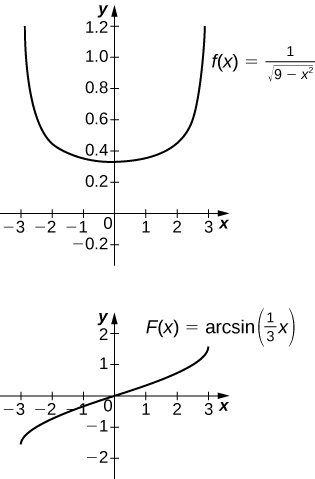
The antiderivative is Taking recovers the definite integral.
[T] over
[T] over
![Two graphs. The first shows the function f(x) = cos(x) / (4 + sin(x)^2). It is an oscillating function over [-6, 6] with turning points at roughly (-3, -2.5), (0, .25), and (3, -2.5), where (0,.25) is a local max and the others are local mins. The second shows the function F(x) = .5 * arctan(.5*sin(x)), which also oscillates over [-6,6]. It has turning points at roughly (-4.5, .25), (-1.5, -.25), (1.5, .25), and (4.5, -.25).](/calculus-bundle/media/CNX_Calc_Figure_05_07_203.jpg)
The antiderivative is Taking recovers the definite integral.
[T] over
In the following exercises, compute the antiderivative using appropriate substitutions.
In the following exercises, use a calculator to graph the antiderivative with over the given interval Approximate a value of C, if possible, such that adding C to the antiderivative gives the same value as the definite integral
[T] over
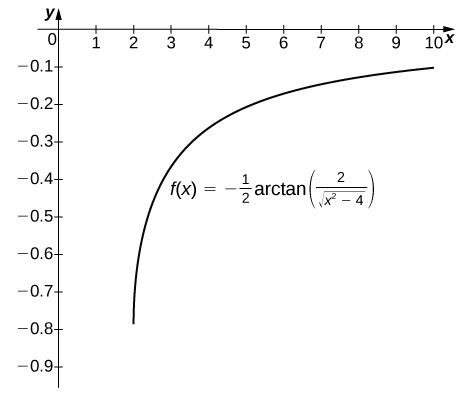
The antiderivative is Taking recovers the definite integral over
[T] over
[T] over
![The graph of f(x) = arctan(x sin(x)) over [-6,6]. It has five turning points at roughly (-5, -1.5), (-2,1), (0,0), (2,1), and (5,-1.5).](/calculus-bundle/media/CNX_Calc_Figure_05_07_207.jpg)
The general antiderivative is Taking recovers the definite integral.
[T] over
[T] over
![A graph of the function f(x) = arctan(ln(x)) over (0, 2]. It is an increasing curve with x-intercept at (1,0).](/calculus-bundle/media/CNX_Calc_Figure_05_07_209.jpg)
The general antiderivative is Taking recovers the definite integral.
[T] over
In the following exercises, compute each integral using appropriate substitutions.
In the following exercises, compute each definite integral.
For compute and evaluate the area under the graph of on
as
For compute and evaluate the area under the graph of over
Use the substitution and the identity to evaluate (Hint: Multiply the top and bottom of the integrand by
Using the hint, one has Set Then, and the integral is If one uses the identity then this can also be written
[T] Approximate the points at which the graphs of and intersect to four decimal places, and approximate the area between their graphs to three decimal places.
[T] Approximate the points at which the graphs of and intersect to four decimal places, and approximate the area between their graphs to three decimal places.
The left endpoint estimate with is 4.781 and these decimals persist for
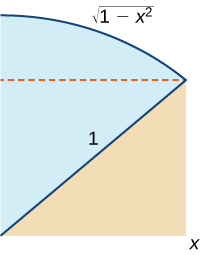
Use the following graph to prove that
Chapter Review Exercises
True or False. Justify your answer with a proof or a counterexample. Assume all functions and are continuous over their domains.
If for all then the right-hand rule underestimates the integral Use a graph to justify your answer.
False
If for all then
True
All continuous functions have an antiderivative.
Evaluate the Riemann sums for the following functions over the specified interval. Compare your answer with the exact answer, when possible, or use a calculator to determine the answer.
over
exact answer: 4
over
over
exact answer: 5.870
over
Evaluate the following integrals.
1
Find the antiderivative.
Find the derivative.
The following problems consider the historic average cost per gigabyte of RAM on a computer.
| Year | 5-Year Change ($) |
|---|---|
| 1980 | 0 |
| 1985 | −5,468,750 |
| 1990 | −755,495 |
| 1995 | −73,005 |
| 2000 | −29,768 |
| 2005 | −918 |
| 2010 | −177 |
A table with two columns and eight rows. The first column has the label “Year” and the values 1980, 1985, 1990, 1995, 2000, 2005, and 2010. The second column has the label “5-Tear Change ($)” and the values 0, -5,468,750, -755,495, -73,005, -29,768, -918, and -177.
If the average cost per gigabyte of RAM in 2010 is $12, find the average cost per gigabyte of RAM in 1980.
$6,328,113
The average cost per gigabyte of RAM can be approximated by the function where is measured in years since 1980, and is cost in US$. Find the average cost per gigabyte of RAM for 1980 to 2010.
Find the average cost of 1GB RAM for 2005 to 2010.
$73.36
The velocity of a bullet from a rifle can be approximated by where is seconds after the shot and is the velocity measured in feet per second. This equation only models the velocity for the first half-second after the shot: What is the total distance the bullet travels in 0.5 sec?
What is the average velocity of the bullet for the first half-second?
Substitute