- Calculate the derivative of an inverse function.
- Recognize the derivatives of the standard inverse trigonometric functions.
In this section we explore the relationship between the derivative of a function and the derivative of its inverse. For functions whose derivatives we already know, we can use this relationship to find derivatives of inverses without having to use the limit definition of the derivative. In particular, we will apply the formula for derivatives of inverse functions to trigonometric functions. This formula may also be used to extend the power rule to rational exponents.
The Derivative of an Inverse Function
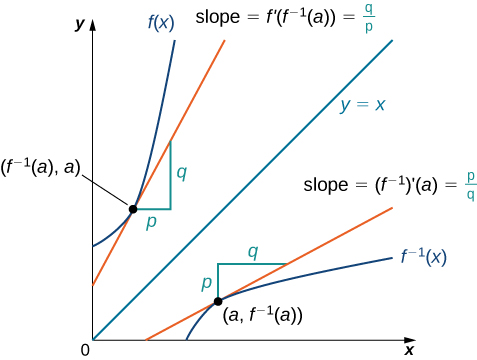
We begin by considering a function and its inverse. If is both invertible and differentiable, it seems reasonable that the inverse of is also differentiable. Figure 3.28 shows the relationship between a function and its inverse Look at the point on the graph of having a tangent line with a slope of This point corresponds to a point on the graph of having a tangent line with a slope of Thus, if is differentiable at then it must be the case that
We may also derive the formula for the derivative of the inverse by first recalling that Then by differentiating both sides of this equation (using the chain rule on the right), we obtain
Solving for we obtain
We summarize this result in the following theorem.
Let be a function that is both invertible and differentiable. Let be the inverse of For all satisfying
Alternatively, if is the inverse of then
Use the inverse function theorem to find the derivative of Compare the resulting derivative to that obtained by differentiating the function directly.
The inverse of is Since begin by finding Thus,
Finally,
We can verify that this is the correct derivative by applying the quotient rule to to obtain
Use the inverse function theorem to find the derivative of Compare the result obtained by differentiating directly.
Use the inverse function theorem to find the derivative of
The function is the inverse of the function Since begin by finding Thus,
Finally,
Find the derivative of by applying the inverse function theorem.
is the inverse of
From the previous example, we see that we can use the inverse function theorem to extend the power rule to exponents of the form where is a positive integer. This extension will ultimately allow us to differentiate where is any rational number.
The power rule may be extended to rational exponents. That is, if is a positive integer, then
Also, if is a positive integer and is an arbitrary integer, then
Proof
The function is the inverse of the function Since begin by finding Thus,
Finally,
To differentiate we must rewrite it as and apply the chain rule. Thus,
□
Find an equation of the line tangent to the graph of at
First find and evaluate it at Since
the slope of the tangent line to the graph at is
Substituting into the original function, we obtain Thus, the tangent line passes through the point Substituting into the point-slope formula for a line, we obtain the tangent line
Find the derivative of
Use the chain rule.
Derivatives of Inverse Trigonometric Functions
We now turn our attention to finding derivatives of inverse trigonometric functions. These derivatives will prove invaluable in the study of integration later in this text. The derivatives of inverse trigonometric functions are quite surprising in that their derivatives are actually algebraic functions. Previously, derivatives of algebraic functions have proven to be algebraic functions and derivatives of trigonometric functions have been shown to be trigonometric functions. Here, for the first time, we see that the derivative of a function need not be of the same type as the original function.
Use the inverse function theorem to find the derivative of
Since for in the interval is the inverse of begin by finding Since
we see that
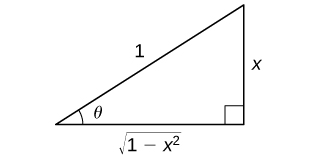
To see that consider the following argument. Set In this case, where We begin by considering the case where Since is an acute angle, we may construct a right triangle having acute angle a hypotenuse of length and the side opposite angle having length From the Pythagorean theorem, the side adjacent to angle has length This triangle is shown in Figure 3.29. Using the triangle, we see that
In the case where we make the observation that and hence
Now if or or and since in either case and we have
Finally, if , and .
Consequently, in all cases,
Apply the chain rule to the formula derived in Example 3.61 to find the derivative of and use this result to find the derivative of
Applying the chain rule to we have
Now let so Substituting into the previous result, we obtain
Use the inverse function theorem to find the derivative of
The inverse of is Use Example 3.61 as a guide.
The derivatives of the remaining inverse trigonometric functions may also be found by using the inverse function theorem. These formulas are provided in the following theorem.
Find the derivative of
Let so Substituting into Equation 3.24, we obtain
Simplifying, we have
Find the derivative of
By applying the product rule, we have
The position of a particle at time is given by for Find the velocity of the particle at time
Begin by differentiating in order to find Thus,
Simplifying, we have
Thus,
Find an equation of the line tangent to the graph of at
is the slope of the tangent line.
Key Concepts
- The inverse function theorem allows us to compute derivatives of inverse functions without using the limit definition of the derivative.
- We can use the inverse function theorem to develop differentiation formulas for the inverse trigonometric functions.
Key Equations
| Inverse function theorem | whenever and is differentiable. |
| Power rule with rational exponents | |
| Derivative of inverse sine function | |
| Derivative of inverse cosine function | |
| Derivative of inverse tangent function | |
| Derivative of inverse cotangent function | |
| Derivative of inverse secant function | |
| Derivative of inverse cosecant function |
.
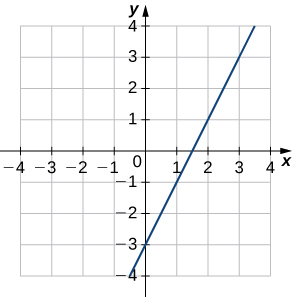
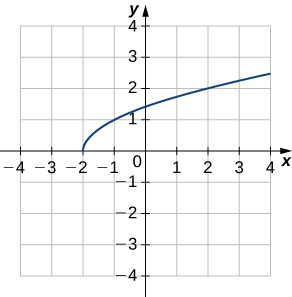
For the following exercises, use the graph of to
- sketch the graph of and
- use part a. to estimate
a.
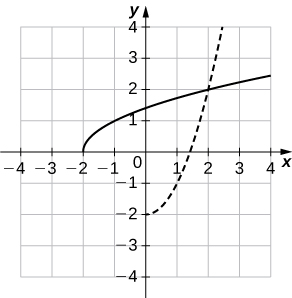
b.
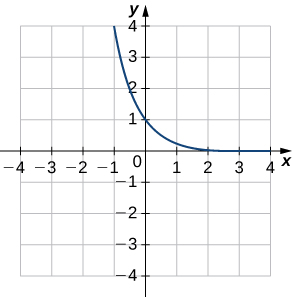
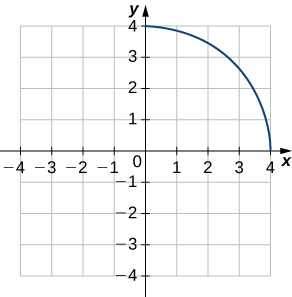
a.
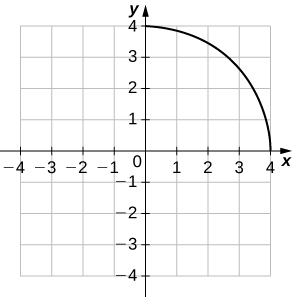
b.
For the following exercises, use the functions to find
- at and
- Then use part b. to find at
a. 6, b. c.
a. b. c.
For each of the following functions, find
For each of the given functions
- find the slope of the tangent line to its inverse function at the indicated point and
- find an equation of the tangent line to the graph of at the indicated point.
a. b.
a. b.
For the following exercises, find for the given function.
For the following exercises, use the given values to find
[T] The position of a moving hockey puck after seconds is where is in meters.
- Find the velocity of the hockey puck at any time
- Find the acceleration of the puck at any time
- Evaluate a. and b. for and seconds.
- What conclusion can be drawn from the results in c.?
a. b. c. d. The hockey puck is decelerating/slowing down at 2, 4, and 6 seconds.
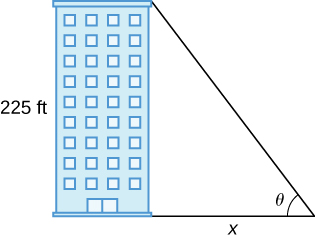
[T] A building that is 225 feet tall casts a shadow of various lengths as the day goes by. An angle of elevation is formed by lines from the top and bottom of the building to the tip of the shadow, as seen in the following figure. Find the rate of change of the angle of elevation when feet.
[T] A pole stands 75 feet tall. An angle is formed when wires of various lengths of feet are attached from the ground to the top of the pole, as shown in the following figure. Find the rate of change of the angle when a wire of length 90 feet is attached.
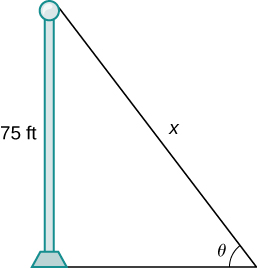
radians per foot
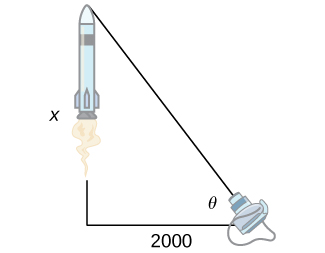
[T] A television camera at ground level is 2000 feet away from the launching pad of a space rocket that is set to take off vertically, as seen in the following figure. The angle of elevation of the camera can be found by where is the height of the rocket. Find the rate of change of the angle of elevation after launch when the camera and the rocket are 5000 feet apart.
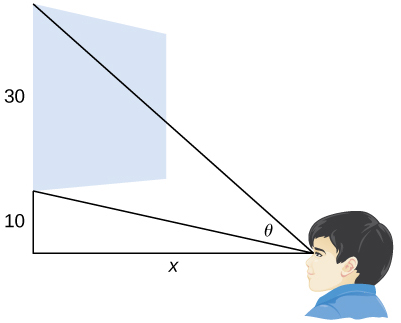
[T] A local movie theater with a 30-foot-high screen that is 10 feet above a person’s eye level when seated has a viewing angle (in radians) given by
where is the distance in feet away from the movie screen that the person is sitting, as shown in the following figure.
- Find
- Evaluate for and 20.
- Interpret the results in b..
- Evaluate for and 40
- Interpret the results in d. At what distance should the person sit to maximize his or her viewing angle?
a. b. c. As a person moves farther away from the screen, the viewing angle is increasing, which implies that as he or she moves farther away, his or her screen vision is widening. d. e. As the person moves beyond 20 feet from the screen, the viewing angle is decreasing. The optimal distance the person should stand for maximizing the viewing angle is 20 feet.
Use the preceding example as a guide.