Problem 2-1: Highest point on a surface
Find the coordinates of the highest point on the surface given by \(z(x,y)=x^2y+xy\) that when projected onto the xy-plane lies on a circle of radius \(r=5\) centered at \(x=2\) and \(y=3\). Use a computer to illustrate the result. You will also likely need to solve the equations numerically.
Problem 2-2: Box with no lid
Find the dimensions that maximize the volume of a box with no lid, if the total surface area of the box is 1 m\(^2\).
Problem 2-3: Euler-Lagrange equations for integrand that depends on more than one function
Show that the stationary value of the functional \(S=\int_a^b L(q_1(t),q_2(t),\dots,\dot{q_1}, \dot{q_2},\dots,t)dt\) gives an Euler-Lagrange equation for each \(q_i(t)\):
Problem 2-4: Euler-Lagrange equation when there is a second order derivative
Show that the equivalent of the Euler-Lagrange equation when the function in the integrand depends on the second derivative of \(y\):
is given by:
Note that you will have to integrate by parts twice and that the variation of \(y'(x)\) is zero at the end points of the integral.
Problem 2-5: Brachistrochrone
Refer to the problem of example 2-4.
a) Find the differential equation for the function \(y(x)\) that solves the brachistrochrone problem, by minimizing \(T\):
Note that we have set the problem up such that one end of the wire is at the origin, gravity is in the positive \(y\) direction, and the constant \(2g\) will not change the shape of the wire. Note that a closed form solution in the form \(y=f(x)\) is not possible, and only parametric solutions can be obtained (so called “cycloids”).
b) Repeat part a), with the wire being constrained to have a length of \(L\).
Problem 2-6: Geodesic
Determine the functional for the shortest distance between two points on a sphere of radius \(a\), and write the differential equation that gives the function \(\phi(\theta)\), where \(\phi\) and \(\theta\) are the azimuthal and polar angles in spherical coordinates, respectively.
Problem 2-7: Straight line
Show that the shortest distance between two points in a plane is a straight line.
Problem 2-8: Catenary
A rope of uniform linear mass density, \(\mu\), and total length, \(L\), is hung across a precipice of length, \(H\) (both sides of the precipice are at the same height). Minimize the potential energy of the rope:
to obtain the differential equation for the shape of the rope. Use a computer to solve and plot the resulting curve (choose reasonable values).
Problem 2-9: Surface and volume of revolution
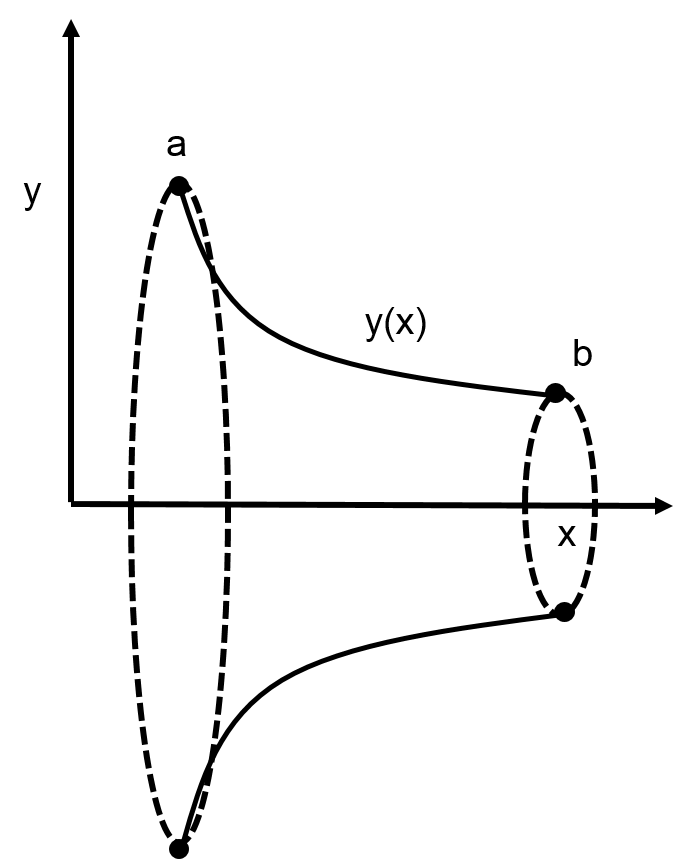
a) Find the shape of the curve, \(y(x)\), passing through two points, \(a\) and \(b\), that gives the minimal surface of revolution when rotated about the x-axis (see figure). Note that this would be the shape of a soap film formed between two hoops.
b) Find the shape of the curve, \(y(x)\), passing through two points, \(a\) and \(b\), that creates a solid of revolution with the minimal moment of inertia about the x-axis (see figure). Assume that the volume is made of a material with uniform density. It will not be possible to get a closed form, write the solution as a differential equation for \(y(x)\) or give \(x\) in terms of an integral over \(y\).