Problem 1-1: Transformations to generalized coordinates
Given the following transformations between the cartesian coordinates (\(x_i(t)\),\(y_i(t)\),\(z_i(t)\)) of a particle \(i\) and a set of generalized coordinates (\(q_i(t)\)), write the velocities and accelerations of the cartesian coordinates in terms of the velocities and accelerations of the generalized coordinates. Note that unless specified, other variables should be taken as constants with respect to time, \(t\).
a)
b)
c)
d)
e)
Problem 1-2: Degrees of freedom and kinetic energy
For the following situations in two dimensional space, give \(n\), the number of degrees of freedom, then choose \(n\) generalized coordinates and write out the kinetic energy of the system in terms of the corresponding generalized velocities (start by writing the kinetic energy in Cartesian coordinates \(\sum \frac{1}{2}m_i(\dot x_i^2+\dot y_i^2)\).
a)Two masses, \(m\), are connected by a massless rigid rod of length L.
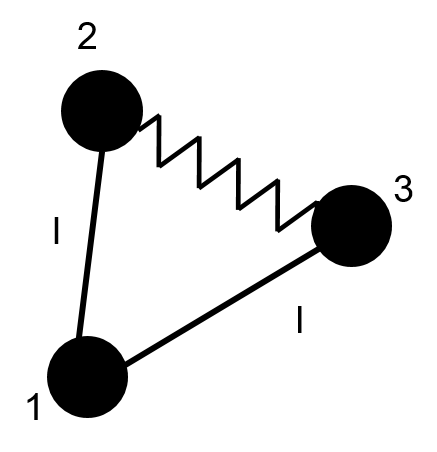
b) Three masses, \(m\), that are connected by 2 massless rigid rods of length \(l\) and a massless spring and are constrained to move in the plane (see figure)
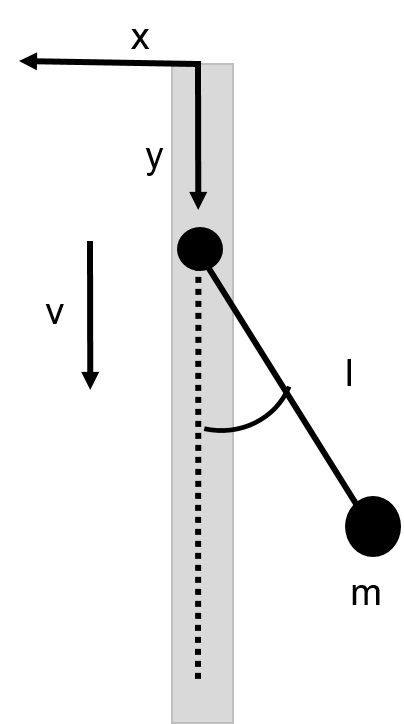
c) A pendulum consisting of a mass, \(m\), connected to a rigid massless bar of length, \(L\), whose other end is constrained to move downwards with a known velocity, \(v\) (see figure)
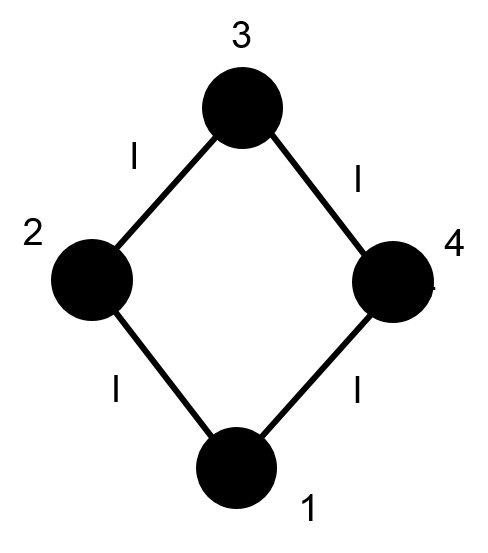
d) Four masses, \(m\) connected by 4 massless rigid rods of length \(l\), and are constrained to the move in the plane (see figure)
Problem 1-3: Block sliding down a ramp
The figure shows a block of mass, \(m\), sliding down a ramp of length \(L_1\) and a slope given by an angle \(\theta\) which is connected to a second “launching” ramp of length \(L_2\) with angle \(\phi\). Assume that the block starts at the top of the first ramp and that the origin is as shown. Furthermore, assume that coefficient of kinetic friction between the block and the ramp is given by \(\mu\)
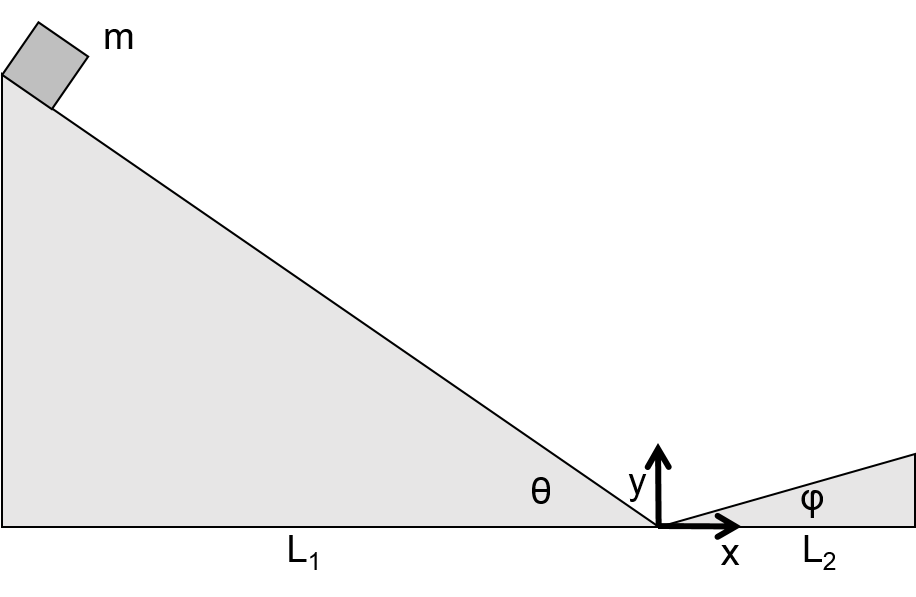
a) Draw a free body diagram of the forces on the block, and write the differential equations of motion for the \(x\) and \(y\) components of the velocity of the block. Do this for each ramp.
b) Solve the differential equations of motion from part a) (using an initial velocity of zero) to determine where the components of the velocity vector as the block leaves the second ramp.
c) Use the result from part b) to determine the distance from the origin at which the block will land
d) Repeat the problem using conservation of energy to find the point at which the block will land.
Problem 1-4: Disk rolling down a ramp
The block from problem 1-4 is replaced by a disk of radius \(r\), and mass \(m\), that rolls without slipping, and has moment of inertia \(I=\frac{1}{2}mr^2\).
a) Draw a free body diagram of the forces and torques on the disk, and write the differential equations of motion for the \(x\) and \(y\) components of the velocity of the disk, as well as for its angular speed, \(\omega\). Do this for each ramp.
b) Solve the differential equations of motion from part a) (using an initial velocity of zero) to determine where the components of the velocity vector and the magnitude of the angular velocity as the disk leaves the second ramp.
c) Use the result from part b) to determine the distance from the origin at which the disk will land
d) Repeat the problem using conservation of energy to find the point at which the disk will land and its angular velocity just before landing.
Problem 1-5: Person on a ladder
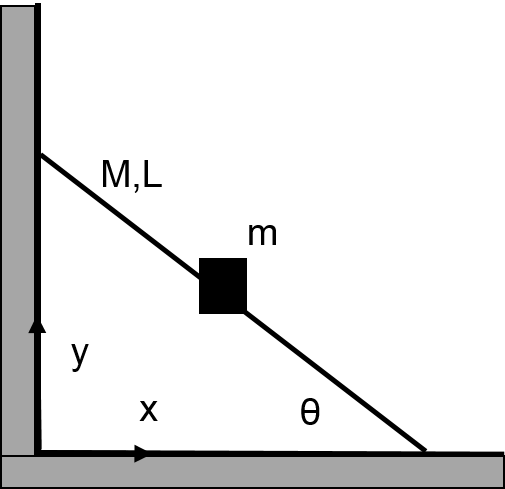
The figure shows a person of mass \(m\) standing in the middle of a ladder of mass \(M\) and length \(L\) inclined against a friction-less vertical wall. What is the minimum value for the coefficient of static friction, \(\mu\), between the ladder and the ground for the ladder not to slide when inclined at an angle \(\theta\)?
Problem 1-6: Compound pendulum
Consider the compound pendulum in Example 1-1. Use Newton’s Laws to do the following:
a) Write out the differential equations of motion for \(\ddot{x}_1\), \(\ddot{y}_1\), \(\ddot{x}_2\), \(\ddot{y}_2\)
b) Show that the system can be described by the generalized coordinates \(\theta\), and \(\phi\), and write out the differential equations of motion for \(\ddot{\theta}\) and \(\ddot{\phi}\).
c) Use a computer to solve the differential equations of motion and make plots of \(\theta(t)\), and \(\phi(t)\) for \(t=0\dots 10\,s\). Use \(L_1\)=1 m, \(L_2\)=0.75 m, \(m_1\)=1 kg, \(m_2\)=2 kg, and initial conditions at \(t=0\) of \(\theta=\frac{\pi}{2}\) and \(\phi=0\).
Problem 1-7: Two masses and two springs
The figure shows two masses, \(m_1\) and \(m_2\), each connected to two springs with spring constants \(k_1\) and \(k_2\). Mass \(m_1\) is constrained to slide without friction along the x-axis, whereas mass \(m_2\) is constrained to move in the vertical direction, constrained by a massless frictionless vertical rod that is attached to \(m_1\). Both springs have a resting length of \(L\).
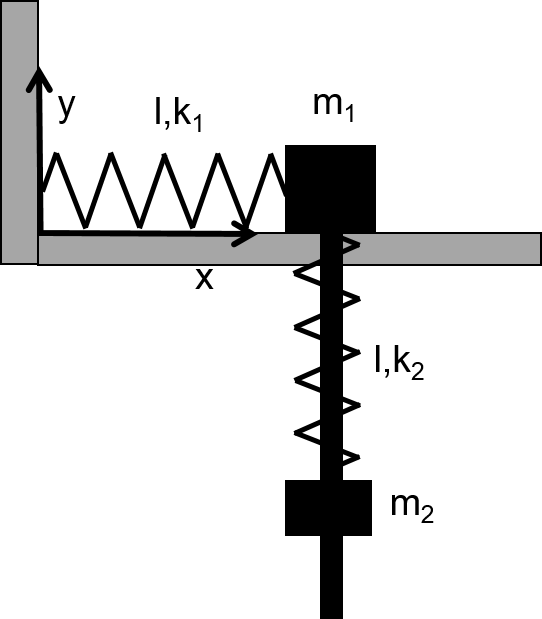
a) Write out the differential equations of motion for \(x_1\), \(x_2\), \(y_1\), and \(y_2\).
b) How many degree of freedom, \(n\), are there? Choose \(n\) generalized coordinates and write out their differential equations of motion.
c) Write out the total energy of the sytem (kinetic + potential) in terms of the generalized coordinates and velocities.
d) Use a computer to plot the path in the xy plane for mass \(m_2\) for \(t=0\dots 10\)s given the following values and initial conditions at \(t=0\): \(m_1=1\) kg, \(m_2=5\) kg, \(L=1\) m, \(k_1=10\) N/m, \(k_2=2\) N/M, \(x_1=1.2\) m, \(v_{1x}=0\) m/s, \(y_2=-0.5\) m, \(v_{2y}=0\) m/s.