
The Cartesian coordinates of a point \((x,y,z)\) are determined by following straight paths starting from the origin: first along the \(x\)-axis, then parallel to the \(y\)-axis, then parallel to the \(z\)-axis, as in Figure 1.7.1. In curvilinear coordinate systems, these paths can be curved. The two types of curvilinear coordinates which we will consider are cylindrical and spherical coordinates. Instead of referencing a point in terms of sides of a rectangular parallelepiped, as with Cartesian coordinates, we will think of the point as lying on a cylinder or sphere. Cylindrical coordinates are often used when there is symmetry around the \(z\)-axis; spherical coordinates are useful when there is symmetry about the origin.
Let \(P = (x,y,z)\) be a point in Cartesian coordinates in \(\Real{3}\), and let \(\ssub{P}{0} = (x,y,0)\) be the projection of \(P\) upon the \(xy\)-plane. Treating \((x,y)\) as a point in \(\Real{2}\), let \((r,\theta)\) be its polar coordinates (see Figure 1.7.2). Let \(\rho\) be the length of the line segment from the origin to \(P\), and let \(\phi\) be the angle between that line segment and the positive \(z\)-axis (see Figure 1.7.3). \(\phi\) is called the zenith angle. Then the cylindrical coordinates \((r,\theta,z)\) and the spherical coordinates \( (\rho,\theta,\phi)\) of \(P(x,y,z)\) are defined as follows:[1]


Spherical coordinates \((\rho,\theta,\phi)\):
where \(~0 \le \theta \le \pi~~\) if \(~~y \ge 0~~\) and \(~~\pi < \theta < 2\pi~~\) if \(~~y < 0\)
Both \(\theta\) and \(\phi\) are measured in radians. Note that \(r \ge 0\), \(0 \le \theta < 2\pi\), \(\rho \ge 0\) and \(0 \le \phi \le \pi\). Also, \(\theta\) is undefined when \((x,y) = (0,0)\), and \(\phi\) is undefined when \((x,y,z) = (0,0,0)\).
Example 1.31
Convert the point \((-2,-2,1)\) from Cartesian coordinates to (a) cylindrical and (b) spherical coordinates.
Solution: (a) \(r = \sqrt{(-2)^2 + (-2)^2} = 2\sqrt{2}\), \(\theta =
\tan^{-1} \left( \frac{-2}{-2} \right) = \tan^{-1}(1) = \frac{5 \pi}{4}\), since \(y = -2 < 0\).
\(\therefore ~ (r,\theta,z) = \left( 2\sqrt{2},\frac{5 \pi}{4},1 \right)\)
(b) \(\rho = \sqrt{(-2)^2 + (-2)^2 + 1^2} = \sqrt{9} = 3\), \(\phi = \cos^{-1} \left( \frac{1}{3} \right)
\approx 1.23\) radians.
\(\therefore ~ (\rho,\theta,\phi) = \left( 3,\frac{5 \pi}{4}, 1.23 \right)\)
width height 0.5pt
For cylindrical coordinates \((r,\theta,z)\), and constants \(\ssub{r}{0}\), \(\ssub{\theta}{0}\) and \(\ssub{z}{0}\), we see from Figure 1.7.1 that the surface \(r = \ssub{r}{0}\) is a cylinder of radius \(\ssub{r}{0}\) centered along the \(z\)-axis, the surface \(\theta = \ssub{\theta}{0}\) is a half-plane emanating from the \(z\)-axis, and the surface \(z = \ssub{z}{0}\) is a plane parallel to the \(xy\)-plane.
![tikzpicture arrows insideoHTML798084 insideiHTMLF0F0F0 outerHTML006146 innerHTML9EF0A6 [left color=insideo,right color=insideo,middle color=insidei] (1,1) arc (0:180:1 and .5) -- (-1,1) arc (180:360:1 and .5); [left color=outer,right color=outer,middle color=inner] (-1,-1) arc (180:360:1 and .5) -- (1,1) -- (1,1) arc (360:180:1 and .5) -- (-1,-1); (1,1) arc (0:180:1 and .5); [dashed,line width=0.2pt] (1,-1) arc (0:180:1 and .5); [black!60,line width=0.3pt,-latex] (0,0) -- (2,0,0); [black!60,line width=0.3pt,-latex] (0,-1.5) -- (0,2,0); [black!60,line width=0.3pt,-latex] (0,0) -- (0,0,4); 1.90.20 [center,center]y; 0.21.90 [center,center]z; 0.203.8 [center,center]x; 0.1-0.20 [center,center]0; [dashed,line width=0.2pt] (0,1) -- (1,1); [dashed,line width=0.2pt] (-1,-1) -- (1,-1); [above] at (0.5,1) r0; tikzpicture](/mecmath-vector-calculus/figures/fig-7e680ed993.svg)
![tikzpicture arrows [red!30] (0,-.5) -- (1,-1.5) -- (1,.5) -- (0,1.5) -- (0,-.5); [black!60,line width=0.3pt,-latex] (0,0) -- (2,0,0); [black!60,line width=0.3pt,-latex] (0,-.5) -- (0,2,0); [black!60,dashed,line width=0.3pt] (0,-1.5) -- (0,-.5); [black!60,line width=0.3pt,-latex] (0,0) -- (0,0,4); 1.90.20 [center,center]y; 0.21.90 [center,center]z; 0.203.8 [center,center]x; -0.20.10 [center,center]0; [line width=0.2pt] (0,-.5) -- (1,-1.5) -- (1,.5) -- (0,1.5) -- (0,-.5); [dashed,line width=0.2pt] (0,0) -- (1,-1); [dashed,line width=0.2pt,-latex] (-0.7,-0.7) arc (225:315:1 and .7); [below] at (-0.3,-.8) 0; tikzpicture](/mecmath-vector-calculus/figures/fig-db292c358c.svg)
![tikzpicture arrows planecolorHTMLFFB270 [planecolor] (-1.8,.9) -- (-1.1,1.6) -- (1.8,1.6) -- (1.1,.9) -- (-1.8,.9); [line width=0.2pt] (-1.8,.9) -- (-1.1,1.6) -- (1.8,1.6) -- (1.1,.9) -- (-1.8,.9); [black!60,line width=0.3pt,-latex] (0,0) -- (2,0,0); [black!60,line width=0.3pt,-latex] (0,-1.5) -- (0,2,0); [black!60,line width=0.3pt,-latex] (0,0) -- (0,0,4); 1.90.20 [center,center]y; 0.21.90 [center,center]z; 0.203.8 [center,center]x; 0.1-0.20 [center,center]0; (0,1.2) circle (1pt); [left] at (0,1.2) z0; tikzpicture](/mecmath-vector-calculus/figures/fig-b069e115a7.svg)
For spherical coordinates \((\rho,\theta,\phi)\), and constants \(\ssub{\rho}{0}\), \(\ssub{\theta}{0}\) and \(\ssub{\phi}{0}\), we see from Figure 1.7.2 that the surface \(\rho = \ssub{\rho}{0}\) is a sphere of radius \(\ssub{\rho}{0}\) centered at the origin, the surface \(\theta = \ssub{\theta}{0}\) is a half-plane emanating from the \(z\)-axis, and the surface \(\phi = \ssub{\phi}{0}\) is a circular cone whose vertex is at the origin.
![tikzpicture arrows spherecolorHTML80DCFF [ball color=spherecolor] (0,0) circle (1.5); [black!60,line width=0.3pt,-latex] (0,0) -- (2,0,0); [black!60,line width=0.3pt,-latex] (0,-1.5) -- (0,2,0); [black!60,line width=0.3pt,-latex] (0,0) -- (0,0,4); 1.90.20 [center,center]y; 0.21.90 [center,center]z; 0.203.8 [center,center]x; 0.1-0.20 [center,center]0; [line width=0.2pt] (-1.5,0) arc (180:360:1.5 and 0.4); [dashed,line width=0.2pt] (1.5,0) arc (0:180:1.5 and 0.4); [dashed,line width=0.2pt,-latex] (0,0) -- (1.06,1.06); [above] at (0.5,0.5) 0; tikzpicture](/mecmath-vector-calculus/figures/fig-6b7e2bb772.svg)
![tikzpicture arrows insideoHTML798084 insideiHTMLF0F0F0 outerHTML424296 innerHTMLD8D8FF [left color=insideo,right color=insideo,middle color=insidei] (1,2.2) arc (0:180:1 and .3) -- (-1,2.2) arc (180:360:1 and .3); [left color=outer,right color=outer,middle color=inner] (-1,2.2) arc (180:360:1 and .3) -- (0,0) -- (-1,2.2); [black!60,line width=0.3pt,-latex] (0,0) -- (2,0,0); [black!60,line width=0.3pt,-latex] (0,-.5) -- (0,3,0); [black!60,line width=0.3pt,-latex] (0,0) -- (0,0,2); 1.90.20 [center,center]y; 0.22.90 [center,center]z; 0.201.8 [center,center]x; 0.2-0.20 [center,center]0; [dashed,line width=0.2pt] (-1,2.2) -- (1,2.2); [dashed,line width=0.2pt,-latex] (0,1.4) arc (100:65:1 and 1.2); [above] at (0.3,0.9) 0; tikzpicture](/mecmath-vector-calculus/figures/fig-12a1b52709.svg)
Figures 1.7.1(a) and 1.7.2(a) show how these coordinate systems got their names.
Sometimes the equation of a surface in Cartesian coordinates can be transformed into a simpler equation in some other coordinate system, as in the following example.
width height 0.5pt
Example 1.32
Write the equation of the cylinder \(x^2 + y^2 = 4\) in cylindrical coordinates.
Solution: Since \(r = \sqrt{x^2 + y^2}\), then the equation in cylindrical coordinates is \(r =2\).
width height 0.5pt
Using spherical coordinates to write the equation of a sphere does not necessarily make the equation simpler, if the sphere is not centered at the origin.
width height 0.5pt
Example 1.33
Write the equation \((x - 2)^2 + (y - 1)^2 + z^2 = 9\) in spherical coordinates.
Solution: Multiplying the equation out gives
after combining terms. Note that this actually makes it more difficult to figure out what the surface is, as opposed to the Cartesian equation where you could immediately identify the surface as a sphere of radius \(3\) centered at \((2,1,0)\).
width height 0.5pt
Example 1.34
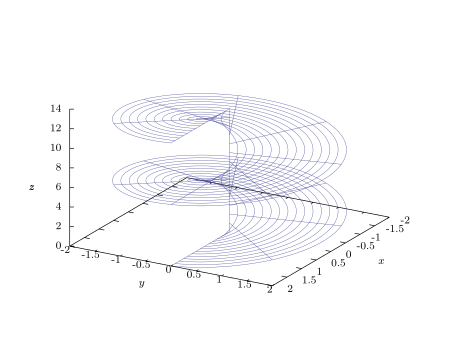
Describe the surface given by \(\theta = z\) in cylindrical coordinates.
Solution: This surface is called a helicoid. As the (vertical) \(z\) coordinate increases, so does the angle \(\theta\), while the radius \(r\) is unrestricted. So this sweeps out a (ruled!) surface shaped like a spiral staircase, where the spiral has an infinite radius. Figure 1.7.3 shows a section of this surface restricted to \(0 \le z \le 4\pi\) and \(0 \le r \le 2\).
width height 0.5pt
A
For Exercises 1-4, find the (a) cylindrical and (b) spherical coordinates of the point whose Cartesian coordinates are given.
4
\((2,2\sqrt{3},-1)\)
\((-5,5,6)\)
\((\sqrt{21},-\sqrt{7},0)\)
\((0,\sqrt{2},2)\)
For Exercises 5-7, write the given equation in (a) cylindrical and (b) spherical coordinates.
3
\(x^2 + y^2 + z^2 = 25\)
\(x^2 + y^2 = 2y\)
\(x^2 + y^2 + 9z^2 = 36\)
B
Describe the intersection of the surfaces whose equations in spherical coordinates are \(\theta = \frac{\pi}{2}\) and \(\phi = \frac{\pi}{4}\).
Show that for \(a \ne 0\), the equation \(\rho = 2a \sin \phi \, \cos \theta\) in spherical coordinates describes a sphere centered at \((a,0,0)\) with radius \(\abs{a}\).
C
Let \(P = (a,\theta,\phi)\) be a point in spherical coordinates, with \(a > 0\) and \(0 < \phi < \pi\). Then \(P\) lies on the sphere \(\rho = a\). Since \(0 < \phi < \pi\), the line segment from the origin to \(P\) can be extended to intersect the cylinder given by \(r = a\) (in cylindrical coordinates). Find the cylindrical coordinates of that point of intersection.
Let \(\ssub{P}{1}\) and \(\ssub{P}{2}\) be points whose spherical coordinates are \(( \ssub{\rho}{1},\ssub{\theta}{1},\ssub{\phi}{1} )\) and \(( \ssub{\rho}{2},\ssub{\theta}{2},\ssub{\phi}{2} )\), respectively. Let \(\ssub{\textbf{v}}{1}\) be the vector from the origin to \(\ssub{P}{1}\), and let \(\ssub{\textbf{v}}{2}\) be the vector from the origin to \(\ssub{P}{2}\). For the angle \(\gamma\) between \(\ssub{\textbf{v}}{1}\) and \(\ssub{\textbf{v}}{2}\), show that
\[\cos \gamma = \cos \ssub{\phi}{1} \, \cos \ssub{\phi}{2} + \sin \ssub{\phi}{1} \, \sin \ssub{\phi}{2} \, \cos ( \, \ssub{\theta}{2} - \ssub{\theta}{1} \, ) .\]This formula is used in electrodynamics to prove the addition theorem for spherical harmonics, which provides a general expression for the electrostatic potential at a point due to a unit charge. See pp. 100-102 in jac.
Show that the distance \(d\) between the points \(\ssub{P}{1}\) and \(\ssub{P}{2}\) with cylindrical coordinates \(( \ssub{r}{1},\ssub{\theta}{1},\ssub{z}{1} )\) and \(( \ssub{r}{2},\ssub{\theta}{2},\ssub{z}{2} )\), respectively, is
\[d = \sqrt{\ssub{r}{1}^2 + \ssub{r}{2}^2 - 2 \ssub{r}{1}\,\ssub{r}{2} \cos (\, \ssub{\theta}{2} - \ssub{\theta}{1} \,) + ( \ssub{z}{2} - \ssub{z}{1} )^2} \, .\]Show that the distance \(d\) between the points \(\ssub{P}{1}\) and \(\ssub{P}{2}\) with spherical coordinates \(( \ssub{\rho}{1},\ssub{\theta}{1},\ssub{\phi}{1} )\) and \(( \ssub{\rho}{2},\ssub{\theta}{2},\ssub{\phi}{2} )\), respectively, is
\[d = \sqrt{\ssub{\rho}{1}^2 + \ssub{\rho}{2}^2 - 2 \ssub{\rho}{1}\,\ssub{\rho}{2} [ \sin \ssub{\phi}{1} \, \sin \ssub{\phi}{2} \,\cos ( \, \ssub{\theta}{2} - \ssub{\theta}{1} \, ) + \cos \ssub{\phi}{1} \, \cos \ssub{\phi}{2} ]} \, .\]
- This “standard” definition of spherical coordinates used by mathematicians results in a left-handed system. For this reason, physicists usually switch the definitions of \(\theta\) and \(\phi\) to make \((\rho,\theta,\phi)\) a right-handed system. ↩
Cylindrical coordinates \((r,\theta,z)\):
where \(~0 \le \theta \le \pi~~\) if \(~~y \ge 0~~\) and \(~~\pi < \theta < 2\pi~~\) if \(~~y < 0\)