In the previous section we discussed planes in Euclidean space. A plane is an example of a surface, which we will define informally[1] as the solution set of the equation \(F(x,y,z) = 0\) in \(\Real{3}\), for some real-valued function \(F\). For example, a plane given by \(ax + by + cz + d = 0\) is the solution set of \(F(x,y,z) = 0\) for the function \(F(x,y,z) = ax + by + cz + d\). Surfaces are 2-dimensional. The plane is the simplest surface, since it is “flat”. In this section we will look at some surfaces that are more complex, the most important of which are the sphere and the cylinder.
Definition 1.9
A sphere \(S\) is the set of all points \((x,y,z)\) in \(\Real{3}\) which are a fixed distance \(r\) (called the radius) from a fixed point \(\ssub{P}{0} = (\ssub{x}{0},\ssub{y}{0},\ssub{z}{0})\) (called the center of the sphere):
Using vector notation, this can be written in the equivalent form:
where \(\textbf{x} = (x,y,z)\) and \(\ssub{\textbf{x}}{0} = (\ssub{x}{0},\ssub{y}{0},\ssub{z}{0})\) are vectors.
Figure 1.6.1 illustrates the vectorial approach to spheres.
![tikzpicture arrows spherecolorHTML80DCFF [ball color=spherecolor] (0,0) circle (1in); [black!60,line width=0.3pt,-latex] (0,0) -- (3,0,0); [black!60,line width=0.3pt,-latex] (0,0) -- (0,3,0); [black!60,line width=0.3pt,-latex] (0,0) -- (0,0,6); 2.90.20 [center,center]y; 0.22.90 [center,center]z; 0.205.8 [center,center]x; 0.05-0.20 [center,center]0; [line width=0.2pt](-1in,0in) arc (180:360:1in and 0.3in); [dashed,line width=0.2pt] (1in,0in) arc (0:180:1in and 0.3in); [black,line width=1.2pt,-latex] (0,0) -- (1.5,1.5); at (2.4,2.1) x = r; [left] at (1.3,1.47) x; (0,0) circle (2pt); (1.525,1.525) circle (2pt); tikzpicture](/mecmath-vector-calculus/figures/fig-ef674470e0.svg)
![tikzpicture arrows spherecolorHTML80DCFF [ball color=spherecolor] (2,2) circle (1.8); [black!60,line width=0.3pt,-latex] (0,0) -- (4,0,0); [black!60,line width=0.3pt,-latex] (0,0) -- (0,4.3,0); [black!60,line width=0.3pt,-latex] (0,0) -- (0,0,2); 3.90.20 [center,center]y; 0.24.20 [center,center]z; 0.201.8 [center,center]x; 0.05-0.20 [center,center]0; [line width=0.2pt] (0.2,2) arc (180:360:1.8 and 0.54); [dashed,line width=0.2pt] (3.8,2) arc (0:180:1.8 and 0.54); [black,line width=1.2pt,-latex] (0,0) -- (1.95,1.95); [black,line width=1.2pt,-latex] (0,0) -- (2.35,3.45); [black,line width=1.2pt,-latex] (2,2) -- (2.38,3.45); at (3,4.1) x - x0 = r; [left] at (2,3.2) x; [right] at (1.4,1.2) x0; at (2.9,2.9) x - x0; at (2.9,2) ( x0, y0, z0); (2,2) circle (2pt); (2.4,3.5) circle (2pt); tikzpicture](/mecmath-vector-calculus/figures/fig-208ba79836.svg)
Note in Figure 1.6.1(a) that the intersection of the sphere with the \(xy\)-plane is a circle of radius \(r\) (i.e. a great circle, given by \(x^2 + y^2 = r^2\) as a subset of \(\Real{2}\)). Similarly for the intersections with the \(xz\)-plane and the \(yz\)-plane. In general, a plane intersects a sphere either at a single point or in a circle.
Example 1.27
Find the intersection of the sphere \(x^2 + y^2 + z^2 = 169\) with the plane \(z = 12\).
![tikzpicture arrows spherecolorHTML80DCFF planecolorHTMLFFB270 [planecolor] (-2,.9) -- (-1.3,1.6) -- (2,1.6) -- (1.3,.9) -- (-2,.9); [ball color=spherecolor] (0,0) circle (1.5); [planecolor] (-1.24,.9) -- (1.24,.9) arc (37:53:1.54) -- (.94,1.2) arc (360:180:.92 and .1) -- (-.94,1.2) arc (143:127:1.54) -- (-1.24,.9); [line width=0.2pt] (.9,1.2) arc (360:180:.9 and .1); [dashed,line width=0.2pt] (.9,1.2) arc (0:180:.9 and .1); [black!60,line width=0.3pt,-latex] (0,0) -- (2,0,0); [black!60,line width=0.3pt,-latex] (0,0) -- (0,2,0); [black!60,line width=0.3pt,-latex] (0,0) -- (0,0,4); 1.90.20 [center,center]y; 0.21.90 [center,center]z; 0.203.8 [center,center]x; 0.05-0.20 [center,center]0; [line width=0.2pt] (-1.5,0) arc (180:360:1.5 and 0.4); [dashed,line width=0.2pt] (1.5,0) arc (0:180:1.5 and 0.4); at (2.2,1.2) z = 12; tikzpicture](/mecmath-vector-calculus/figures/fig-ac000be1fc.svg)
Solution: The sphere is centered at the origin and has radius \(13 = \sqrt{169}\), so it does intersect the plane \(z = 12\). Putting \(z = 12\) into the equation of the sphere gives
which is a circle of radius \(5\) centered at \((0,0,12)\), parallel to the \(xy\)-plane (see Figure 1.6.2).
width height 0.5pt
If the equation in formula (1.29) is multiplied out, we get an equation of the form:
for some constants \(a\), \(b\), \(c\) and \(d\). Conversely, an equation of this form may describe a sphere, which can be determined by completing the square for the \(x\), \(y\) and \(z\) variables.
width height 0.5pt
Example 1.28
Is \(2x^2 + 2y^2 + 2z^2 - 8x + 4y - 16z + 10 = 0\) the equation of a sphere?
Solution: Dividing both sides of the equation by \(2\) gives
which is a sphere of radius \(4\) centered at \((2,-1,4)\).
width height 0.5pt
Example 1.29
Find the points(s) of intersection (if any) of the sphere from Example 1.28 and the line \(x = 3 + t\), \(y = 1 + 2t\), \(z = 3 - t\).
Solution: Put the equations of the line into the equation of the sphere, which was \((x - 2)^2 + (y + 1)^2 + (z - 4)^2 = 16\), and solve for \(t\):
The quadratic formula gives the solutions \(~t = -1 \pm \dfrac{4}{\sqrt{6}}\). Putting those two values into the equations of the line gives the following two points of intersection:
width height 0.5pt If two spheres intersect, they do so either at a single point or in a circle.
width height 0.5pt
Example 1.30
Find the intersection (if any) of the spheres \(x^2 + y^2 + z^2 = 25\) and \(x^2 + y^2 + (z - 2)^2 = 16\).
Solution: For any point \((x,y,z)\) on both spheres, we see that
\(\therefore\) The intersection is the circle \(x^2 + y^2 = \frac{231}{16}\) of radius \(\frac{\sqrt{231}}{4} \approx 3.8\) centered at \((0,0,\frac{13}{4})\).
width height 0.5pt
The cylinders that we will consider are right circular cylinders. These are cylinders obtained by moving a line \(L\) along a circle \(C\) in \(\Real{3}\) in a way so that \(L\) is always perpendicular to the plane containing \(C\). We will only consider the cases where the plane containing \(C\) is parallel to one of the three coordinate planes (see Figure 1.6.2).
![tikzpicture arrows insideoHTML798084 insideiHTMLF0F0F0 outerHTML006146 innerHTML9EF0A6 [left color=insideo,right color=insideo,middle color=insidei] (1,2) arc (0:180:1 and .5) -- (-1,2) arc (180:360:1 and .5); [left color=outer,right color=outer,middle color=inner] (-1,0) arc (180:360:1 and .5) -- (1,2) -- (1,2) arc (360:180:1 and .5) -- (-1,0); (1,2) arc (0:180:1 and .5); [dashed,line width=0.2pt] (1,0) arc (0:180:1 and .5); [black!60,line width=0.3pt,-latex] (0,0) -- (2,0,0); [black!60,line width=0.3pt,-latex] (0,0) -- (0,3,0); [black!60,line width=0.3pt,-latex] (0,0) -- (0,0,2); 1.90.20 [center,center]y; 0.22.90 [center,center]z; 0.201.8 [center,center]x; 0.05-0.20 [center,center]0; [dashed,line width=0.2pt] (0,2) -- (1,2); [above] at (0.5,2) r; tikzpicture](/mecmath-vector-calculus/figures/fig-ad09cd7a9e.svg)
![tikzpicture arrows insideoHTML798084 insideiHTMLF0F0F0 outerHTML006146 innerHTML9EF0A6 [top color=insideo,bottom color=insideo,middle color=insidei] (2,1) arc (90:270:.5 and 1) -- (2,-1) arc (-90:90:.5 and 1); [top color=outer,bottom color=outer,middle color=inner] (0,1) arc (90:270:.5 and 1) -- (2,-1) -- (2,-1) arc (270:90:.5 and 1) -- (0,1); (2,-1) arc (-90:90:.5 and 1); [dashed,line width=0.2pt] (0,-1) arc (-90:90:.5 and 1); [black!60,line width=0.3pt,-latex] (0,0) -- (3,0,0); [black!60,line width=0.3pt,-latex] (0,0) -- (0,1.5,0); [black!60,line width=0.3pt,-latex] (0,0) -- (0,0,2.5); 2.90.20 [center,center]y; 0.21.40 [center,center]z; 0.202.3 [center,center]x; 0.05-0.20 [center,center]0; [dashed,line width=0.2pt] (2,0) -- (2,1); [right] at (2,0.5) r; tikzpicture](/mecmath-vector-calculus/figures/fig-3648dea56c.svg)
![tikzpicture arrows insideoHTML798084 insideiHTMLF0F0F0 outerHTML006146 innerHTML9EF0A6 [shading=axis,top color=insideo,bottom color=insideo,middle color=insidei,shading angle=45] (0,0) circle (1); [rotate=45,shading=axis,top color=outer,bottom color=outer,middle color=inner,shading angle=45] (0,1) arc (90:-90:1 and 1) -- (2.5,-1) -- (2.5,-1) arc (-90:90:1 and 1) -- (0,1); [dashed,line width=0.2pt] (2.474,1.0606) arc (315:135:1 and 1); [black!60,line width=0.3pt,-latex] (0,0) -- (3,0,0); [black!60,line width=0.3pt,-latex] (0,0) -- (0,2.7,0); [black!60,line width=0.3pt,-latex] (0,0) -- (0,0,3); 2.90.20 [center,center]y; 0.22.60 [center,center]z; 0.202.8 [center,center]x; 0.05-0.20 [center,center]0; [dashed,line width=0.2pt] (0,0) -- (-0.7071,0.7071); [below] at (-0.35,0.35) r; tikzpicture](/mecmath-vector-calculus/figures/fig-7202f8681b.svg)
For example, the equation of a cylinder whose base circle \(C\) lies in the \(xy\)-plane and is centered at \((a,b,0)\) and has radius \(r\) is
where the value of the \(z\) coordinate is unrestricted. Similar equations can be written when the base circle lies in one of the other coordinate planes. A plane intersects a right circular cylinder in a circle, ellipse, or one or two lines, depending on whether that plane is parallel, oblique[2], or perpendicular, respectively, to the plane containing \(C\). The intersection of a surface with a plane is called the trace of the surface.
The equations of spheres and cylinders are examples of second-degree equations in \(\Real{3}\), i.e. equations of the form
for some constants \(A\), \(B\), \(\dots\), \(J\). If the above equation is not that of a sphere, cylinder, plane, line or point, then the resulting surface is called a quadric surface.
![tikzpicture arrows ellipsecolorHTMLAAAAFF [ball color=ellipsecolor] (0,0) ellipse (2.8 and 1.5); [line width=0.2pt] (-2.8,0) arc (180:360:2.8 and .35); [dashed,line width=0.2pt] (2.8,0) arc (0:180:2.8 and .35); [line width=0.2pt] (0,1.5) arc (90:270:.4 and 1.5); [dashed,line width=0.2pt] (0,-1.5) arc (-90:90:.4 and 1.5); [black!60,line width=0.3pt,-latex] (0,0) -- (3.5,0,0); [black!60,line width=0.3pt,-latex] (0,0) -- (0,2,0); [black!60,line width=0.3pt,-latex] (0,0) -- (0,0,4.5); 3.40.20 [center,center]y; 0.21.90 [center,center]z; 0.204.3 [center,center]x; 0.05-0.20 [center,center]0; [below,right] at (-0.49,-0.49) a; [below,right] at (2.7,-0.2) b; [above,left] at (0,1.65) c; tikzpicture](/mecmath-vector-calculus/figures/fig-5afe6356b4.svg)
One type of quadric surface is the ellipsoid, given by an equation of the form:
In the case where \(a = b = c\), this is just a sphere. In general, an ellipsoid is egg-shaped (think of an ellipse rotated around its major axis). Its traces in the coordinate planes are ellipses.
Two other types of quadric surfaces are the hyperboloid of one sheet, given by an equation of the form:
and the hyperboloid of two sheets, whose equation has the form:
![tikzpicture arrows insideoHTML798084 insideiHTMLF0F0F0 outerHTML424296 innerHTMLD8D8FF [left color=insideo,right color=insideo,middle color=insidei] (2,2) arc (0:180:2 and .5) -- (-2,2) arc (180:360:2 and .5); [left color=outer,right color=outer,middle color=inner] (-2,-2) arc (180:360:2 and .5) .. controls (1,-1) and (1,1) .. (2,2) -- (2,2) arc (360:180:2 and .5) .. controls (-1,1) and (-1,-1) .. (-2,-2); (2,2) arc (0:180:2 and .5); [line width=0.2pt] (-1.25,0) arc (180:360:1.25 and .4); [dashed,line width=0.2pt] (1.25,0) arc (0:180:1.25 and .4); [dashed,line width=0.2pt] (2,-2) arc (0:180:2 and .5); [line width=0.2pt] (-0.8,-2.47) .. controls (-0.21,-1.485) and (-0.21,0.515) .. (-0.8,1.53); [dashed,line width=0.2pt] (0.8,-1.53) .. controls (0.21,-0.515) and (0.21,1.485) .. (0.8,2.47); [dashed,line width=0.2pt] (-0.8,-2.47) -- (0.8,-1.53); [dashed,line width=0.2pt] (-0.8,1.53) -- (0.8,2.47); [dashed,line width=0.2pt] (-2,2) -- (2,2); [dashed,line width=0.2pt] (-2,-2) -- (2,-2); [black!60,line width=0.3pt,-latex] (-2,0) -- (2,0,0); [black!60,line width=0.3pt,-latex] (0,-3) -- (0,3,0); [black!60,line width=0.3pt,-latex] (1,1) -- (0,0,7); 1.90.20 [center,center]y; 0.22.90 [center,center]z; 0.206.8 [center,center]x; 0.05-0.20 [center,center]0; tikzpicture](/mecmath-vector-calculus/figures/fig-93dcd64d9b.svg)
![tikzpicture arrows insideoHTML798084 insideiHTMLF0F0F0 outerHTML424296 innerHTMLD8D8FF [rotate=-45,left color=insideo,right color=insideo,middle color=insidei,shading angle=45] (0,-2.5) ellipse (1 and 0.5); [rotate=-45,left color=outer,right color=outer,middle color=inner,shading angle=45] (-1,-2.5) arc (180:0:1 and 0.5) -- (1,-2.5) parabola bend (0,-0.5) (-1,-2.5); [rotate=-45,left color=outer,right color=outer,middle color=inner,shading angle=45] (-1,2.5) arc (180:0:1 and 0.5) -- (1,2.5) parabola bend (0,0.5) (-1,2.5); [rotate=-45,dashed,line width=0.2pt] (-1,2.5) arc (180:360:1 and 0.5); [rotate=-45,dashed,line width=0.2pt] (-0.4472,-2.9472) -- (0.4472,-2.0528); [rotate=-45,dashed,line width=0.2pt] (0.4472,-2.9472) -- (-0.4472,-2.0528); [rotate=-45,line width=0.2pt] (0.4472,-2.0528) parabola [bend at end] (0,-0.5); [rotate=-45,dashed,line width=0.2pt] (-0.4472,-2.9472) parabola [bend at end] (0,-0.5); [rotate=-45,dashed,line width=0.2pt] (-0.4472,2.9472) -- (0.4472,2.0528); [rotate=-45,dashed,line width=0.2pt] (0.4472,2.9472) -- (-0.4472,2.0528); [rotate=-45,dashed,line width=0.2pt] (-0.4472,2.0528) parabola [bend at end] (0,0.5); [rotate=-45,line width=0.2pt] (0.4472,2.9472) parabola [bend at end] (0,0.5); [black!60,line width=0.3pt,-latex] (-2.5,0) -- (2.5,0,0); [black!60,line width=0.3pt,-latex] (0,-3) -- (0,3,0); [black!60,line width=0.3pt,-latex] (2.5,2.5) -- (0,0,7); 2.40.20 [center,center]y; 0.22.90 [center,center]z; 0.206.8 [center,center]x; 0.05-0.20 [center,center]0; tikzpicture](/mecmath-vector-calculus/figures/fig-f47c171691.svg)
For the hyperboloid of one sheet, the trace in any plane parallel to the \(xy\)-plane is an ellipse. The traces in the planes parallel to the \(xz\)- or \(yz\)-planes are hyperbolas (see Figure 1.6.3), except for the special cases \(x = \pm a\) and \(y = \pm b\); in those planes the traces are pairs of intersecting lines (see Exercise 8).
For the hyperboloid of two sheets, the trace in any plane parallel to the \(xy\)- or \(xz\)-plane is a hyperbola (see Figure 1.6.4). There is no trace in the \(yz\)-plane. In any plane parallel to the \(yz\)-plane for which \(\abs{x} > \abs{a}\), the trace is an ellipse.
![tikzpicture arrows insideoHTML798084 insideiHTMLF0F0F0 outerHTML424296 innerHTMLD8D8FF [left color=insideo,right color=insideo,middle color=insidei] (0,3) ellipse (2 and 0.7); [left color=outer,right color=outer,middle color=inner] (2,3) arc (360:180:2 and 0.7) -- (-2,3) parabola bend (0,0) (2,3); [dashed,line width=0.2pt] (-2,3) -- (2,3); [dashed,line width=0.2pt] (-0.66,2.34) -- (0.66,3.66); [line width=0.2pt] (-0.66,2.34) parabola [bend at end] (0,0); [dashed,line width=0.2pt] (0.66,3.66) parabola [bend at end] (0,0); [line width=0.2pt] (-1.25,1.2) arc (180:360:1.25 and 0.4); [dashed,line width=0.2pt] (-1.25,1.2) arc (180:0:1.25 and 0.4); [black!60,line width=0.3pt,-latex] (-2,0) -- (2,0,0); [black!60,line width=0.3pt,-latex] (0,0) -- (0,4,0); [black!60,line width=0.3pt,-latex] (0,0) -- (0,0,2); 1.90.20 [center,center]y; 0.23.90 [center,center]z; 0.201.8 [center,center]x; 0.05-0.20 [center,center]0; tikzpicture](/mecmath-vector-calculus/figures/fig-b5ac423e5f.svg)
The elliptic paraboloid is another type of quadric surface, whose equation has the form:
The traces in planes parallel to the \(xy\)-plane are ellipses, though in the \(xy\)-plane itself the trace is a single point. The traces in planes parallel to the \(xz\)- or \(yz\)-planes are parabolas. Figure 1.6.7 shows the case where \(c > 0\). When \(c < 0\) the surface is turned downward. In the case where \(a = b\), the surface is called a paraboloid of revolution, which is often used as a reflecting surface, e.g. in vehicle headlights.[3]
A more complicated quadric surface is the hyperbolic paraboloid, given by:
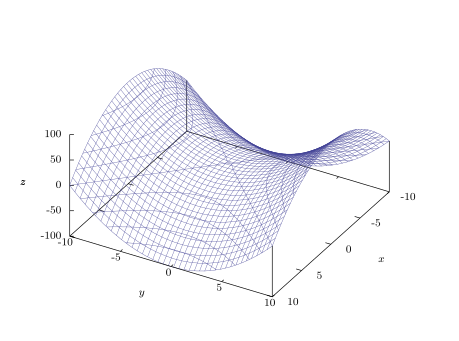
The hyperbolic paraboloid can be tricky to draw; using graphing software on a computer can make it easier. For example, Figure 1.6.5 was created using the free Gnuplot package (see Appendix C). It shows the graph of the hyperbolic paraboloid \(z = y^2 - x^2\), which is the special case where \(a = b = 1\) and \(c = -1\) in equation (1.38). The mesh lines on the surface are the traces in planes parallel to the coordinate planes. So we see that the traces in planes parallel to the \(xz\)-plane are parabolas pointing upward, while the traces in planes parallel to the \(yz\)-plane are parabolas pointing downward. Also, notice that the traces in planes parallel to the \(xy\)-plane are hyperbolas, though in the \(xy\)-plane itself the trace is a pair of intersecting lines through the origin. This is true in general when \(c < 0\) in equation (1.38). When \(c > 0\), the surface would be similar to that in Figure 1.6.5, only rotated \(90\Degrees\) around the \(z\)-axis and the nature of the traces in planes parallel to the \(xz\)- or \(yz\)-planes would be reversed.
![tikzpicture arrows insideoHTML798084 insideiHTMLF0F0F0 outerHTML424296 innerHTMLD8D8FF [left color=insideo,right color=insideo,middle color=insidei] (1.3,2) arc (0:180:1.3 and .5) -- (-1.3,2) arc (180:360:1.3 and .5); [left color=outer,right color=outer,middle color=inner] (-1.3,-2) arc (180:360:1.3 and .5) -- (-1.3,2) -- (-1.3,2) arc (180:360:1.3 and .5) -- (-1.3,-2); [dashed,line width=0.2pt] (1.275,-2) arc (0:180:1.275 and .5); [dashed,line width=0.2pt] (-1.3,2) -- (1.3,2); [dashed,line width=0.2pt] (-1.3,-2) -- (1.3,-2); [black!60,line width=0.3pt,-latex] (-2.2,0) -- (2.2,0,0); [black!60,line width=0.3pt,-latex] (0,-2.5) -- (0,2.9,0); [black!60,line width=0.3pt,-latex] (1,1) -- (0,0,5); 2.10.20 [center,center]y; 0.22.80 [center,center]z; 0.204.8 [center,center]x; 0.05-0.20 [center,center]0; tikzpicture](/mecmath-vector-calculus/figures/fig-ab5497969f.svg)
The last type of quadric surface that we will consider is the elliptic cone, which has an equation of the form:
The traces in planes parallel to the \(xy\)-plane are ellipses, except in the \(xy\)-plane itself where the trace is a single point. The traces in planes parallel to the \(xz\)- or \(yz\)-planes are hyperbolas, except in the \(xz\)- and \(yz\)-planes themselves where the traces are pairs of intersecting lines.
Notice that every point on the elliptic cone is on a line which lies entirely on the surface; in Figure 1.6.9 these lines all go through the origin. This makes the elliptic cone an example of a ruled surface. The cylinder is also a ruled surface.
What may not be as obvious is that both the hyperboloid of one sheet and the hyperbolic paraboloid are ruled surfaces. In fact, on both surfaces there are two lines through each point on the surface (see Exercises 11-12). Such surfaces are called doubly ruled surfaces, and the pairs of lines are called a regulus.
It is clear that for each of the six types of quadric surfaces that we discussed, the surface can be translated away from the origin (e.g. by replacing \(x^2\) by \((x - \ssub{x}{0})^2\) in its equation). It can be proved[4] that every quadric surface can be translated and/or rotated so that its equation matches one of the six types that we described. For example, \(z = 2xy\) is a case of equation (1.33) with “mixed” variables, e.g. with \(D \ne 0\) so that we get an \(xy\) term. This equation does not match any of the types we considered. However, by rotating the \(x\)- and \(y\)-axes by \(45\Degrees\) in the \(xy\)-plane by means of the coordinate transformation \(x = (x' - y')/\sqrt{2}\), \(y = (x' + y')/\sqrt{2}\), \(z = z'\), then \(z = 2xy\) becomes the hyperbolic paraboloid \(z' = (x')^2 - (y')^2\) in the \((x',y',z')\) coordinate system. That is, \(z = 2xy\) is a hyperbolic paraboloid as in equation (1.38), but rotated \(45\Degrees\) in the \(xy\)-plane.
A
For Exercises 1-4, determine if the given equation describes a sphere. If so, find its radius and center.
2
\(x^2 + y^2 + z^2 - 4x - 6y - 10z + 37 = 0\)
\(x^2 + y^2 + z^2 + 2x - 2y - 8z + 19 = 0\)
2
\(2x^2 + 2y^2 + 2z^2 + 4x + 4y + 4z - 44 = 0\)
\(x^2 + y^2 - z^2 + 12x + 2y - 4z + 32 = 0\)
Find the point(s) of intersection of the sphere \((x - 3)^2 + (y + 1)^2 + (z - 3)^2 = 9\) and the line \(x = -1 + 2t\), \(y = -2 - 3t\), \(z = 3 + t\).
B
Find the intersection of the spheres \(x^2 + y^2 + z^2 = 9\) and \((x - 4)^2 + (y + 2)^2 + (z - 4)^2 = 9\).
Find the intersection of the sphere \(x^2 + y^2 + z^2 = 9\) and the cylinder \(x^2 + y^2 = 4\).
Find the trace of the hyperboloid of one sheet \(\frac{x^2}{a^2} + \frac{y^2}{b^2} - \frac{z^2}{c^2} = 1\) in the plane \(x = a\), and the trace in the plane \(y = b\).
Find the trace of the hyperbolic paraboloid \(\frac{x^2}{a^2} - \frac{y^2}{b^2} = \frac{z}{c}\) in the \(xy\)-plane.
C
It can be shown that any four noncoplanar points (i.e. points that do not lie in the same plane) determine a sphere.[5] Find the equation of the sphere that passes through the points \((0,0,0)\), \((0,0,2)\), \((1,-4,3)\) and \((0,-1,3)\). (Hint: Equation (1.31))
Show that the hyperboloid of one sheet is a doubly ruled surface, i.e. each point on the surface is on two lines lying entirely on the surface. (Hint: Write equation (1.35) as \(\frac{x^2}{a^2} - \frac{z^2}{c^2} = 1 - \frac{y^2}{b^2}\) , factor each side. Recall that two planes intersect in a line.)
Show that the hyperbolic paraboloid is a doubly ruled surface. (Hint: Exercise 11)
![tikzpicture arrows spherecolorHTML80DCFF [red!30] (-1.5,.5) -- (2,.5) -- (1,-.5) -- (-2.5,-.5) -- (-1.5,.5); [ball color=spherecolor] (0,1) circle (1); [black!60,line width=0.2pt] (-1,1) arc (180:360:1 and .2); [black!60,dashed,line width=0.2pt] (1,1) arc (0:180:1 and .2); [black!60,line width=0.3pt,-latex] (0,0) -- (1.5,0,0); [black!60,line width=0.3pt,-latex] (0,0) -- (0,2.7,0); [black!60,line width=0.3pt,-latex] (0,0) -- (0,0,2); 1.40.20 [center,center]y; 0.22.60 [center,center]z; 0.201.8 [center,center]x; 0.05-0.20 [center,center]0; (0,2) circle (2pt); [above,right] at (0,2.2) (0,0,2); (-1.75,-0.25) circle (2pt); [below,right] at (-1.75,-0.25) (x,y,0); (-.5,1.357) circle (2pt); [left] at (-.5,1.357) (a,b,c); [dashed,line width=0.2pt] (0,2) -- (-.5,1.357); [line width=0.2pt] (-.5,1.357) -- (-1.75,-0.25); [dashed,black!60,line width=0.2pt] (0,1) -- (1,1); [black,left] at (0,1) 1; at (1.2,1.2) S; tikzpicture](/mecmath-vector-calculus/figures/fig-196d5532db.svg)
Let \(S\) be the sphere with radius \(1\) centered at \((0,0,1)\), and let \(S^*\) be \(S\) without the “north pole” point \((0,0,2)\). Let \((a,b,c)\) be an arbitrary point on \(S^*\). Then the line passing through \((0,0,2)\) and \((a,b,c)\) intersects the \(xy\)-plane at some point \((x,y,0)\), as in Figure 1.6.10. Find this point \((x,y,0)\) in terms of \(a\), \(b\) and \(c\).
(Note: Every point in the \(xy\)-plane can be matched with a point on \(S^*\), and vice versa, in this manner. This method is called stereographic projection, which essentially identifies all of \(\Real{2}\) with a “punctured” sphere.)