We saw in Section 5.1 how the graphs of the trigonometric functions repeat every \(2\pi\) radians. In this section we will discuss this and other properties of graphs, especially for the sinusoidal functions (sine and cosine).
First, recall that the domain of a function \(f(x)\) is the set of all numbers \(x\) for which the function is defined. For example, the domain of \(f(x) = \sin\;x\) is the set of all real numbers, whereas the domain of \(f(x) = \tan\;x\) is the set of all real numbers except \(x=\pm\,\frac{\pi}{2}\), \(\pm\,\frac{3\pi}{2}\), \(\pm\,\frac{5\pi}{2}\), \(...\). The range of a function \(f(x)\) is the set of all values that \(f(x)\) can take over its domain. For example, the range of \(f(x)=\sin\;x\) is the set of all real numbers between \(-1\) and \(1\) (i.e. the interval \(\ival{-1}{1}\)), whereas the range of \(f(x) = \tan\;x\) is the set of all real numbers, as we can see from their graphs.
A function \(f(x)\) is periodic if there exists a number \(p>0\) such that \(x+p\) is in the domain of \(f(x)\) whenever \(x\) is, and if the following relation holds:
There could be many numbers \(p\) that satisfy the above requirements. If there is a smallest such number \(p\), then we call that number the period of the function \(f(x)\).
Example 5.3
The functions \(\sin\;x\), \(\cos\;x\), \(\csc\;x\), and \(\sec\;x\) all have the same period: \(2\pi\) radians. We saw in Section 5.1 that the graphs of \(y=\tan\;x\) and \(y=\cot\;x\) repeat every \(2\pi\) radians but they also repeat every \(\pi\) radians. Thus, the functions \(\tan\;x\) and \(\cot\;x\) have a period of \(\pi\) radians.
Example 5.4
What is the period of \(f(x)=\sin\;2x\,\)?
Solution: The graph of \(y=\sin\;2x\) is shown in Figure 5.2.1, along with the graph of \(y=\sin\;x\) for comparison, over the interval \(\ival{0}{2\pi}\). Note that \(\sin\;2x\) “goes twice as fast” as \(\sin\;x\).
![tikzpicture[scale=1.2,every node/.style=font=] scope[shift=(3,0),dashed,line width=1pt,x=6cm/360] [black!60,line width=0.3pt,dotted] (0,-1) grid[xstep=45,ystep=1] (360,1); [black!60,line width=0.3pt,-latex] (0,0) -- (380,0) node[right] x; [black!60,line width=0.3pt,-latex] (0,-1.2) -- (0,1.5) node[above] y; 0,5,...,360 sin( ) stroke [black,left] at (0,0) 0; in 45,90,135,180,225,270,315,360 [black!60,line width=0.3pt,shift=( ,0)] (0pt,3pt) -- (0pt,-3pt); in -1,1 [black!60,line width=0.3pt,shift=(0, )] (3pt,0pt) -- (-3pt,0pt) node[black,left] ; [black,below] at (45,-0.1) 4; [black,below] at (90,-0.1) 2; [black,below] at (135,-0.1) 3 4; [black,below] at (180,-0.1) ; [black,below] at (225,-0.1) 5 4; [black,below] at (270,-0.1) 3 2; [black,below] at (315,-0.1) 7 4; [black,below] at (360,-0.1) 2 ; scope scope[shift=(3,0),color=linecolor,line width=1.5pt,x=6cm/360] 0,5,...,360 sin(2* ) stroke scope [linecolor,line width=1.5pt] (0,1) -- (0.5,1) node[black,right] y= \;2x; [dashed,line width=1pt] (0,0.5) -- (0.5,0.5) node[right] y= \;x; tikzpicture](/mecmath-trigonometry/figures/fig-a5d8e1fc9e.svg)
For example, for \(x\) from \(0\) to \(\frac{\pi}{2}\), \(\sin\;x\) goes from \(0\) to \(1\), but \(\sin\;2x\) is able to go from \(0\) to \(1\) quicker, just over the interval \(\ival{0}{\frac{\pi}{4}}\). While \(\sin\;x\) takes a full \(2\pi\) radians to go through an entire cycle (the largest part of the graph that does not repeat), \(\sin\;2x\) goes through an entire cycle in just \(\pi\) radians. So the period of \(\sin\;2x\) is \(\pi\) radians.
The above example made use of the graph of \(\sin\;2x\), but the period can be found analytically. Since \(\sin\;x\) has period \(2\pi\),[1] we know that \(\sin\;(x+2\pi) = \sin\;x\) for all \(x\). Since \(2x\) is a number for all \(x\), this means in particular that \(\sin\;(2x+2\pi) = \sin\;2x\) for all \(x\). Now define \(f(x)=\sin\;2x\). Then
for all \(x\), so the period \(p\) of \(\sin\;2x\) is at most \(\pi\), by our definition of period. We have to show that \(p>0\) can not be smaller than \(\pi\). To do this, we will use a proof by contradiction. That is, assume that \(0<p<\pi\), then show that this leads to some contradiction, and hence can not be true. So suppose \(0<p<\pi\). Then \(0<2p<2\pi\), and hence
for all \(x\). Since any number \(u\) can be written as \(2x\) for some \(x\) (i.e \(u = 2(u/2)\)), this means that \(\sin\;u = \sin\;(u+2p)\) for all real numbers \(u\), and hence the period of \(\sin\;x\) is as most \(2p\). This is a contradiction. Why? Because the period of \(\sin\;x\) is \(2\pi > 2p\). Hence, the period \(p\) of \(\sin\;2x\) can not be less than \(\pi\), so the period must equal \(\pi\).
The above may seem like a lot of work to prove something that was visually obvious from the graph (and intuitively obvious by the “twice as fast” idea). Luckily, we do not need to go through all that work for each function, since a similar argument works when \(\sin\;2x\) is replaced by \(\sin\;\omega x\) for any positive real number \(\omega\): instead of dividing \(2\pi\) by \(2\) to get the period, divide by \(\omega\). And the argument works for the other trigonometric functions as well. Thus, we get:
If \(\omega < 0\), then use \(\sin\;(-A) = -\sin\;A\) and \(\cos\;(-A) = \cos\;A\) (e.g. \(\sin\;(-3x) = -\sin\;3x\)).
Example 5.5
The period of \(y=\cos\;3x\) is \(\frac{2\pi}{3}\) and the period of \(y=\cos\;\frac{1}{2}x\) is \(4\pi\). The graphs of both functions are shown in Figure 5.2.2:
![tikzpicture[scale=1.1,every node/.style=font=] scope[shift=(0,0),dashed,line width=1pt,x=6cm/360] [black!60,line width=0.3pt,dotted] (0,-1) grid[xstep=45,ystep=1] (720,1); [black!60,line width=0.3pt,-latex] (0,0) -- (740,0) node[right] x; [black!60,line width=0.3pt,-latex] (0,-1.2) -- (0,1.5) node[above] y; 0,5,...,720 cos(3* ) stroke [black,left] at (0,0) 0; in 30,60,90,120,150,180,210,240,270,300,330,360,390,420,450,480,510,540,570,600, 630,660,690,720 [black!60,line width=0.3pt,shift=( ,0)] (0pt,3pt) -- (0pt,-3pt); in -1,1 [black!60,line width=0.3pt,shift=(0, )] (3pt,0pt) -- (-3pt,0pt) node[black,left] ; [black,below] at (30,-0.1) 6; [black,below] at (60,-0.1) 3; [black,below] at (90,-0.1) 2; [black,below] at (120,-0.1) 2 3; [black,below] at (150,-0.1) 5 6; [black,below] at (180,-0.1) ; [black,below] at (210,-0.1) 7 6; [black,below] at (240,-0.1) 4 3; [black,below] at (270,-0.1) 3 2; [black,below] at (300,-0.1) 5 3; [black,below] at (330,-0.1) 11 6; [black,below] at (360,-0.1) 2 ; [black,below] at (390,-0.1) 13 6; [black,below] at (420,-0.1) 7 3; [black,below] at (450,-0.1) 5 2; [black,below] at (480,-0.1) 8 3; [black,below] at (510,-0.1) 17 6; [black,below] at (540,-0.1) 3 ; [black,below] at (570,-0.1) 19 6; [black,below] at (600,-0.1) 10 3; [black,below] at (630,-0.1) 7 2; [black,below] at (660,-0.1) 11 3; [black,below] at (690,-0.1) 23 6; [black,below] at (720,-0.1) 4 ; scope scope[shift=(0,0),color=linecolor,line width=1.5pt,x=6cm/360] 0,5,...,720 cos(0.5* ) stroke scope [linecolor,line width=1.5pt] (2,2) -- (2.5,2) node[black,right] y= \; 12x; [dashed,line width=1pt] (2,1.5) -- (2.5,1.5) node[right] y= \;3x; tikzpicture](/mecmath-trigonometry/figures/fig-6399061917.svg)
We know that \(\;-1 \le \sin\;x \le 1\;\) and \(\;-1 \le \cos\;x \le 1\;\) for all \(x\). Thus, for a constant \(A \ne 0\),
for all \(x\). In this case, we call \(\abs{A}\) the amplitude of the functions \(y=A\,\sin\;x\) and \(y=A\,\cos\;x\). In general, the amplitude of a periodic curve \(f(x)\) is half the difference of the largest and smallest values that \(f(x)\) can take:
In other words, the amplitude is the distance from either the top or bottom of the curve to the horizontal line that divides the curve in half, as in Figure 5.2.3.
![tikzpicture[scale=1.2,every node/.style=font=] scope[shift=(0,0),color=linecolor,line width=1.5pt,x=6cm/360] [black!60,line width=0.3pt,dotted] (0,-1) grid[xstep=45,ystep=1] (360,1); [black!60,line width=0.3pt,-latex] (0,0) -- (380,0) node[right] x; [black!60,line width=0.3pt,-latex] (0,-1.2) -- (0,1.5) node[above] y; 0,5,...,360 sin(2* ) stroke [black,left] at (0,0) 0; in 45,90,135,180,225,270,315,360 [black!60,line width=0.3pt,shift=( ,0)] (0pt,3pt) -- (0pt,-3pt); in -1,1 [black!60,line width=0.3pt,shift=(0, )] (3pt,0pt) -- (-3pt,0pt); [black,left] at (0,1) A; [black,left] at (0,-1) - A; [black,below] at (45,-0.1) 4; [black,below] at (90,-0.1) 2; [black,below] at (135,-0.1) 3 4; [black,below] at (180,-0.1) ; [black,below] at (225,-0.1) 5 4; [black,below] at (270,-0.1) 3 2; [black,below] at (315,-0.1) 7 4; [black,below] at (360,-0.1) 2 ; scope scope[>=latex] [|<->|] (-1,-1) -- (-1,1) node[midway,fill=white] 2\, A; [|<->|] (7,0) -- (7,1) node[midway,right] A; [<->|] (7,0) -- (7,-1) node[midway,right] A; scope tikzpicture](/mecmath-trigonometry/figures/fig-7eee2ac426.svg)
Not all periodic curves have an amplitude. For example, \(\tan\;x\) has neither a maximum nor a minimum, so its amplitude is undefined. Likewise, \(\cot\;x\), \(\csc\;x\), and \(\sec\;x\) do not have an amplitude. Since the amplitude involves vertical distances, it has no effect on the period of a function, and vice versa.
Example 5.6
Find the amplitude and period of \(y=3\,\cos\;2x\).
Solution: The amplitude is \(\abs{3} = 3\) and the period is \(\frac{2\pi}{2}=\pi\). The graph is shown in Figure 5.2.4:
![tikzpicture[scale=1.2,every node/.style=font=] scope[shift=(0,0),color=linecolor,line width=1.5pt,x=8cm/360,y=1.5cm/3] [black!60,line width=0.3pt,dotted] (0,-3) grid[xstep=45,ystep=1] (360,3); [black!60,line width=0.3pt,-latex] (0,0) -- (380,0) node[right] x; [black!60,line width=0.3pt,-latex] (0,-3.2) -- (0,3.5) node[above] y; 0,5,...,360 3*cos(2* ) stroke [black,left] at (0,0) 0; in 30,60,90,120,150,180,210,240,270,300,330,360 [black!60,line width=0.3pt,shift=( ,0)] (0pt,3pt) -- (0pt,-3pt); in -3,-2,-1,1,2,3 [black!60,line width=0.3pt,shift=(0, )] (3pt,0pt) -- (-3pt,0pt) node[black,left] ; [black,below] at (30,-0.1) 6; [black,below] at (60,-0.1) 3; [black,below] at (90,-0.1) 2; [black,below] at (120,-0.1) 2 3; [black,below] at (150,-0.1) 5 6; [black,below] at (180,-0.1) ; [black,below] at (210,-0.1) 7 6; [black,below] at (240,-0.1) 4 3; [black,below] at (270,-0.1) 3 2; [black,below] at (300,-0.1) 5 3; [black,below] at (330,-0.1) 11 6; [black,below] at (360,-0.1) 2 ; scope scope[>=latex] [|<->|] (-1,-1.5) -- (-1,1.5) node[midway,fill=white] 6; [|<->|] (9,0) -- (9,1.5) node[midway,right] 3; [<->|] (9,0) -- (9,-1.5) node[midway,right] 3; scope tikzpicture](/mecmath-trigonometry/figures/fig-ee0b2ea471.svg)
Example 5.7
Find the amplitude and period of \(y=2 - 3\,\sin\;\frac{2\pi}{3}x\).
Solution: The amplitude of \(-3\,\sin\;\frac{2\pi}{3}x\) is \(\abs{-3} =3\). Adding \(2\) to that function to get the function \(y=2 - 3\,\sin\;\frac{2\pi}{3}x\) does not change the amplitude, even though it does change the maximum and minimum. It just shifts the entire graph upward by \(2\). So in this case, we have
The period is \(\dfrac{2\pi}{\frac{2\pi}{3}}=3\). The graph is shown in Figure 5.2.5:
![tikzpicture[scale=1.2,every node/.style=font=] scope[shift=(0,0),color=linecolor,line width=1.5pt,x=8cm/540,y=2cm/3] [black!60,line width=0.3pt,dotted] (0,-1) grid[xstep=45,ystep=1] (540,5); [black!60,line width=0.3pt,-latex] (0,0) -- (560,0) node[right] x; [black!60,line width=0.3pt,-latex] (0,-1.2) -- (0,5.5) node[above] y; 0,5,...,540 2-3*sin(2* /3) stroke [black,left] at (0,0) 0; in 135,270,405,540 [black!60,line width=0.3pt,shift=( ,0)] (0pt,3pt) -- (0pt,-3pt); in -1,1,2,3,4,5 [black!60,line width=0.3pt,shift=(0, )] (3pt,0pt) -- (-3pt,0pt) node[black,left] ; [black,below] at (135,-0.1) 34; [black,below] at (270,-0.1) 32; [black,below] at (405,-0.1) 94; [black,below] at (540,-0.1) 3; [dashed,black!60,line width=0.5pt] (0,2) -- (540,2); scope scope[>=latex] [|<->|] (-1,-0.67) -- (-1,3.33) node[midway,fill=white] 6; [|<->|] (9,1.33) -- (9,3.33) node[midway,right] 3; [<->|] (9,1.33) -- (9,-0.67) node[midway,right] 3; scope tikzpicture](/mecmath-trigonometry/figures/fig-309df6b36d.svg)
Example 5.8
Find the amplitude and period of \(y=2\,\sin\;( x^2 )\).
Solution: This is not a periodic function, since the angle that we are taking the sine of, \(x^2\), is not a linear function of \(x\), i.e. is not of the form \(ax+b\) for some constants \(a\) and \(b\). Recall how we argued that \(\sin\;2x\) was “twice as fast” as \(\sin\;x\), so that its period was \(\pi\) instead of \(2\pi\). Can we say that \(\sin\;( x^2 )\) is some constant times as fast as \(\sin\;x\,\)? No. In fact, we see that the “speed” of the curve keeps increasing as \(x\) gets larger, since \(x^2\) grows at a variable rate, not a constant rate. This can be seen in the graph of \(y=2\,\sin\;( x^2 )\), shown in Figure 5.2.6:[2]
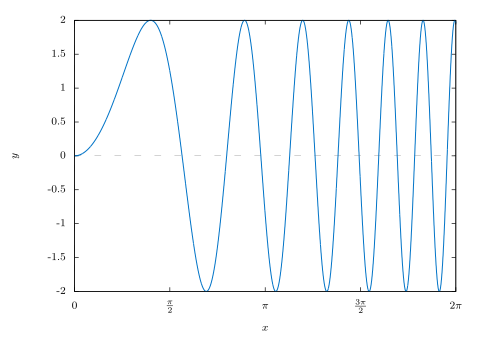
Notice how the curve “speeds up” as \(x\) gets larger, making the “waves” narrower and narrower. Thus, \(y=2\,\sin\;( x^2 )\) has no period. Despite this, it appears that the function does have an amplitude, namely \(2\). To see why, note that since \(\abs{\sin\;\theta} \le 1\) for all \(\theta\), we have
In the exercises you will be asked to find values of \(x\) such that \(2\,\sin\;( x^2 )\) reaches the
maximum value \(2\) and the minimum value \(-2\). Thus, the amplitude is indeed \(2\).
Note: This curve
is still sinusoidal despite not being periodic, since the general shape is still that of a “sine
wave”, albeit one with variable cycles.
So far in our examples we have been able to determine the amplitudes of sinusoidal curves fairly easily. This will not always be the case.
Example 5.9
Find the amplitude and period of \(y=3\,\sin\;x + 4\,\cos\;x\).
Solution: This is sometimes called a combination sinusoidal curve, since it is the sum of two such curves. The period is still simple to determine: since \(\sin\;x\) and \(\cos\;x\) each repeat every \(2\pi\) radians, then so does the combination \(3\,\sin\;x + 4\,\cos\;x\). Thus, \(y=3\,\sin\;x + 4\,\cos\;x\) has period \(2\pi\). We can see this in the graph, shown in Figure 5.2.7:
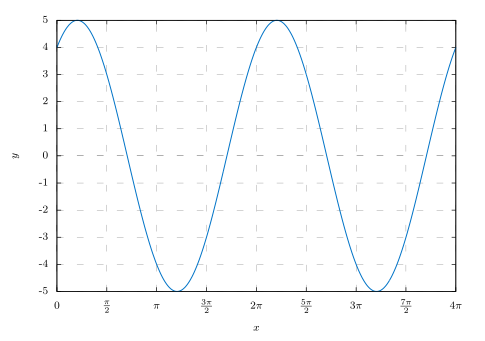
The graph suggests that the amplitude is \(5\), which may not be immediately obvious just by looking at how the function is defined. In fact, the definition \(y=3\,\sin\;x + 4\,\cos\;x\) may tempt you to think that the amplitude is \(7\), since the largest that \(3\,\sin\;x\) could be is \(3\) and the largest that \(4\,\cos\;x\) could be is \(4\), so that the largest their sum could be is \(3+4=7\). However, \(3\,\sin\;x\) can never equal \(3\) for the same \(x\) that makes \(4\,\cos\;x\) equal to \(4\) (why?).
![tikzpicture[scale=0.5, every node/.style=font=] [fill=fillcolor] (0,0) -- (3,0) -- (3,4) -- (0,0); (0:1.5) arc (0:53.13:1.5); [line width=0.5pt] (2.625,0) -- (2.625,0.375) -- (3,0.375); [linecolor,line width=1.5pt] (0,0) -- (3,0) -- (3,4) -- cycle; [below] at (1.5,0) 3; [right] at (3,2) 4; [above left] at (1.5,2) 5; at (0.9,0.4) ; tikzpicture](/mecmath-trigonometry/figures/fig-e35e740777.svg)
There is a useful technique (which we will discuss further in Chapter 6) for showing that the amplitude of \(y=3\,\sin\;x + 4\,\cos\;x\) is \(5\). Let \(\theta\) be the angle shown in the right triangle in Figure 5.2.8. Then \(\cos\;\theta = \frac{3}{5}\) and \(\sin\;\theta = \frac{4}{5}\). We can use this as follows:
Thus, \(\abs{y} = \abs{5\,\sin\;(x+\theta)} = \abs{5}\,\cdot\,\abs{\sin\;(x+\theta)} \le (5)(1) = 5\), so the amplitude of \(y=3\,\sin\;x + 4\,\cos\;x\) is \(5\).
In general, a combination of sines and cosines will have a period equal to the lowest common multiple of the periods of the sines and cosines being added. In Example 5.9, \(\sin\;x\) and \(\cos\;x\) each have period \(2\pi\), so the lowest common multiple (which is always an integer multiple) is \(1 \,\cdot\, 2\pi = 2\pi\).
Example 5.10
Find the period of \(y=\cos\;6x + \sin\;4x\).
Solution: The period of \(\cos\;6x\) is \(\frac{2\pi}{6} = \frac{\pi}{3}\), and the period of \(\sin\;4x\) is \(\frac{2\pi}{4} = \frac{\pi}{2}\). The lowest common multiple of \(\frac{\pi}{3}\) and \(\frac{\pi}{2}\) is \(\pi\):
Thus, the period of \(y=\cos\;6x + \sin\;4x\) is \(\pi\). We can see this from its graph in Figure 5.2.9:
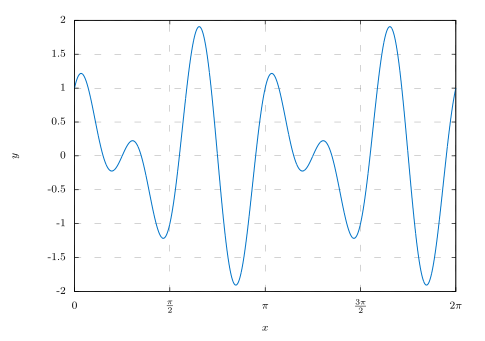
What about the amplitude? Unfortunately we can not use the technique from Example 5.9, since we are not taking the cosine and sine of the same angle; we are taking the cosine of \(6x\) but the sine of \(4x\). In this case, it appears from the graph that the maximum is close to \(2\) and the minimum is close to \(-2\). In Chapter 6, we will describe how to use a numerical computation program to show that the maximum and minimum are \(\pm\,1.90596111871578\), respectively (accurate to within \(\approx 2.2204 \times 10^{-16}\)). Hence, the amplitude is \(1.90596111871578\).
Generalizing Example 5.9, an expression of the form \(a\,\sin\;\omega x \;+\; b\,\cos\;\omega x\) is equivalent to \(\sqrt{a^2 + b^2}\;\sin\;(x+\theta)\), where \(\theta\) is an angle such that \(\cos\;\theta = \frac{a}{\sqrt{a^2 + b^2}}\) and \(\sin\;\theta = \frac{b}{\sqrt{a^2 + b^2}}\). So \(y=a\,\sin\;\omega x \;+\; b\,\cos\;\omega x\) will have amplitude \(\sqrt{a^2 + b^2}\). Note that this method only works when the angle \(\omega x\) is the same in both the sine and cosine terms.
We have seen how adding a constant to a function shifts the entire graph vertically. We will now see how to shift the entire graph of a periodic curve horizontally.
![tikzpicture[scale=1.2, every node/.style=font=] scope[shift=(0,0),color=linecolor,line width=1.5pt,x=3cm/360] [black!60,line width=0.3pt,dotted] (0,-1) grid[xstep=90,ystep=1] (360,1); [black!60,line width=0.3pt,-latex] (0,0) -- (380,0) node[right] x; [black!60,line width=0.3pt,-latex] (0,-1.2) -- (0,1.6) node[above] y; 0,5,...,360 sin( ) stroke [black,left] at (0,0) 0; in 90,180,270,360 [black!60,line width=0.3pt,shift=( ,0)] (0pt,3pt) -- (0pt,-3pt); in -1,1 [black!60,line width=0.3pt,shift=(0, )] (3pt,0pt) -- (-3pt,0pt); [black,left] at (0,1) A; [black,left] at (0,-1) -A; [black,below] at (180,-0.1) ; [black,below] at (360,-0.1) 2 ; scope scope[>=latex] [<->|] (0,1.3) -- (3,1.3) node[midway,fill=white] period = 2 ; scope tikzpicture](/mecmath-trigonometry/figures/fig-6373752f1d.svg)
Consider a function of the form \(y=A\,\sin\;\omega x\), where \(A\) and \(\omega\) are nonzero constants. For simplicity we will assume that \(A >0\) and \(\omega > 0\) (in general either one could be negative). Then the amplitude is \(A\) and the period is \(\frac{2\pi}{\omega}\). The graph is shown in Figure 5.2.10.
Now consider the function \(y=A\,\sin\;(\omega x - \phi)\), where \(\phi\) is some constant. The amplitude is still \(A\), and the period is still \(\frac{2\pi}{\omega}\), since \(\omega x - \phi\) is a linear function of \(x\). Also, we know that the sine function goes through an entire cycle when its angle goes from \(0\) to \(2\pi\). Here, we are taking the sine of the angle \(\omega x - \phi\). So as \(\omega x - \phi\) goes from \(0\) to \(2\pi\), an entire cycle of the function \(y=A\,\sin\;(\omega x - \phi)\) will be traced out. That cycle starts when
Thus, the graph of \(y=A\,\sin\;(\omega x - \phi)\) is just the graph of \(y=A\,\sin\;\omega x\) shifted horizontally by \(\frac{\phi}{\omega}\), as in Figure 5.2.11. The graph is shifted to the right when \(\phi >0\), and to the left when \(\phi <0\). The amount \(\frac{\phi}{\omega}\) of the shift is called the phase shift of the graph.
![tikzpicture[scale=1.2,every node/.style=font=] scope[shift=(0,0),color=linecolor,line width=1.5pt,x=3cm/360] [black!60,line width=0.3pt,-latex] (0,0) -- (500,0) node[right] x; [black!60,line width=0.3pt,-latex] (0,-1.2) -- (0,1.7) node[above] y; 90,95,...,450 sin(-90+ ) stroke [black,left] at (0,0) 0; in 90,180,270,360,450 [black!60,line width=0.3pt,shift=( ,0)] (0pt,3pt) -- (0pt,-3pt); in -1,1 [black!60,line width=0.3pt,shift=(0, )] (3pt,0pt) -- (-3pt,0pt); [black,left] at (0,1) A; [black,left] at (0,-1) -A; [black,below right] at (425,-0.1) 2 + ; [black,below] at (90,-0.1) ; scope scope[>=latex] [|<->|] (0.75,1.4) -- (3.75,1.4) node[midway,fill=white] period = 2 ; [<->|] (0,-0.9) -- (0.75,-0.9); [below right] at (0,-0.9) phase shift; scope tikzpicture](/mecmath-trigonometry/figures/fig-d9924eee66.svg)
![tikzpicture[scale=1.2,every node/.style=font=] scope[shift=(0,0),color=linecolor,line width=1.5pt,x=3cm/360] [black!60,line width=0.3pt,-latex] (-120,0) -- (320,0) node[right] x; [black!60,line width=0.3pt,-latex] (0,-1.2) -- (0,1.7) node[above] y; -90,-85,...,270 sin(90+ ) stroke [black,below right] at (0,0) 0; in -90,90,180,270 [black!60,line width=0.3pt,shift=( ,0)] (0pt,3pt) -- (0pt,-3pt); in -1,1 [black!60,line width=0.3pt,shift=(0, )] (3pt,0pt) -- (-3pt,0pt); [black,left] at (0,1.1) A; [black,right] at (0,-1) -A; [black,below right] at (245,-0.1) 2 + ; [black,below] at (-90,-0.1) ; scope scope[>=latex] [|<->|] (-0.75,1.4) -- (2.25,1.4) node[pos=0.6,fill=white] period = 2 ; [|<->] (-0.75,-0.9) -- (0,-0.9); [below left] at (0,-0.9) phase shift; scope tikzpicture](/mecmath-trigonometry/figures/fig-a02cfb8617.svg)
The phase shift is defined similarly for the other trigonometric functions.
Example 5.11
Find the amplitude, period, and phase shift of \(y=3\,\cos\;(2x - \pi)\).
Solution: The amplitude is \(3\), the period is \(\frac{2\pi}{2} = \pi\), and the phase shift is \(\frac{\pi}{2}\). The graph is shown in Figure 5.2.12:
![tikzpicture[scale=1.2,every node/.style=font=] scope[shift=(0,0),color=linecolor,line width=1.5pt,x=8cm/360,y=1.5cm/3] [black!60,line width=0.3pt,dotted] (0,-3) grid[xstep=90,ystep=1] (360,3); [black!60,line width=0.3pt,-latex] (0,0) -- (380,0) node[right] x; [black!60,line width=0.3pt,-latex] (0,-3.8) -- (0,3.8) node[above] y; 0,5,...,360 3*cos(-180+2* ) stroke [black,left] at (0,0) 0; in 90,180,270,360 [black!60,line width=0.3pt,shift=( ,0)] (0pt,3pt) -- (0pt,-3pt); in -3,-2,-1,1,2,3 [black!60,line width=0.3pt,shift=(0, )] (3pt,0pt) -- (-3pt,0pt) node[black,left] ; [black,below] at (90,-0.1) 2; [black,below] at (180,-0.1) ; [black,below] at (270,-0.1) 3 2; [black,below] at (360,-0.1) 2 ; scope scope[>=latex] [|<->|] (2,1.9) -- (6,1.9) node[midway,fill=white] period = ; [<->|] (0,-1.7) -- (2,-1.7); [below right] at (0,-1.7) phase shift = 2; [|<->|] (-0.9,0) -- (-0.9,1.5) node[midway,left] amplitude = 3; scope tikzpicture](/mecmath-trigonometry/figures/fig-09b81c66d3.svg)
Notice that the graph is the same as the graph of \(y=3\,\cos\;2x\) shifted to the right by \(\frac{\pi}{2}\), the amount of the phase shift.
Example 5.12
Find the amplitude, period, and phase shift of \(y=-2\,\sin\;\left(3x + \frac{\pi}{2}\right)\).
Solution: The amplitude is \(2\), the period is \(\frac{2\pi}{3}\), and the phase shift is \(\frac{-\frac{\pi}{2}}{3} = -\frac{\pi}{6}\). Notice the negative sign in the phase shift, since \(3x+\pi=3x-(-\pi)\) is in the form \(\omega x - \phi\). The graph is shown in Figure 5.2.13:
![tikzpicture[scale=1.1,every node/.style=font=] scope[shift=(0,0),color=linecolor,line width=1.5pt,x=8cm/240,y=1.5cm/2] [black!60,line width=0.3pt,dotted] (-30,-2) grid[xstep=30,ystep=1] (240,2); [black!60,line width=0.3pt,-latex] (-50,0) -- (250,0) node[right] x; [black!60,line width=0.3pt,-latex] (0,-2.8) -- (0,2.8) node[above] y; -30,-25,...,240 -2*sin(90+3* ) stroke [black,below left] at (0,0) 0; in -30,30,60,90,120,150,180,210,240 [black!60,line width=0.3pt,shift=( ,0)] (0pt,3pt) -- (0pt,-3pt); in -2,-1,1,2 [black!60,line width=0.3pt,shift=(0, )] (3pt,0pt) -- (-3pt,0pt) node[black,left] ; [black,below] at (-35,-0.1) - 6; [black,below] at (30,-0.1) 6; [black,below] at (60,-0.1) 3; [black,below] at (90,-0.1) 2; [black,below] at (120,-0.1) 2 3; [black,below] at (150,-0.1) 5 6; [black,below] at (180,-0.1) ; [black,below] at (210,-0.1) 7 6; [black,below] at (240,-0.1) 4 3; scope scope[>=latex] [|<->|] (-1,1.9) -- (3,1.9) node[pos=0.55,fill=white] period = 2 3; [|<->] (-1,-1.7) -- (0,-1.7); [below left] at (0,-1.75) phase shift = - 6; [|<->|] (-1.1,0) -- (-1.1,1.5) node[midway,left] amplitude = 2; scope tikzpicture](/mecmath-trigonometry/figures/fig-723944fedb.svg)
In engineering two periodic functions with the same period are said to be out of phase if their phase shifts differ. For example, \(\sin\;\left( x - \frac{\pi}{6} \right)\) and \(\sin\;x\) would be \(\frac{\pi}{6}\) radians (or \(30\Degrees\)) out of phase, and \(\sin\;x\) would be said to lag \(\sin\;\left( x - \frac{\pi}{6} \right)\) by \(\frac{\pi}{6}\) radians, while \(\sin\;\left( x - \frac{\pi}{6} \right)\) leads \(\sin\;x\) by \(\frac{\pi}{6}\) radians. Periodic functions with the same period and the same phase shift are in phase.
The following is a summary of the properties of trigonometric graphs:
For any constants \(A \ne 0\), \(\omega \ne 0\), and \(\phi\):
For Exercises 1-12, find the amplitude, period, and phase shift of the given function. Then graph one cycle of the function, either by hand or by using Gnuplot (see Appendix B).
4
\(y=3\,\cos\;\pi x\)
\(y=\sin\;(2\pi x - \pi)\)
\(y=-\sin\;(5x + 3)\)
\(y=1+8\,\cos\;(6x- \pi)\)
4
\(y=2+\cos\;(5x + \pi)\)
\(y=1-\sin\;(3\pi - 2x)\)
\(y=1-\cos\;(3\pi - 2x)\)
\(y=2\,\tan\;(x - 1)\)
4
\(y=1-\tan\;(3\pi - 2x)\)
\(y=\sec\;(2x + 1)\)
\(y=2\csc\;(2x - 1)\)
\(y=2+4\,\cot\;(1-x)\)
For the function \(y=2\,\sin\;( x^2 )\) in Example 5.8, for which values of \(x\) does the function reach its maximum value \(2\), and for which values of \(x\) does it reach its minimum value \(-2\,\)?
For the function \(y=3\,\sin\;x + 4\,\cos\;x\) in Example 5.9, for which values of \(x\) does the function reach its maximum value \(5\), and for which values of \(x\) does it reach its minimum value \(-5\,\)? You can restrict your answers to be between \(0\) and \(2\pi\).
Graph the function \(y=\sin^2 \,x\) from \(x=0\) to \(x=2\pi\), either by hand or by using Gnuplot. What are the amplitude and period of this function?
The current \(i(t)\) in an AC electrical circuit at time \(t\ge 0\) is given by \(i(t) = I_m \,\sin\;\omega t\), and the voltage \(v(t)\) is given by \(v(t) = V_m \,\sin\;\omega t\), where \(V_m > I_m > 0\) and \(\omega > 0\) are constants. Sketch one cycle of both \(i(t)\) and \(v(t)\) together on the same graph (i.e. on the same set of axes). Are the current and voltage in phase or out of phase?
Repeat Exercise 16 with \(i(t)\) the same as before but with \(v(t)= V_m \,\sin\;\left(\omega t + \frac{\pi}{4}\right)\).
Repeat Exercise 16 with \(i(t)=-I_m \,\cos\;\left(\omega t - \frac{\pi}{3}\right)\) and \(v(t)= V_m \,\sin\;\left(\omega t - \frac{5\pi}{6}\right)\).
For Exercises 19-21, find the amplitude and period of the given function. Then graph one cycle of the function, either by hand or by using Gnuplot.
3
\(y=3\,\sin\;\pi x \;-\; 5\,\cos\;\pi x\)
\(y=-5\,\sin\;3x \;+\; 12\,\cos\;3x\)
\(y=2\,\cos\;x \;+\; 2\,\sin\;x\)
Find the amplitude of the function \(y=2\,\sin\;( x^2 ) \;+\; \cos\;( x^2 )\).
For Exercises 23-25, find the period of the given function. Graph one cycle using Gnuplot.
3
\(y=\sin\;3x \;-\; \cos\;5x\)
\(y=\sin\;\frac{x}{3} \;+\; 2\,\cos\;\frac{3x}{4}\)
\(y=2\,\sin\;\pi x \;+\; 3\,\cos\;\frac{\pi}{3}x\)
Let \(y = 0.5\,\sin\;x ~\sin\;12x\,\). Its graph for \(x\) from \(0\) to \(4\pi\) is shown in Figure 5.2.14:
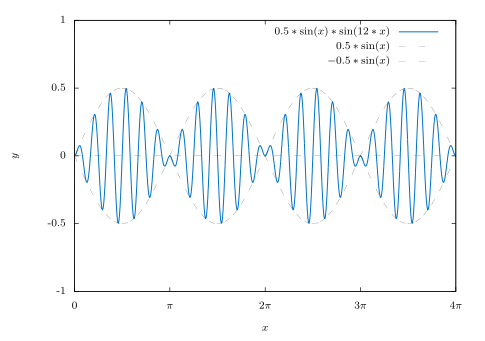
Figure 5.2.14Modulated wave \(y=0.5\,\sin\;x ~\sin\;12x\) You can think of this function as \(\sin\;12x\) with a sinusoidally varying “amplitude”of \(0.5\,\sin\;x\). What is the period of this function? From the graph it looks like the amplitude may be \(0.5\). Without finding the exact amplitude, explain why the amplitude is in fact less than \(0.5\). The function above is known as a modulated wave, and the functions \(\pm\,0.5\,\sin\;x\) form an amplitude envelope for the wave (i.e. they enclose the wave). Use an identity from Section 3.4 to write this function as a sum of sinusoidal curves.
Use Gnuplot to graph the function \(y= x^2 \,\sin\;10x\) from \(x = -2\pi\) to \(x=2\pi\). What functions form its amplitude envelope? (Note: Use
set samples 500in Gnuplot.)Use Gnuplot to graph the function \(y= \frac{1}{x^2} \,\sin\;80x\) from \(x = 0.2\) to \(x=\pi\). What functions form its amplitude envelope? (Note: Use
set samples 500in Gnuplot.)Does the function \(y=\sin\;\pi x \;+\; \cos\;x\) have a period? Explain your answer.
Use Gnuplot to graph the function \(y=\frac{\sin\;x}{x}\) from \(x=-4\pi\) to \(x=4\pi\). What happens at \(x=0\)?
- We will usually leave out the “radians” part when discussing periods from now on. ↩
- This graph was created using Gnuplot, an open-source graphing program which is freely available at http://gnuplot.info. See Appendix B for a brief tutorial on how to use Gnuplot. ↩
For any number \(\omega >0\):