A function \(y = f(x)\) is usually given by an explicit formula, such as \(y = x^2\). It is then straightforward to find \(\dydx\) using the differentiation rules you have learned so far. But suppose instead that you were given merely an equation involving \(x\) and \(y\), such as
The set of points \((x,y)\) satisfying this equation describes some sort of curve in the \(xy\)-plane, but it might not be possible to solve for \(y\) in terms of \(x\)—that is, there might not be an explicit formula for \(y\) as a function of the variable \(x\). So in this case does the derivative \(\dydx\) even have any meaning, and if so then how would you find it?
It turns out that \(\dydx\) does make sense in such a case, because an equation involving \(x\) and \(y\) such as the one above implicitly defines \(y\) in terms of \(x\) in the following sense: as \(x\) varies so does \(y\). Hence it should be possible to find the rate of change of \(y\) with respect to the variable \(x\) (i.e. \(\dydx\)). To do so, take \(\ddx\) of both sides of the equation, then assume that \(y\) really is a function of \(x\) so that you can use the Chain Rule to solve for \(\dydx\). The example below illustrates this procedure, called implicit differentiation.
Example 3.26
[r]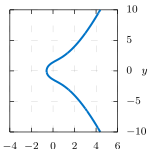 Find \(\dydx\) given the equation \(x^3 + 3x + 2 = y^2\).
Solution: The above equation implicitly defines an elliptic curve, and its graph is shown on the right. This curve is not a function \(y=f(x)\), since it violates the vertical line test, but \(y\) still varies with \(x\). To find \(\dydx\) take \(\ddx\) of both sides of the equation then solve for \(\dydx\):
At first this might seem unsatisfying—or confusing—since \(\dydx\) is given in terms of both \(x\) and \(y\). However, the derivative can still be evaluated at specific points \((x,y)\) on the curve, i.e. any \((x,y)\) satisfying the original equation. For example, it is easy to check that \((x,y) = (1,\sqrt{6})\) satisfies the equation \(x^3 + 3x + 2 = y^2\), so \(\dydx(1,\sqrt{6}) = \frac{3(1)^2 + 3}{2\sqrt{6}} = \frac{\sqrt{6}}{2}\). Note that \(\dydx\) is not defined when \(y=0\).
Notice that taking the square root of both sides of the original equation does not result in an explicit formula for \(y\), since \(y = \pm \sqrt{x^3 + 3x + 2}\) defines two functions, not just one. The beauty of implicit differentiation is that the derivative \(\dydx = \frac{3x^2 + 3}{2y}\) calculated above gives you a single expression for the derivative of both those functions.
An algebraic curve is defined as the set of all points \((x,y)\) satisfying a polynomial equation in the variables \(x\) and \(y\), such as \(x^2 - 3xy^4 + 1 = x^5 - y^2\). An elliptic curve is a special case of an algebraic curve, where the polynomial has the specific form \(x^3 + ax + b = y^2\), such as the equation \(x^3 + 3x + 2 = y^2\) from Example 3.26. Elliptic curves have certain properties that have found applications in cryptography.[1]
Example 3.27
[r]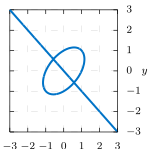 Find \(\dydx\) given the equation \(x + y = x^3 + y^3\).
Solution: The above equation implicitly defines an algebraic curve and its graph is shown on the right. To find \(\dydx\) take \(\ddx\) of both sides of the equation then solve for \(\dydx\):
Notice that the curve consists of an oval shape (an ellipse, actually) with a line through it. In fact, that line is \(y = -x\), as can be verified by replacing each instance of \(y\) in the equation \(x + y = x^3 + y^3\) by \(-x\) (resulting in the equation \(0=0\)). You might be wondering how \(\dydx\) is defined at the points where that line intersects the ellipse: is it the slope of the line \(y=-x\) (i.e. \(-1\)), or is it the slope of the tangent line to the ellipse at those points (which would not equal \(-1\))? This is discussed in the exercises.
The graph was created with the free open-source graphing program Gnuplot[2] using the following Gnuplot commands (which give an idea of how to plot implicit functions in general):
set size square
set view 0,0
set isosamples 500,500
set contour base
set cntrparam levels discrete 0
unset surface
set grid
unset key
unset ztics
set xlabel 'x'
set ylabel 'y'
f(x,y) = x + y - x**3 - y**3
splot [-3:3][-3:3] f(x,y) lw 3
Example 3.28
[r]![tikzpicture[>=latex, every node/.style=font=] [->,black!60,line width=1pt] (-1.5,0) -- (1.8,0) node[right] x; [->,black!60,line width=1pt] (0,-1.2) -- (0,1.5) node[above] y; [linecolor,line width=1.5pt] (0,0) circle (1); [below left] at (0,0) 0; [below right] at (1,0) 1; [left] at (-0.4,1.2) x^2 + y^2 = 1; [red,line width=0.6pt] (0.8,0.6) -- +(-0.6,0.8) -- +(0.3,-0.4); (0.8,0.6) circle (2.5pt); [right] at (0.8,0.6) (4/5,3/5); tikzpicture](/mecmath-elementary-calculus/figures/fig-543e2ea0be.svg) Find the tangent line to the curve \(x^2 + y^2 = 1\) at the point
\((4/5,3/5)\).
Find the tangent line to the curve \(x^2 + y^2 = 1\) at the point
\((4/5,3/5)\).
Solution: This curve is the unit circle, shown in the picture on the right. First use implicit differentiation to find \(\dydx\):
The slope \(m\) of the tangent line to the curve at \((4/5,3/5)\) is then \(m = \dydx(4/5,3/5) = -\frac{4/5}{3/5} = -4/3\). Thus, the equation of the tangent line is \(y - \frac{3}{5} = -\frac{4}{3}\left(x - \frac{4}{5}\right)\).
A
For Exercises 1-9, use implicit differentiation to find \(\dydx\).
3
\(x^3 y ~-~ 4xy^2 ~=~ y ~+~ x^2\)
\(xy ~=~ (x+y)^3\)
\((x+y)^3 ~=~ (x - y + 1)^2\)
3
\(x^{2/3} ~+~ y^{2/3} ~=~ a^{2/3}\vphantom{\dfrac{x}{x}}\)
\((x^2 - y^2 )^2 ~=~ 2x^2 + y^2\vphantom{\dfrac{x}{x}}\)
\(\dfrac{x+y}{x-y} ~=~ x^2 + y^2\)
3
\(\cos\,(xy) ~=~ \sin\,(x^2 y^2)\)
\(x^3 ~-~ x ~=~ y^2\)
\(x^3 y^2 e^{\sin\,(xy)} ~=~ x^2 ~+~ xy ~+~ y^3\)
In Example 3.28 is it possible to solve the equation \(x^2 + y^2 = 1\) explicitly for \(y\) in terms of \(x\)? Explain.
In Example 3.28 what happens to the tangent line at the point \((1,0)\)? Why does this make sense geometrically?
Find the equation of the tangent line to the curve \(x^3 + 3x^2 y + y^3 ~=~ 8\) at the point \((2,0)\).
B
Find \(\frac{d^2y}{\dx^2}\) for the curve \(x^2 + y^2 = 1\). You may use the results from Example 3.28.
Show that at every point \((x_0,y_0)\) on the curve \(y^2 = 4ax\), the equation of the tangent line to the curve is \(y y_0 = 2a(x + x_0)\).
Show that at every point \((x_0,y_0)\) on the ellipse \(\dfrac{x^2}{a^2} + \dfrac{y^2}{b^2} = 1\), the equation of the tangent line to the ellipse is \(\dfrac{x x_0}{a^2} + \dfrac{y y_0}{b^2} = 1\).
Show that at every point \((x_0,y_0)\) on the hyperbola \(\dfrac{x^2}{a^2} - \dfrac{y^2}{b^2} = 1\), the equation of the tangent line to the hyperbola is \(\dfrac{x x_0}{a^2} - \dfrac{y y_0}{b^2} = 1\).
Show that \(\dydx\) is not defined at the points of intersection of the line and ellipse described by the curve \(x+y=x^3+y^3\) from Example 3.27. (Hint: Factor the equation \(x+y=x^3+y^3\).)
Show that the points \(P=(2,4)\) and \(Q=(-31/64,-337/512)\) are on the elliptic curve \(x^3+3x+2=y^2\) from Example 3.26, and that the tangent line to the curve at \(P\) also goes through \(Q\).
- For example, see Section 12.2 in Buchmann, J.A., Introduction to Cryptography, New York: Springer-Verlag, 2001. ↩
- See the documentation at http://www.gnuplot.info/documentation.html ↩