In this section we consider the constant coefficient equation
where \(n\ge3\) and \(F\) is a linear combination of functions of the form
or
From Theorem 9.1.5, the general solution of (9.3.1) is \(y=y_p+y_c\), where \(y_p\) is a particular solution of (9.3.1) and \(y_c\) is the general solution of the complementary equation
In Section 9.2 we learned how to find \(y_c\). Here we will learn how to find \(y_p\) when the forcing function has the form stated above. The procedure that we use is a generalization of the method that we used in Sections 5.4 and 5.5, and is again called method of undetermined coefficients. Since the underlying ideas are the same as those in Sections 5.4 and 5.5, we’ll give an informal presentation based on examples.
Forcing Functions of the Form \(e^{\alpha x}\left(p_0+p_1x+\cdots+p_kx^k\right)\)
We first consider equations of the form
Example 9.3.1
Find a particular solution of
Solution Substituting
into (9.3.2) and canceling \(e^x\) yields
or
Since the unknown \(u\) appears on the left, we can see that (9.3.3) has a particular solution of the form
Then
Substituting from the last four equations into the left side of (9.3.3) yields
Comparing coefficients of like powers of \(x\) on the right sides of this equation and (9.3.3) shows that \(u_p\) satisfies (9.3.3) if
Solving these equations successively yields \(D=1\), \(C=-1\), \(B=2\), \(A=1\). Therefore
is a particular solution of (9.3.3), so
is a particular solution of (9.3.2) (Figure 9.3.1).
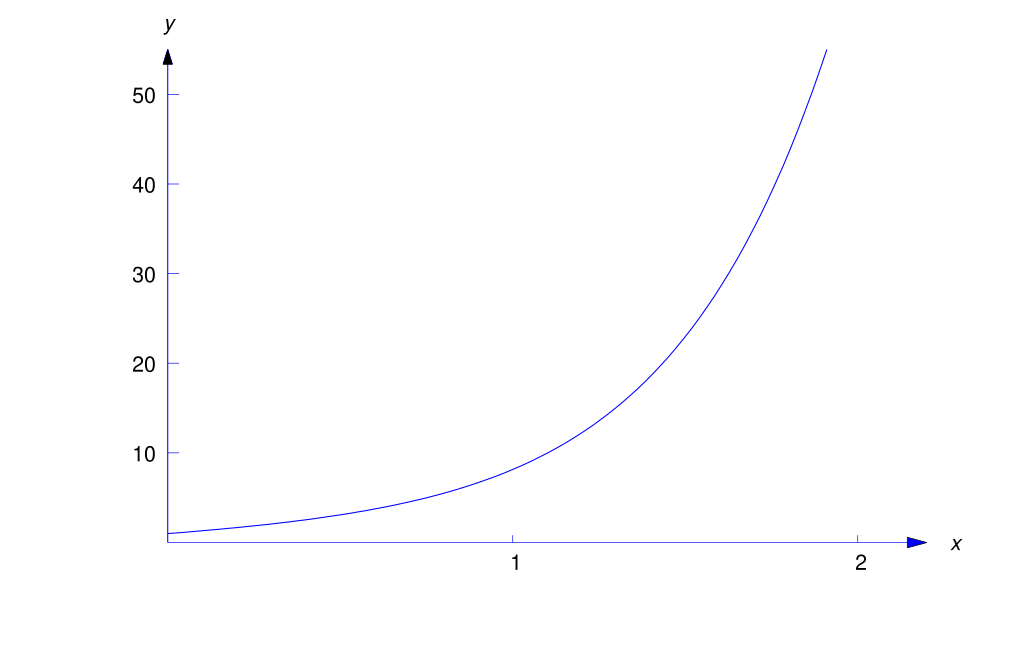
Example 9.3.2
Find a particular solution of
Solution Substituting
into (9.3.4) and canceling \(e^{2x}\) yields
or
Since neither \(u\) nor \(u'\) appear on the left, we can see that (9.3.5) has a particular solution of the form
Then
Substituting \(u_p''\), \(u_p'''\), and \(u_p^{(4)}\) into the left side of (9.3.5) yields
Comparing coefficients of like powers of \(x\) on the right sides of this equation and (9.3.5) shows that \(u_p\) satisfies (9.3.5) if
Solving these equations successively yields \(C=1/24\), \(B=1/6\), \(A=-1/6\). Substituting these into (9.3.6) shows that
is a particular solution of (9.3.5), so
is a particular solution of (9.3.4). (Figure 9.3.2).
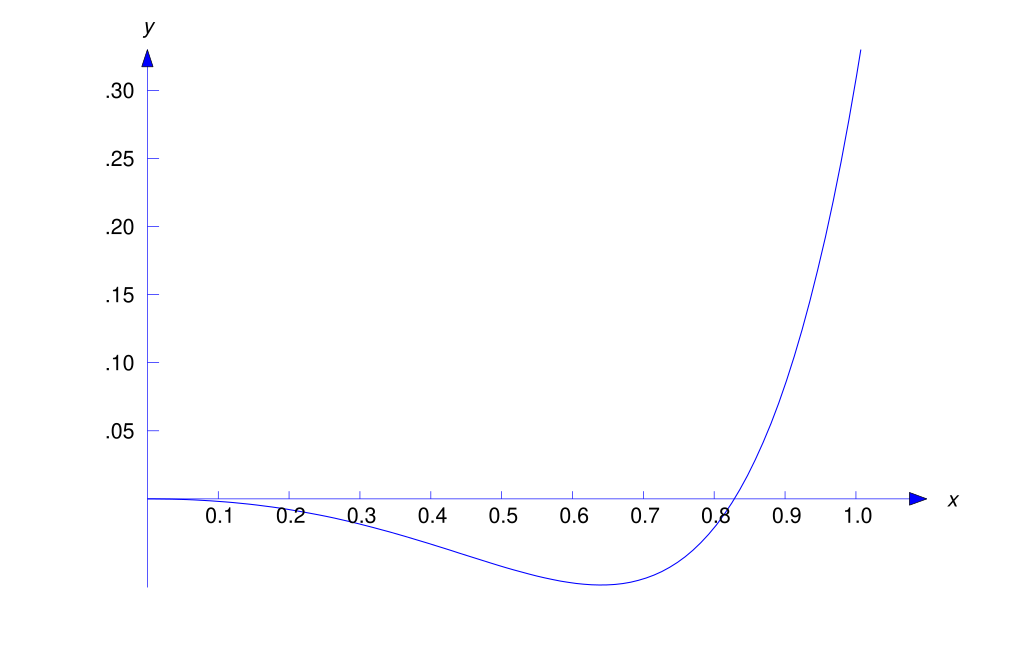
Forcing Functions of the Form \(e^{\lambda x}\left(P(x)\cos\omega x+Q(x)\sin\omega x\right)\)
We now consider equations of the form
where \(P\) and \(Q\) are polynomials.
Example 9.3.3
Find a particular solution of
Solution Substituting
into (9.3.7) and canceling \(e^x\) yields
or
Since \(\cos x\) and \(\sin x\) are not solutions of the complementary equation
a theorem analogous to Theorem 5.5.1 implies that (9.3.8) has a particular solution of the form
Then
so
Comparing the coefficients of \(x\cos x\), \(x\sin x\), \(\cos x\), and \(\sin x\) here with the corresponding coefficients in (9.3.8) shows that \(u_p\) is a solution of (9.3.8) if
Solving the first two equations yields \(A_1=1/2\), \(B_1=-1/2\). Substituting these into the last two equations yields
so \(A_0=-1\), \(B_0=-1/2\). Substituting \(A_0=-1\), \(A_1=1/2\), \(B_0=-1/2\), \(B_1=-1/2\) into (9.3.9) shows that
is a particular solution of (9.3.8), so
is a particular solution of (9.3.7) (Figure 9.3.3).
![y_p=e^xu_p=-e^x2[(2-x)x+(1+x)x]](/differentialEquations/figures/fig090303.svg)
Example 9.3.4
Find a particular solution of
Solution Substituting
into (9.3.10) and canceling \(e^{-x}\) yields
or
Since \(\cos x\) and \(\sin x\) are solutions of the complementary equation
a theorem analogous to Theorem 5.5.1 implies that (9.3.11) has a particular solution of the form
Then
so
Comparing the coefficients of \(x\cos x\), \(x\sin x\), \(\cos x\), and \(\sin x\) here with the corresponding coefficients in (9.3.11) shows that \(u_p\) is a solution of (9.3.11) if
Solving the first two equations yields \(A_1=1\), \(B_1=-1/2\). Substituting these into the last two equations yields
![y_p=-xe^-x2[(3-2x)x+(1+x)x]](/differentialEquations/figures/fig090304.svg)
so \(A_0=-3/2\) and \(B_0=-1/2\). Substituting \(A_0=-3/2\), \(A_1=1\), \(B_0=-1/2\), \(B_1=-1/2\) into (9.3.12) shows that
is a particular solution of (9.3.11), so
(Figure 9.3.4) is a particular solution of (9.3.10).
9.3 Exercises
In Exercises 1–59 find a particular solution.
-
\(y'''-6y''+11y'-6y=-e^{-x}(4+76x-24x^2)\)
Show answer
\(y_p=e^{-x}(2+x-x^2)\)
-
\(y'''-2y''-5y'+6y=e^{-3x}(32-23x+6x^2)\)
Show answer
\(y_p=-\dst{e^{-3x}\over4}(3-x+x^2)\)
-
\(4y'''+8y''-y'-2y=-e^x(4+45x+9x^2)\)
Show answer
\(y_p=e^x(1+x-x^2)\)
-
\(y'''+3y''-y'-3y=e^{-2x}(2-17x+3x^2)\)
Show answer
\(y_p=e^{-2x}(1-5x+x^2)\).
-
\(y'''+3y''-y'-3y=e^x(-1+2x+24x^2+16x^3)\)
Show answer
\(y_p=-\dst{xe^x\over2}(1-x+x^2-x^3)\)
-
\(y'''+y''-2y=e^x(14+34x+15x^2)\)
Show answer
\(y_p=x^2e^x(1+x)\)
-
\(4y'''+8y''-y'-2y=-e^{-2x}(1-15x)\)
Show answer
\(y_p=\dst{xe^{-2x}\over2}(2+x)\)
-
\(y'''-y''-y'+y=e^x(7+6x)\)
Show answer
\(y_p=\dst{x^2e^x\over2}(2+x)\)
-
\(2y'''-7y''+4y'+4y=e^{2x}(17+30x)\)
Show answer
\(y_p=\dst{x^2e^{2x}\over2}(1+2x)\)
-
\(y'''-5y''+3y'+9y=2e^{3x}(11-24x^2)\)
Show answer
\(y_p=x^2e^{3x}(2+x-x^2)\)
-
\(y'''-7y''+8y'+16y=2e^{4x}(13+15x)\)
Show answer
\(y_p=x^2e^{4x}(2+x)\)
-
\(8y'''-12y''+6y'-y=e^{x/2}(1+4x)\)
Show answer
\(y_p=\dst{x^3e^{x/2}\over48}(1+x)\)
-
\(y^{(4)}+3y'''-3y''-7y'+6y=-e^{-x}(12+8x-8x^2)\)
Show answer
\(y_p=e^{-x}(1-2x+x^2)\)
-
\(y^{(4)}+3y'''+y''-3y'-2y=-3e^{2x}(11+12x)\)
Show answer
\(y_p=e^{2x}(1-x)\)
-
\(y^{(4)}+8y'''+24y''+32y'=-16e^{-2x}(1+x+x^2-x^3)\)
Show answer
\(y_p=e^{-2x}(1+x+x^2-x^3)\)
-
\(4y^{(4)}-11y''-9y'-2y=-e^x(1-6x)\)
Show answer
\(y_p=\dst{e^x\over3}(1-x)\)
-
\(y^{(4)}-2y'''+3y'-y=e^x(3+4x+x^2)\)
Show answer
\(y_p=e^x(1+x)^2\)
-
\(y^{(4)}-4y'''+6y''-4y'+2y=e^{2x}(24+x+x^4)\)
Show answer
\(y_p=xe^x(1+x^3)\)
-
\(2y^{(4)}+5y'''-5y'-2y=18e^x(5+2x)\)
Show answer
\(y_p=xe^x(2+x)\)
-
\(y^{(4)}+y'''-2y''-6y'-4y=-e^{2x}(4+28x+15x^2)\)
Show answer
\(y_p=\dst{xe^{2x}\over6}(1-x^2)\)
-
\(2y^{(4)}+y'''-2y'-y=3e^{-x/2}(1-6x)\)
Show answer
\(y_p=4xe^{-x/2}(1+x)\)
-
\(y^{(4)}-5y''+4y=e^x(3+x-3x^2)\)
Show answer
\(y_p=\dst{xe^x\over6}(1+x^2)\)
-
\(y^{(4)}-2y'''-3y''+4y'+4y=e^{2x}(13+33x+18x^2)\)
Show answer
\(y_p=\dst{x^2e^{2x}\over6}(1+x+x^2)\)
-
\(y^{(4)}-3y'''+4y'=e^{2x}(15+26x+12x^2)\)
Show answer
\(y_p=\dst{x^2e^{2x}\over6}(3+x+x^2)\)
-
\(y^{(4)}-2y'''+2y'-y=e^x(1+x)\)
Show answer
\(y_p=\dst{x^3e^x\over48}(2+x)\)
-
\(2y^{(4)}-5y'''+3y''+y'-y=e^x(11+12x)\)
Show answer
\(y_p=\dst{x^3e^x\over6}(1+x)\)
-
\(y^{(4)}+3y'''+3y''+y'=e^{-x}(5-24x+10x^2)\)
Show answer
\(y_p=-\dst{x^3e^{-x}\over6}(1-x+x^2)\)
-
\(y^{(4)}-7y'''+18y''-20y'+8y=e^{2x}(3-8x-5x^2)\)
Show answer
\(y_p=\dst{x^3e^{2x}\over12}(2+x-x^2)\)
-
\(y'''-y''-4y'+4y=e^{-x}\left[(16+10x)\cos x+(30-10x)\sin x\right]\)
Show answer
\(y_p=e^{-x}\left[(1+x)\cos x+(2-x)\sin x\right]\)
-
\(y'''+y''-4y'-4y=e^{-x}\left[(1-22x)\cos 2x-(1+6x)\sin2x\right]\)
Show answer
\(y_p=e^{-x}\left[(1-x)\cos2x+(1+x)\sin2 x\right]\)
-
\(y'''-y''+2y'-2y=e^{2x}[(27+5x-x^2)\cos x+(2+13x+9x^2)\sin x]\)
Show answer
\(y_p=e^{2x}[(1+x-x^2)\cos x+(1+2x)\sin x]\)
-
\(y'''-2y''+y'-2y=-e^x[(9-5x+4x^2)\cos 2x-(6-5x-3x^2)\sin2x]\)
Show answer
\(y_p=\dst{e^x\over2}[(1+x)\cos 2x+(1-x+x^2)\sin2x]\)
-
\(y'''+3y''+4y'+12y=8\cos2x-16\sin2x\)
Show answer
\(y_p=\dst{x\over13}(8\cos2x+14\sin2x)\)
-
\(y'''-y''+2y=e^x[(20+4x)\cos x-(12+12x)\sin x]\)
Show answer
\(y_p=xe^x[(1+x)\cos x+(3+x)\sin x]\)
-
\(y'''-7y''+20y'-24y=-e^{2x}[(13-8x)\cos 2x-(8-4x)\sin2x]\)
Show answer
\(y_p=\dst{xe^{2x}\over2}[(3-x)\cos 2x+\sin2x]\)
-
\(y'''-6y''+18y'=-e^{3x}[(2-3x)\cos 3x-(3+3x)\sin3x]\)
Show answer
\(y_p=-\dst{xe^{3x}\over12}(x\cos 3x+\sin3x)\)
-
\(y^{(4)}+2y'''-2y''-8y'-8y=e^x(8\cos x+16\sin x)\)
Show answer
\(y_p=-\dst{e^x\over10}(\cos x+7\sin x)\)
-
\(y^{(4)}-3y'''+2y''+2y'-4y=e^x(2\cos2x -\sin2x)\)
Show answer
\(y_p=\dst{e^x\over12}(\cos2x-\sin2x)\)
-
\(y^{(4)}-8y'''+24y''-32y'+15y=e^{2x}(15x\cos2x+32\sin2x)\)
Show answer
\(y_p=xe^{2x}\cos2x\)
-
\(y^{(4)}+6y'''+13y''+12y'+4y=e^{-x}[(4-x)\cos x-(5+x)\sin x]\)
Show answer
\(y_p=-\dst{e^{-x}\over2}[(1+x)\cos x+(2-x)\sin x]\)
-
\(y^{(4)}+3y'''+2y''-2y'-4y=-e^{-x} (\cos x-\sin x)\)
Show answer
\(y_p=\dst{xe^{-x}\over10}(\cos x+2\sin x)\)
-
\(y^{(4)}-5y'''+13y''-19y'+10y=e^x (\cos2x+\sin2x)\)
Show answer
\(y_p=\dst{xe^x\over40}(3\cos2x-\sin2x)\)
-
\(y^{(4)}+8y'''+32y''+64y'+39y=e^{-2x}[(4-15x)\cos3x-(4+15x)\sin 3x]\)
Show answer
\(y_p=\dst{xe^{-2x}\over8}[(1-x)\cos 3x+(1+x)\sin3x]\)
-
\(y^{(4)}-5y'''+13y''-19y'+10y=e^x[(7+8x)\cos 2x+(8-4x)\sin2x]\)
Show answer
\(y_p=-\dst{xe^x\over4}(1+x)\sin2x\)
-
\(y^{(4)}+4y'''+8y''+8y'+4y=-2e^{-x} (\cos x-2\sin x)\)
Show answer
\(y_p=\dst{x^2e^{-x}\over4}(\cos x-2\sin x)\)
-
\(y^{(4)}-8y'''+32y''-64y'+64y=e^{2x} (\cos2x-\sin2x)\)
Show answer
\(y_p=-\dst{x^2e^{2x}\over32}(\cos2x-\sin2x)\)
-
\(y^{(4)}-8y'''+26y''-40y'+25y=e^{2x}[3\cos x-(1+3x)\sin x]\)
Show answer
\(y_p=\dst{x^2e^{2x}\over8}(1+x)\sin x\)
-
\(y'''-4y''+5y'-2y=e^{2x}-4e^x-2\cos x+4\sin x\)
Show answer
\(y_p=2x^2e^x+xe^{2x}-\cos x\)
-
\(y'''-y''+y'-y=5e^{2x}+2e^x-4\cos x+4\sin x\)
Show answer
\(y_p=e^{2x}+xe^x+2x\cos x\)
-
\(y'''-y'=-2(1+x)+4e^x-6e^{-x}+96e^{3x}\)
Show answer
\(y_p=2x+x^2+2xe^x-3xe^{-x}+4e^{3x}\)
-
\(y'''-4y''+9y'-10y=10e^{2x}+20e^x\sin2x-10\)
Show answer
\(y_p=xe^x(\cos2x-2\sin2x)+2xe^{2x}+1\)
-
\(y'''+3y''+3y'+y=12e^{-x}+9\cos2x-13\sin2x\)
Show answer
\(y_p=x^2e^{-2x}(1+2x)-\cos2x+\sin2x\)
-
\(y'''+y''-y'-y=4e^{-x}(1-6x)-2x\cos x+2(1+x)\sin x \)
Show answer
\(y_p=2x^2(1+x)e^{-x}+x\cos x-2\sin x\)
-
\(y^{(4)}-5y''+4y=-12e^x+6e^{-x}+10\cos x\)
Show answer
\(y_p=2xe^x+xe^{-x}+\cos x\)
-
\(y^{(4)}-4y'''+11y''-14y'+10y=-e^x(\sin x+2\cos2x)\)
Show answer
\(y_p=\dst{xe^x\over6}(\cos x+\sin2x)\)
-
\(y^{(4)}+2y'''-3y''-4y'+4y=2e^x(1+x)+e^{-2x}\)
Show answer
\(y_p=\dst{x^2\over54}[(2+2x)e^x+3e^{-2x}]\)
-
\(y^{(4)}+4y=\sinh x\cos x-\cosh x\sin x\)
Show answer
\(y_p=\dst{x\over8}\sinh x\sin x\)
-
\(y^{(4)}+5y'''+9y''+7y'+2y=e^{-x}(30+24x)-e^{-2x}\)
Show answer
\(y_p=x^3(1+x)e^{-x}+xe^{-2x}\)
-
\(y^{(4)}-4y'''+7y''-6y'+2y=e^x(12x-2\cos x+2\sin x)\)
Show answer
\(y_p=xe^x(2x^2+\cos x+\sin x)\)
-
\(y'''-y''-y'+y=e^{2x}(10+3x)\)
Show answer
\(y=e^{2x}(1+x)+c_1e^{-x}+e^x(c_2+c_3x)\)
-
\(y'''+y''-2y=-e^{3x}(9+67x+17x^2)\)
Show answer
\(y=e^{3x}\dst\left(1-x-{x^2\over2}\right)+ c_1e^x+e^{-x}(c_2\cos x+c_3\sin x)\)
-
\(y'''-6y''+11y'-6y=e^{2x}(5-4x-3x^2)\)
Show answer
\(y=xe^{2x}(1+x)^2+c_1e^x+c_2e^{2x}+c_3e^{3x}\)
-
\(y'''+2y''+y'=-2e^{-x}(7-18x+6x^2)\)
Show answer
\(y=x^2e^{-x}(1-x)^2+c_1 +e^{-x}(c_2+c_3x)\)
-
\(y'''-3y''+3y'-y=e^x(1+x)\)
Show answer
\(y=\dst{x^3e^x\over24}(4+x) +e^x(c_1+c_2x+c_3x^2)\)
-
\(y^{(4)}-2y''+y=-e^{-x}(4-9x+3x^2)\)
Show answer
\(y=\dst{x^2e^{-x}\over16}(1+2x-x^2) +e^x(c_1+c_2x)+e^{-x}(c_3+c_4x)\)
-
\(y'''+2y''-y'-2y=e^{-2x}\left[(23-2x)\cos x+(8-9x)\sin x\right]\)
Show answer
\(y=e^{-2x}\dst{\left[\left(1+{x\over2}\right) \cos x+\left({3\over2}-2x\right)\sin x\right]} +c_1e^x+c_2e^{-x}+c_3e^{-2x}\)
-
\(y^{(4)}-3y'''+4y''-2y'=e^x\left[(28+6x)\cos 2x+(11-12x)\sin2x\right]\)
Show answer
\(y=-xe^x\sin2x+c_1+c_2e^x +e^x(c_3\cos x+c_4\sin x)\)
-
\(y^{(4)}-4y'''+14y''-20y'+25y=e^x\left[(2+6x)\cos 2x+3\sin2x\right]\)
Show answer
\(y=-\dst{x^2e^x\over16}(1+x)\cos2x +e^x\left[(c_1+c_2x)\cos2x+(c_3+c_4x)\sin2x\right]\)
-
C/G \(y'''-2y''-5y'+6y=2e^x(1-6x),\quad y(0)=2, \quad y'(0)=7,\quad y''(0)=9\)
Show answer
\(y=(x^2+2)e^x-e^{-2x}+e^{3x}\)
-
C/G \(y'''-y''-y'+y=-e^{-x}(4-8x),\quad y(0)=2, \quad y'(0)=0,\quad y''(0)=0\)
Show answer
\(y=e^{-x}(1+x+x^2) +(1-x)e^x\)
-
C/G \(4y'''-3y'-y=e^{-x/2}(2-3x),\quad y(0)=-1, \quad y'(0)=15,\quad y''(0)=-17\)
Show answer
\(y=\dst\left({x^2\over12}+16\right)xe^{-x/2} -e^x\)
-
C/G \(y^{(4)}+2y'''+2y''+2y'+y=e^{-x}(20-12x),\, y(0)=3,\; y'(0)=-4,\; y''(0)=7,\; y'''(0)=-22\)
Show answer
\(y=(2-x)(x^2+1)e^{-x}+\cos x-\sin x\)
-
C/G \(y'''+2y''+y'+2y=30\cos x-10\sin x, \quad y(0)=3,\quad y'(0)=-4,\quad y''(0)=16\)
Show answer
\(y=(2-x)\cos x-(1-7x)\sin x+e^{-2x}\)
-
C/G \(y^{(4)}-3y'''+5y''-2y'=-2e^x(\cos x-\sin x),\; y(0)=2,\; y'(0)=0,\; y''(0)~=~-1, \\ \hspace*{30pt} y'''(0)=-5\)
Show answer
\(2 +e^x\left[(1+x)\cos x-\sin x-1\right]\)
-
Prove: A function \(y\) is a solution of the constant coefficient nonhomogeneous equation
\[ a_0y^{(n)}+a_1y^{(n-1)}+\cdots+a_ny=e^{\alpha x}G(x) \tag*{\rm(A)} \]if and only if \(y=ue^{\alpha x}\), where \(u\) satisfies the differential equation
\[ a_0u^{(n)}+{p^{(n-1)}(\alpha)\over(n-1)!}u^{(n-1)}+ {p^{(n-2)}(\alpha)\over(n-2)!}u^{(n-2)}+\cdots+p(\alpha)u=G(x) \tag*{\rm(B)} \]and
\[ p(r)=a_0r^n+a_1r^{n-1} + \cdots + a_n \]is the characteristic polynomial of the complementary equation
\[ a_0y^{(n)}+a_1y^{(n-1)}+\cdots+a_ny=0. \] -
Prove:
The equation
\[ \begin{array}{lcl} a_0u^{(n)}&+&\dst{p^{(n-1)}(\alpha)\over(n-1)!}u^{(n-1)}+ \dst{p^{(n-2)}(\alpha)\over(n-2)!}u^{(n-2)}+\cdots+p(\alpha)u\\ &=&\left(p_0+p_1x+\cdots+p_kx^k\right)\cos \omega x\\&&\,+ \left(q_0+q_1x+\cdots+q_kx^k\right)\sin\omega x \end{array} \tag*{\rm(A)} \]has a particular solution of the form
\[ u_p=x^m\left(u_0+u_1x+\cdots+u_kx^k\right)\cos\omega x+ \left(v_0+v_1x+\cdots+v_kx^k\right)\sin\omega x. \]If \(\lambda+i\omega\) is a zero of \(p\) with multiplicity \(m\ge1\), then (A) can be written as
\[ a(u''+\omega^2 u)= \left(p_0+p_1x+\cdots+p_kx^k\right)\cos\omega x+ \left(q_0+q_1x+\cdots+q_kx^k\right)\sin\omega x, \]which has a particular solution of the form
\[ u_p=U(x)\cos\omega x+V(x)\sin\omega x, \]where
\[ U(x)=u_0x+u_1x^2+\cdots+u_kx^{k+1},\,V(x)=v_0x+v_1x^2+\cdots+v_kx^{k+1} \]and
\[ \begin{array}{rcl} a(U''(x)+2\omega V'(x))&=&p_0+p_1x+\cdots+p_kx^k\\[10pt] a(V''(x)-2\omega U'(x))&=&q_0+q_1x+\cdots+q_kx^k. \end{array} \]