If \(a_0\), \(a_1\), …, \(a_n\) are constants and \(a_0\ne0\), then
is said to be a constant coefficient equation. In this section we consider the homogeneous constant coefficient equation
Since (9.2.1) is normal on \((-\infty,\infty)\), the theorems in Section 9.1 all apply with \((a,b)=(-\infty,\infty)\).
As in Section 5.2, we call
the characteristic polynomial of (9.2.1). We saw in Section 5.2 that when \(n=2\) the solutions of (9.2.1) are determined by the zeros of the characteristic polynomial. This is also true when \(n>2\), but the situation is more complicated in this case. Consequently, we take a different approach here than in Section 5.2.
If \(k\) is a positive integer, let \(D^k\) stand for the \(k\)-th derivative operator; that is
If
is an arbitrary polynomial, define the operator
such that
whenever \(y\) is a function with \(m\) derivatives. We call \(q(D)\) a polynomial operator.
With \(p\) as in (9.2.2),
so (9.2.1) can be written as \(p(D)y=0\). If \(r\) is a constant then
that is
This shows that \(y=e^{rx}\) is a solution of (9.2.1) if \(p(r)=0\). In the simplest case, where \(p\) has \(n\) distinct real zeros \(r_1\), \(r_2\),…, \(r_n\), this argument yields \(n\) solutions
It can be shown (Exercise 39) that the Wronskian of \(\{e^{r_1x},e^{r_2x},\dots,e^{r_nx}\}\) is nonzero if \(r_1\), \(r_2\), …, \(r_n\) are distinct; hence, \(\{e^{r_1x},e^{r_2x},\dots,e^{r_nx}\}\) is a fundamental set of solutions of \(p(D)y=0\) in this case.
Example 9.2.1
Find the general solution of
\begin{equation} y'''-6y''+11y'-6y=0. \tag{9.2.3}\end{equation}Solve the initial value problem
\begin{equation} y'''-6y''+11y'-6y=0, \quad y(0)=4,\quad y'(0)=5,\quad y''(0)=9. \tag{9.2.4}\end{equation}
Solution The characteristic polynomial of (9.2.3) is
Therefore \(\{e^x,e^{2x},e^{3x}\}\) is a set of solutions of (9.2.3). It is a fundamental set, since its Wronskian is
Therefore the general solution of (9.2.3) is
Solution (b) We must determine \(c_1\), \(c_2\) and \(c_3\) in (9.2.5) so that \(y\) satisfies the initial conditions in (9.2.4). Differentiating (9.2.5) twice yields
Setting \(x=0\) in (9.2.5) and (9.2.6) and imposing the initial conditions yields
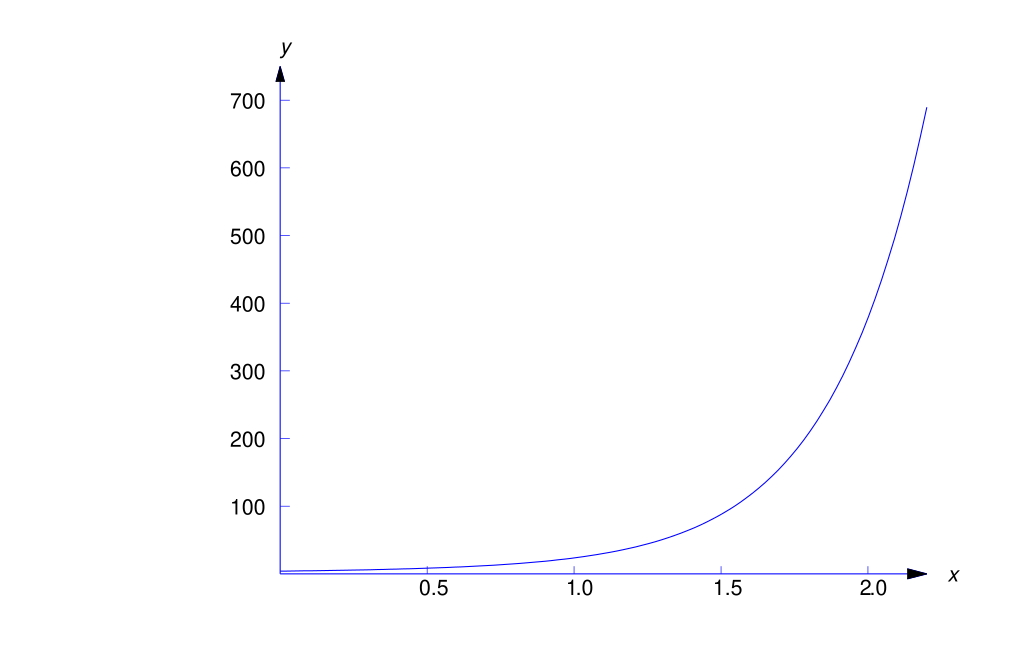
The solution of this system is \(c_1=4\), \(c_2=-1\), \(c_3=1\). Therefore the solution of (9.2.4) is
(Figure 9.2.1). ∎
Now we consider the case where the characteristic polynomial (9.2.2) does not have \(n\) distinct real zeros. For this purpose it is useful to define what we mean by a factorization of a polynomial operator. We begin with an example.
Example 9.2.2
Consider the polynomial
and the associated polynomial operator
Since \(p(r)\) can be factored as
it’s reasonable to expect that p(D) can be factored as
However, before we can make this assertion we must define what we mean by saying that two operators are equal, and what we mean by the products of operators in (9.2.7). We say that two operators are equal if they apply to the same functions and always produce the same result. The definitions of the products in (9.2.7) is this: if \(y\) is any three-times differentiable function then
\((D-1)(D^2+1)y\) is the function obtained by first applying \(D^2+1\) to \(y\) and then applying \(D-1\) to the resulting function
\((D^2+1)(D-1)y\) is the function obtained by first applying \(D-1\) to \(y\) and then applying \(D^2+1\) to the resulting function.
From (a),
This implies that
From (b),
which completes the justification of (9.2.7).
Example 9.2.3
Use the result of Example 9.2.2 to find the general solution of
Solution From (9.2.8), we can rewrite (9.2.10) as
which implies that any solution of \((D^2+1)y=0\) is a solution of (9.2.10). Therefore \(y_1=\cos x\) and \(y_2=\sin x\) are solutions of (9.2.10).
From (9.2.9), we can rewrite (9.2.10) as
which implies that any solution of \((D-1)y=0\) is a solution of (9.2.10). Therefore \(y_3=e^x\) is solution of (9.2.10).
The Wronskian of \(\{e^x,\cos x,\sin x\}\) is
Since
\(\{\cos x,\sin x,e^x\}\) is linearly independent and
is the general solution of (9.2.10).
Example 9.2.4
Find the general solution of
Solution The characteristic polynomial of (9.2.11) is
By arguments similar to those used in Examples 9.2.2 and 9.2.3, it can be shown that (9.2.11) can be written as
or
or
Therefore \(y\) is a solution of (9.2.11) if it’s a solution of any of the three equations
Hence, \(\{e^{2x},e^{-2x},\cos2x,\sin2x\}\) is a set of solutions of (9.2.11). The Wronskian of this set is
Since
\(\{e^{2x},e^{-2x},\cos2x,\sin2x\}\) is linearly independent, and
is the general solution of (9.2.11).
It is known from algebra that every polynomial
with real coefficients can be factored as
where no pair of the polynomials \(p_1\), \(p_2\), …, \(p_k\) has a commom factor and each is either of the form
where \(r_j\) is real and \(m_j\) is a positive integer, or
where \(\lambda_j\) and \(\omega_j\) are real, \(\omega_j\ne0\), and \(m_j\) is a positive integer. If (9.2.12) holds then \(r_j\) is a real zero of \(p\), while if (9.2.13) holds then \(\lambda+i\omega\) and \(\lambda-i\omega\) are complex conjugate zeros of \(p\). In either case, \(m_j\) is the multiplicity of the zero(s).
By arguments similar to those used in our examples, it can be shown that
and that the order of the factors on the right can be chosen arbitrarily. Therefore, if \(p_j(D)y=0\) for some \(j\) then \(p(D)y=0\). To see this, we simply rewrite (9.2.14) so that \(p_j(D)\) is applied first. Therefore the problem of finding solutions of \(p(D)y=0\) with \(p\) as in (9.2.14) reduces to finding solutions of each of these equations
where \(p_j\) is a power of a first degree term or of an irreducible quadratic. To find a fundamental set of solutions \(\{y_1,y_2,\dots,y_n\}\) of \(p(D)y=0\), we find fundamental set of solutions of each of the equations and take \(\{y_1,y_2,\dots,y_n\}\) to be the set of all functions in these separate fundamental sets. In Exercise 40 we sketch the proof that \(\{y_1,y_2,\dots,y_n\}\) is linearly independent, and therefore a fundamental set of solutions of \(p(D)y=0\).
To apply this procedure to general homogeneous constant coefficient equations, we must be able to find fundamental sets of solutions of equations of the form
and
where \(m\) is an arbitrary positive integer. The next two theorems show how to do this.
Theorem 9.2.1
If \(m\) is a positive integer, then
is a fundamental set of solutions of
Proof We’ll show that if
is an arbitrary polynomial of degree \(\le m-1\), then \(y=e^{ax}f\) is a solution of (9.2.16). First note that if \(g\) is any differentiable function then
so
Therefore
Since \(f^{(m)}=0\), the last equation implies that \(y=e^{ax}f\) is a solution of (9.2.16) if \(f\) is any polynomial of degree \(\le m-1\). In particular, each function in (9.2.15) is a solution of (9.2.16). To see that (9.2.15) is linearly independent (and therefore a fundamental set of solutions of (9.2.16)), note that if
for all \(x\) in some interval \((a,b)\), then
for all \(x\) in \((a,b)\). However, we know from algebra that if this polynomial has more than \(m-1\) zeros then \(c_1=c_2=\cdots=c_n=0\).
Example 9.2.5
Find the general solution of
Solution The characteristic polynomial of (9.2.18) is
Therefore (9.2.18) can be written as
so Theorem 9.2.1 implies that the general solution of (9.2.18) is
The proof of the next theorem is sketched in Exercise 41.
Theorem 9.2.2
If \(\omega \ne0\) and \(m\) is a positive integer, then
is a fundamental set of solutions of
Example 9.2.6
Find the general solution of
Solution The characteristic polynomial of (9.2.19) is
Therefore (9.2.19) can be be written as
so Theorem 9.2.2 implies that the general solution of (9.2.19) is
Example 9.2.7
Find the general solution of
Solution The characteristic polynomial of (9.2.20) is
Therefore (9.2.20) can be written as
Fundamental sets of solutions of
are given by
respectively. Therefore the general solution of (9.2.20) is
Example 9.2.8
Find a fundamental set of solutions of
Solution A fundamental set of solutions of (9.2.21) can be obtained by combining fundamental sets of solutions of
Fundamental sets of solutions of these equations are given by
respectively. These ten functions form a fundamental set of solutions of (9.2.21).
9.2 Exercises
In Exercises 1–14 find the general solution.
-
\(y'''-3y''+3y'-y=0\)
Show answer
\(y=e^x(c_1+c_2x+c_3x^2)\)
-
\(y^{(4)}+8y''-9y=0\)
Show answer
\(y=c_1e^x+c_2e^{-x}+c_3\cos3x+c_4\sin3x\)
-
\(y'''-y''+16y'-16y=0\)
Show answer
\(y=c_1e^x+c_2\cos4x+c_3\sin4x\)
-
\(2y'''+3y''-2y'-3y=0\)
Show answer
\(y=c_1e^x+c_2e^{-x}+c_3e^{-3x/2}\)
-
\(y'''+5y''+9y'+5y=0\)
Show answer
\(y=c_1e^{-x}+e^{-2x}(c_1\cos x+c_2\sin x)\)
-
\(4y'''-8y''+5y'-y=0\)
Show answer
\(y=c_1e^x+e^{x/2}(c_2+c_3x)\)
-
\(27y'''+27y''+9y'+y=0\)
Show answer
\(y=e^{-x/3}(c_1+c_2x+c_3x^2)\)
-
\(y^{(4)}+y''=0\)
Show answer
\(y=c_1+c_2x+c_3\cos x+c_4\sin x\)
-
\(y^{(4)}-16y=0\)
Show answer
\(y=c_1e^{2x}+c_2e^{-2x}+c_3\cos2x+c_4\sin2x\)
-
\(y^{(4)}+12y''+36y=0\)
Show answer
\(y=(c_1+c_2x)\cos\sqrt{6} x+(c_3+c_4x)\sin\sqrt{6} x\)
-
\(16y^{(4)}-72y''+81y=0\)
Show answer
\(y=e^{3x/2}(c_1+c_2x)+e^{-3x/2}(c_3+c_4x)\)
-
\(6y^{(4)}+5y'''+7y''+5y'+y=0\)
Show answer
\(y=c_1e^{-x/2}+c_2e^{-x/3}+c_3\cos x+c_4\sin x\)
-
\(4y^{(4)}+12y'''+3y''-13y'-6y=0\)
Show answer
\(y=c_1e^x+c_2e^{-2x}+c_3e^{-x/2}+c_4e^{-3x/2}\)
-
\(y^{(4)}-4y'''+7y''-6y'+2y=0\)
Show answer
\(y=e^x(c_1+c_2x+c_3\cos x+c_4\sin x)\)
-
\(y'''-2y''+4y'-8y=0, \quad y(0)=2,\quad y'(0)=-2,\; y''(0)=0\)
Show answer
\(y=\cos2x-2\sin2x+e^{2x}\)
-
\(y'''+3y''-y'-3y=0, \quad y(0)=0,\quad y'(0)=14,\quad y''(0)=-40\)
Show answer
\(y=2e^x+3e^{-x}-5e^{-3x}\)
-
C/G \(y'''-y''-y'+y=0, \quad y(0)=-2,\quad y'(0)=9,\quad y''(0)=4\)
Show answer
\(y=2e^x+3xe^x-4e^{-x}\)
-
C/G \(y'''-2y'-4y=0, \quad y(0)=6,\quad y'(0)=3,\quad y''(0)=22\)
Show answer
\(y=2e^{-x}\cos x-3e^{-x}\sin x+4e^{2x}\)
-
C/G
\(3y'''-y''-7y'+5y=0, \quad y(0)=\dst{14\over5},\quad y'(0)=0,\quad y''(0)=10\)
Show answer
\(y=\dst{9\over5}e^{-5x/3}+e^x(1+2x)\)
-
\(y'''-6y''+12y'-8y=0, \quad y(0)=1,\quad y'(0)=-1,\quad y''(0)=-4\)
Show answer
\(y=e^{2x}(1-3x+2x^2)\)
-
\(2y'''-11y''+12y'+9y=0, \quad y(0)=6,\quad y'(0)=3,\quad y''(0)=13\)
Show answer
\(y=e^{3x}(2-x)+4e^{-x/2}\)
-
\(8y'''-4y''-2y'+y=0, \quad y(0)=4,\quad y'(0)=-3,\quad y''(0)=-1\)
Show answer
\(y=e^{x/2}(1-2x)+3e^{-x/2}\)
-
\(y^{(4)}-16y=0, \quad y(0)=2,\; y'(0)=2,\; y''(0)=-2,\; y'''(0)=0\)
Show answer
\(y=\dst{1\over8}(5e^{2x}+e^{-2x}+10\cos2x+4\sin2x)\)
-
\(y^{(4)}-6y'''+7y''+6y'-8y=0, \quad y(0)=-2,\quad y'(0)=-8,\quad y''(0)=-14\),
\(y'''(0)=-62\)
Show answer
\(y=-4e^x+e^{2x}-e^{4x}+2e^{-x}\)
-
\(4y^{(4)}-13y''+9y=0, \quad y(0)=1,\quad y'(0)=3,\quad y''(0)=1,\quad y'''(0)=3\)
Show answer
\(y=2e^x-e^{-x}\)
-
\(y^{(4)}+2y'''-2y''-8y'-8y=0, \quad y(0)=5,\quad y'(0)=-2,\quad y''(0)=6,\quad y'''(0)=8\)
Show answer
\(y=e^{2x}+e^{-2x}+e^{-x}(3\cos x+\sin x)\)
-
C/G \(4y^{(4)}+8y'''+19y''+32y'+12y=0, \quad y(0)=3,\quad y'(0)=-3,\quad y''(0)= -\dst{7\over2}\), \(y'''(0)=\dst{31\over4}\)
Show answer
\(y=2e^{-x/2}+\cos2x-\sin2x\)
-
Find a fundamental set of solutions of the given equation, and verify that it’s a fundamental set by evaluating its Wronskian at \(x=0\).
(a) \((D-1)^2(D-2)y=0\) (b) \((D^2+4)(D-3)y=0\) (c) \((D^2+2D+2)(D-1)y=0\) (d) \(D^3(D-1)y=0\) (e) \((D^2-1)(D^2+1)y=0\) (f) \((D^2-2D+2)(D^2+1)y=0\) Show answer
(a) \(\{e^x,\,xe^x,\; e^{2x}\}:\; 1\) (b) \(\{\cos2x,\,\sin2x,\,e^{3x}\}: \; 26\)
(c) \(\{e^{-x}\cos x,\,e^{-x}\sin x,\,e^x\}: \; 5\) (d) \(\{1,\,x,\,x^2,\,e^x\} \; 2e^x\)
(e) \(\{e^x,\,e^{-x},\,\cos x,\,\sin x\} \-8\) (f) \(\{\cos x,\,\sin x,\,e^x\cos x,\,e^x\sin x\}:\; 5\)
-
\((D^2+6D+13)(D-2)^2D^3y=0\)
Show answer
\(\{e^{-3x}\cos2x,\,e^{-3x}\sin2x,\,e^{2x},\,xe^{2x},\,1,\, x,\,x^2\}\)
-
\((D-1)^2(2D-1)^3(D^2+1)y=0\)
Show answer
\(\{e^x,\,xe^x,\,e^{x/2},\,xe^{x/2},\,x^2e^{x/2},\,\cos x,\,\sin x\}\)
-
\((D^2+9)^3D^2y=0\)
Show answer
\(\{\cos3x,\,x\cos3x,\,x^2\cos3x,\,\sin3x,\,x\sin3x, \,x^2\sin3x,\,1,\,x\}\)
-
\((D-2)^3(D+1)^2Dy=0\)
Show answer
\(\{e^{2x},\,xe^{2x},\,x^2e^{2x},\,e^{-x},\,xe^{-x},\,1\}\)
-
\((D^2+1)(D^2+9)^2(D-2)y=0\)
Show answer
\(\{\cos x,\,\sin x,\,\cos3x,\,x\cos 3x,\,\sin3x,\,x\sin3x, \,e^{2x}\}\)
-
\((D^4-16)^2y=0\)
Show answer
\(\{e^{2x},\,xe^{2x},\,e^{-2x},\,xe^{-2x},\,\cos2x,\,x\cos2x, \,\sin2x,\,x\sin2x\}\)
-
\((4D^2+4D+9)^3y=0\)
Show answer
\(\{e^{-x/2}\cos2x,\,xe^{-x/2}\cos2x,\,x^2e^{-x/2}\cos2x ,\,e^{-x/2}\sin2x,\,xe^{-x/2}\sin2x\),
\(x^2e^{-x/2}\sin2x\}\)
-
\(D^3(D-2)^2(D^2+4)^2y=0\)
Show answer
\(\{1,\,x,\,x^2,\,e^{2x},\,xe^{2x},\,\cos2x,\,x\cos2x,\,\sin2x,\,x\sin2x\}\)
-
\((4D^2+1)^2(9D^2+4)^3y=0\)
Show answer
\(\{\cos(x/2),\,x\cos(x/2),\,\sin(x/2),\,x\sin(x/2),\,\cos2x/3\,\,x\cos(2x/3)\),
\(x^2\cos(2x/3),\,\sin(2x/3),\,x\sin(2x/3),\,x^2\sin(2x/3)\}\)
-
\(\left[(D-1)^4-16\right]y=0\)
Show answer
\(\{e^{-x},\,e^{3x},\,e^x\cos2x,\,e^x\sin2x\}\)
-
It can be shown that
\[ \left|\begin{array}{cccc} 1&1&\cdots&1\\[6pt] a_1&a_2&\cdots&a_n\\[6pt] a^2_1&a^2_2&\cdots&a^2_n\\[6pt] \vdots&\vdots&\ddots&\vdots\\[6pt] a^{n-1}_1&a^{n-1}_2&\cdots&a^{n-1}_n\end{array}\right|= \prod_{1\le i<j\le n}(a_j-a_i), \tag*{\rm (A)} \]where the left side is the Vandermonde determinant and the right side is the product of all factors of the form \((a_j-a_i)\) with \(i\) and \(j\) between \(1\) and \(n\) and \(i<j\).
Verify (A) for \(n=2\) and \(n=3\).
Find the Wronskian of \(\{e^{{a_1}x}, \quad e^{{a_2}x},\dots, e^{{a_n}x}\}\).
Show answer
(b) \(\dst{e^{(a_1+a_2+\cdots+a_n)x}\prod_{1\le i<j\le n}(a_j-a_i)}\)
-
A theorem from algebra says that if \(P_1\) and \(P_2\) are polynomials with no common factors then there are polynomials \(Q_1\) and \(Q_2\) such that
\[ Q_1P_1+Q_2P_2=1. \]This implies that
\[ Q_1(D)P_1(D)y+Q_2(D)P_2(D)y=y \]for every function \(y\) with enough derivatives for the left side to be defined.
Use this to show that if \(P_1\) and \(P_2\) have no common factors and
\[ P_1(D)y=P_2(D)y=0 \]then \(y=0\).
Suppose \(P_1\) and \(P_2\) are polynomials with no common factors. Let \(u_1\), …, \(u_r\) be linearly independent solutions of \(P_1(D)y=0\) and let \(v_1\), …, \(v_s\) be linearly independent solutions of \(P_2(D)y=0\). Use (a) to show that \(\{u_1,\dots,u_r,\allowbreak v_1,\dots,v_s\}\) is a linearly independent set.
Suppose the characteristic polynomial of the constant coefficient equation
\[ a_0y^{(n)}+a_1y^{(n-1)}+\cdots+a_ny=0 \tag*{\rm (A)} \]has the factorization
\[ p(r)=a_0p_1(r)p_2(r)\cdots p_k(r), \]where each \(p_j\) is of the form
\[ p_j(r)=(r-r_j)^{n_j} \mbox{ or } p_j(r)=[(r-\lambda_j)^2+w^2_j]^{m_j}\quad (\omega_j>0) \]and no two of the polynomials \(p_1\), \(p_2\), …, \(p_k\) have a common factor. Show that we can find a fundamental set of solutions \(\{y_1,y_2,\dots,y_n\}\) of (A) by finding a fundamental set of solutions of each of the equations
\[ p_j(D)y=0,\quad 1\le j\le k, \]and taking \(\{y_1,y_2,\dots,y_n\}\) to be the set of all functions in these separate fundamental sets.
-
Show that if
\[ z=p(x)\cos\omega x+q(x)\sin\omega x, \tag*{\rm (A)} \]where \(p\) and \(q\) are polynomials of degree \(\le k\), then
\[ (D^2+\omega^2)z=p_1(x)\cos\omega x+q_1(x)\sin\omega x, \]where \(p_1\) and \(q_1\) are polynomials of degree \(\le k-1\).
Apply (a) \(m\) times to show that if \(z\) is of the form (A) where \(p\) and \(q\) are polynomial of degree \(\le m-1\), then
\[ (D^2+\omega^2)^mz=0. \tag*{\rm (B)} \]Use Eqn. (9.2.17) to show that if \(y=e^{\lambda x}z\) then
\[ [(D-\lambda)^2+\omega^2]^my=e^{\lambda x}(D^2+\omega^2)^mz. \]Conclude from (b) and (c) that if \(p\) and \(q\) are arbitrary polynomials of degree \(\le m-1\) then
\[ y=e^{\lambda x}(p(x)\cos\omega x+q(x)\sin\omega x) \]is a solution of
\[ [(D-\lambda)^2+\omega^2]^my=0. \tag*{\rm (C)} \]Conclude from (d) that the functions
\[ \begin{array}{rl} e^{\lambda x}\cos\omega x, xe^{\lambda x}\cos\omega x, &\dots, x^{m-1}e^{\lambda x}\cos\omega x,\\ e^{\lambda x}\sin\omega x, xe^{\lambda x}\sin\omega x,& \dots, x^{m-1}e^{\lambda x}\sin\omega x \end{array} \tag*{\rm (D)} \]are all solutions of (C).
Complete the proof of Theorem 9.2.2 by showing that the functions in (D) are linearly independent.
-
Use the trigonometric identities
\begin{eqnarray*} \cos(A+B)&=&\cos A\cos B-\sin A\sin B \\ \sin(A+B)&=&\cos A\sin B+\sin A\cos B \end{eqnarray*}to show that
\[ (\cos A+i\sin A)(\cos B+i\sin B)=\cos(A+B)+i\sin(A+B). \]Apply (a) repeatedly to show that if \(n\) is a positive integer then
\[ \prod_{k=1}^n(\cos A_k+i\sin A_k)=\cos(A_1+A_2+\cdots+A_n) +i\sin(A_1+A_2+\cdots+A_n). \]Infer from (b) that if \(n\) is a positive integer then
\[ (\cos\theta+i\sin\theta)^n=\cos n\theta+i\sin n\theta. \tag*{\rm (A)} \]Show that (A) also holds if \(n=0\) or a negative integer.
Hint
Verify by direct calculation that
\[ (\cos\theta+i\sin\theta)^{-1}=(\cos\theta-i\sin\theta). \]Then replace \(\theta\) by \(-\theta\) in (A).
Now suppose \(n\) is a positive integer. Infer from (A) that if
\[ z_k=\cos\left(2k\pi\over n\right)+i\sin\left(2k\pi\over n\right) ,\quad k=0,1,\dots,n-1, \]and
\[ \zeta_k=\cos\left((2k+1)\pi\over n\right)+i\sin\left((2k+1)\pi\over n\right) ,\quad k=0,1,\dots,n-1, \]then
\[ z_k^n=1\quad\mbox{ and }\quad\zeta_k^n=-1,\quad k=0,1,\dots,n-1. \](Why don’t we also consider other integer values for \(k\)?)
Let \(\rho\) be a positive number. Use (e) to show that
\[ z^n-\rho=(z-\rho^{1/n} z_0)(z-\rho^{1/n}z_1)\cdots(z-\rho^{1/n} z_{n-1}) \]and
\[ z^n+\rho=(z-\rho^{1/n} \zeta_0)(z-\rho^{1/n} \zeta_1)\cdots(z-\rho^{1/n} \zeta_{n-1}). \]
-
Use (e) of Exercise 42 to find a fundamental set of solutions of the given equation.
(a) \(y'''-y=0\) (b) \(y'''+y=0\) (c) \(y^{(4)}+64y=0\) (d) \(y^{(6)}-y=0\) (e) \(y^{(6)}+64y=0\) (f) \(\left[(D-1)^6-1\right]y=0\) (g) \(y^{(5)}+y^{(4)}+y'''+y''+y'+y=0\)
Show answer
(a) \(\dst\left\{e^x,\,e^{-x/2}\cos\left({\sqrt3\over2}x\right), \,e^{-x/2}\sin\left({\sqrt3\over2}x\right)\right\}\) (b) \(\dst\left\{e^{-x},\,e^{x/2}\cos\left({\sqrt3\over2}x\right), \,e^{x/2}\sin\left({\sqrt3\over2}x\right)\right\}\)
(c) \(\{e^{2x}\cos2x,\,e^{2x}\sin2x,\,e^{-2x}\cos2x,\,e^{-2x}\sin2x\}\)
(d) \(\dst\left\{e^x,\,e^{-x} ,\,e^{x/2}\cos\left({\sqrt3\over2}x\right), \,e^{x/2}\sin\left({\sqrt3\over2}x\right), \,e^{-x/2}\cos\left({\sqrt3\over2}x\right), \,e^{-x/2}\sin\left({\sqrt3\over2}x\right)\right\}\)
(e) \(\{\cos2x,\,\sin2x,\,e^{-\sqrt3x}\cos x,\,e^{-\sqrt3x}\sin x ,\,e^{\sqrt3x}\cos x,\,e^{\sqrt3x}\sin x\}\)
(f) \(\dst\left\{1,\,e^{2x} ,\,e^{3x/2}\cos\left({\sqrt3\over2}x\right), \,e^{3x/2}\sin\left({\sqrt3\over2}x\right), \,e^{x/2}\cos\left({\sqrt3\over2}x\right), \,e^{x/2}\sin\left({\sqrt3\over2}x\right)\right\}\)
(g) \(\dst\left\{e^{-x} ,\,e^{x/2}\cos\left({\sqrt3\over2}x\right), \,e^{x/2}\sin\left({\sqrt3\over2}x\right), \,e^{-x/2}\cos\left({\sqrt3\over2}x\right), \,e^{-x/2}\sin\left({\sqrt3\over2}x\right)\right\}\)
-
An equation of the form
\[ a_0x^ny^{(n)}+a_1x^{n-1}y^{(n-1)}+\cdots +a_{n-1}xy'+a_ny=0,\quad x>0, \tag*{\rm (A)} \]where \(a_0\), \(a_1\), …, \(a_n\) are constants, is an Euler or equidimensional equation.
Show that if
\[ x=e^t \quad \mbox{ and } \quad Y(t)=y(x(t)), \tag*{\rm (B)} \]then
\begin{eqnarray*} \dst x {dy\over dx}&=&\dst{dY\over dt} \\[6pt] \dst x^2{d^2y\over dx^2}&=&\dst{d^2Y\over dt^2}-{dY\over dt} \\[6pt] \dst x^3{d^3y\over dx^3}&=&\dst{d^3Y\over dt^3}-3{d^2Y\over dt^2}+2{dY\over dt}. \end{eqnarray*}In general, it can be shown that if \(r\) is any integer \(\ge2\) then
\[ x^r {d^ry\over dx^r}={d^rY\over dt^r}+ A_{1r}{d^{r-1}Y\over dt^{r-1}}+\cdots+A_{r-1,r} {dY\over dt} \]where \(A_{1r}\), …, \(A_{r-1,r}\) are integers. Use these results to show that the substitution (B) transforms (A) into a constant coefficient equation for \(Y\) as a function of \(t\).
-
Use Exercise 44 to show that a function \(y=y(x)\) satisfies the equation
\[ a_0x^3y'''+a_1x^2y''+a_2xy'+a_3y=0, \tag*{\rm (A)} \]on \((0,\infty)\) if and only if the function \(Y(t)=y(e^t)\) satisfies
\[ a_0{d^3Y\over dt^3}+(a_1-3a_0) {d^2Y\over dt^2}+(a_2-a_1+2a_0) {dY\over dt}+a_3Y=0. \]Assuming that \(a_0\), \(a_1\), \(a_2\), \(a_3\) are real and \(a_0 \ne0\), find the possible forms for the general solution of (A).
Show answer
\(y=c_1x^{r_1}+c_2x^{r_2}+c_3x^{r_3}\; (r_1, r_2, r_3\) distinct); \(y=c_1x^{r_1}+(c_2+c_3 \ln x)x^{r_2}\; (r_1, r_2 \)
\(\mbox{distinct});\) \(y=[c_1+c_2 \ln x+c_3(\ln x)^2]x^{r_1}\); \(y=c_1x^{r_1}+x^\lambda [c_2\cos(\omega \ln x)+c_3\sin (\omega \ln x)]\)