The temperature \(u=u(x,y,t)\) in a two-dimensional plate satisfies the two-dimensional heat equation
where \((x,y)\) varies over the interior of the plate and \(t>0\). To find a solution of (12.3.1), it’s necessary to specify the initial temperature \(u(x,y,0)\) and conditions that must be satisfied on the boundary. However, as \(t\to\infty\), the influence of the initial condition decays, so
and the temperature approaches a steady state distribution \(u=u(x,y)\) that satisfies
This is Laplace’s equation. This equation also arises in applications to fluid mechanics and potential theory; in fact, it is also called the potential equation. We seek solutions of (12.3.2) in a region \(R\) that satisfy specified conditions – called boundary conditions – on the boundary of \(R\). For example, we may require \(u\) to assume prescribed values on the boundary. This is called a Dirichlet condition, and the problem is called a Dirichlet problem. Or, we may require the normal derivative of \(u\) at each point \((x,y)\) on the boundary to assume prescribed values. This is called a Neumann condition, and the problem is called a Neumann problem. In some problems we impose Dirichlet conditions on part of the boundary and Neumann conditions on the rest. Then we say that the boundary conditions and the problem are mixed.
Solving boundary value problems for (12.3.2) over general regions is beyond the scope of this book, so we consider only very simple regions. We begin by considering the rectangular region shown in Figure 12.3.1.
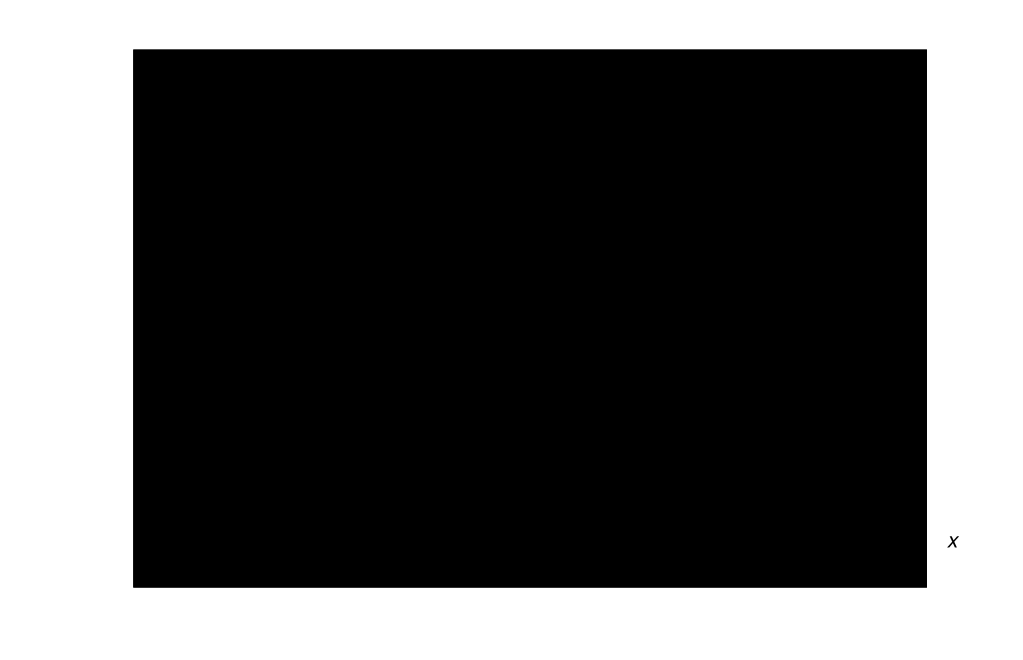
The possible boundary conditions for this region can be written as
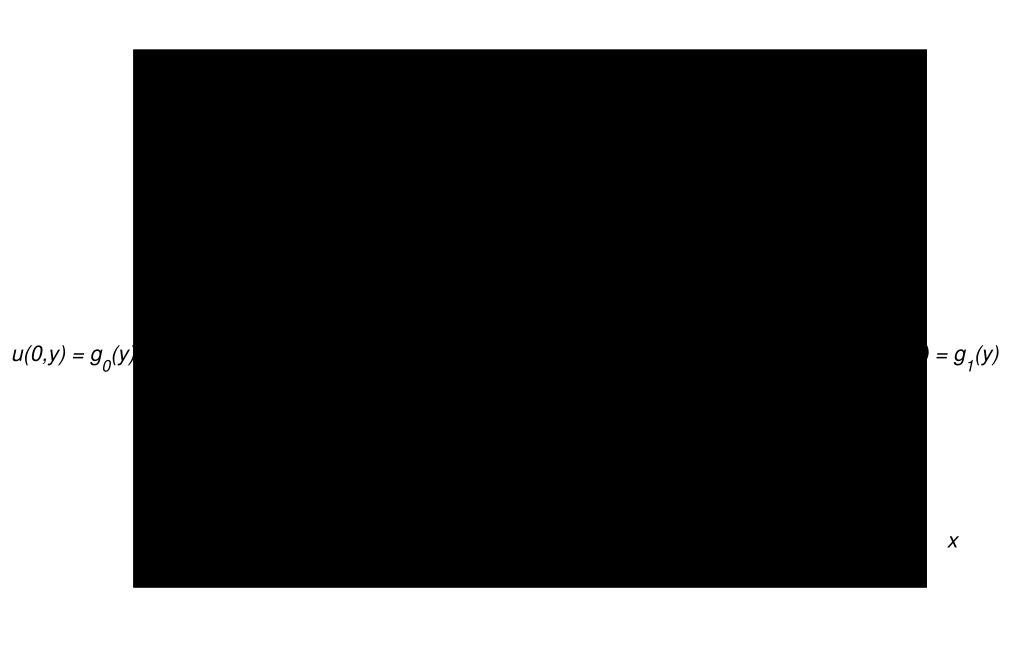
where \(\alpha\), \(\beta\), \(\gamma\), and \(\delta\) can each be either \(0\) or \(1\); thus, there are 16 possibilities. Let BVP\((\alpha,\beta,\gamma,\delta)(f_0,f_1,g_0,g_1)\) denote the problem of finding a solution of (12.3.2) that satisfies these conditions. This is a Dirichlet problem if
(Figure 12.3.2), or a Neumann problem if
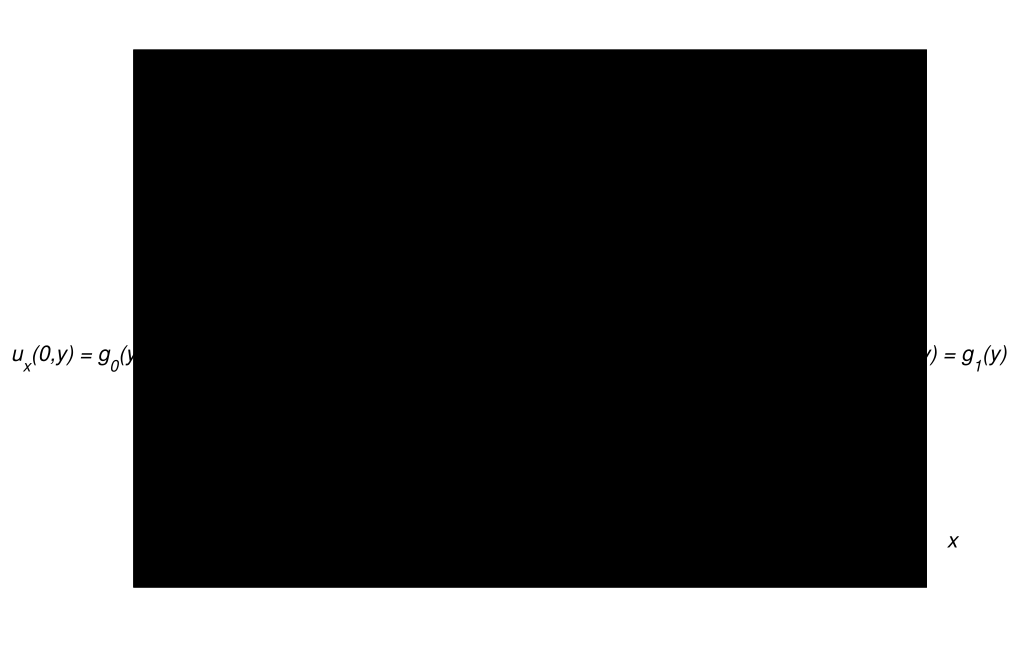
(Figure 12.3.3). The other 14 problems are mixed.
For given \((\alpha,\beta,\gamma,\delta)\), the sum of solutions of
is a solution of
Therefore we concentrate on problems where only one of the functions \(f_0\), \(f_1\), \(g_0\), \(g_2\) isn’t identically zero. There are 64 (count them!) problems of this form. Each has homogeneous boundary conditions on three sides of the rectangle, and a nonhomogeneous boundary condition on the fourth. We use separation of variables to find infinitely many functions that satisfy Laplace’s equation and the three homogeneous boundary conditions in the open rectangle. We then use these solutions as building blocks to construct a formal solution of Laplace’s equation that also satisfies the nonhomogeneous boundary condition. Since it’s not feasible to consider all 64 cases, we’ll restrict our attention in the text to just four. Others are discussed in the exercises.
If \(v(x,y)=X(x)Y(y)\) then
for all \((x,y)\) if and only if
for all \((x,y)\), where \(k\) is a separation constant. This equation is equivalent to
From here, the strategy depends upon the boundary conditions. We illustrate this by examples.
Example 12.3.1
Define the formal solution of
(Figure 12.3.4).
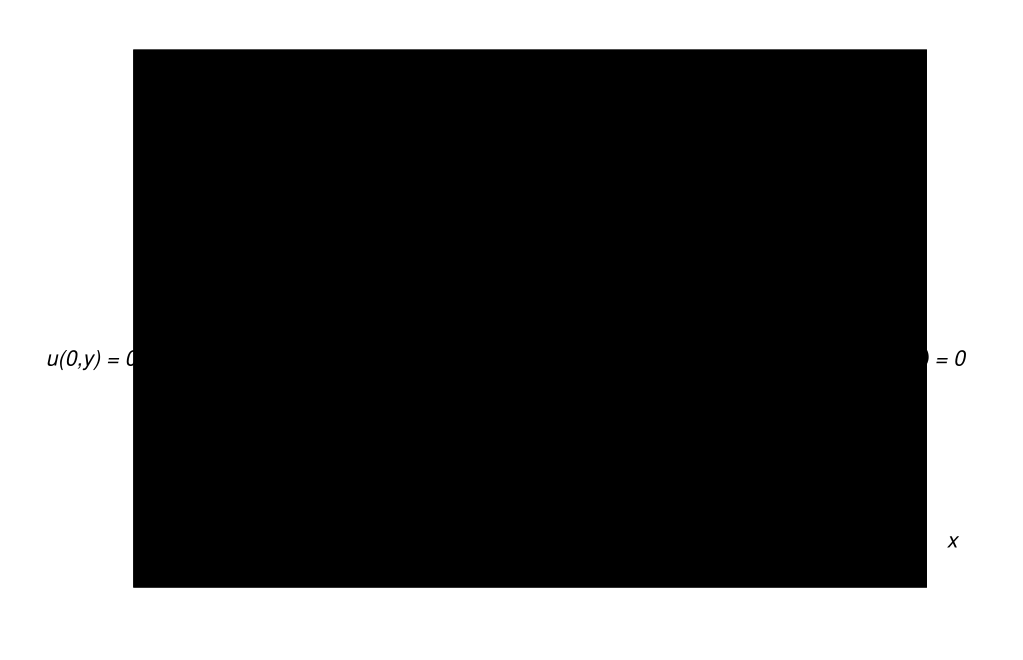
Solution The boundary conditions in (12.3.4) require products \(v(x,y)=X(x)Y(y)\) such that \(X(0)=X(a)=Y(b)=0\); hence, we let \(k=-\lambda\) in (12.3.3). Thus, \(X\) and \(Y\) must satisfy
and
From Theorem 11.1.2, the eigenvalues of (12.3.5) are \(\lambda_n=n^2\pi^2/a^2\), with associated eigenfunctions
Substituting \(\lambda=n^2\pi^2/a^2\) into (12.3.6) yields
so we could take
however, because of the nonhomogeneous Dirichlet condition at \(y=0\), it’s better to require that \(Y_n(0)=1\), which can be achieved by dividing the right side of (12.3.7) by its value at \(y=0\); thus, we take
Then
so \(v_n(x,0)=\sin n\pi x/a\) and \(v_n\) satisfies (12.3.4) with \(f(x)=\sin n\pi x/a\). More generally, if \(\alpha_1\), …, \(\alpha_m\) are arbitrary constants then
satisfies (12.3.4) with
Therefore, if \(f\) is an arbitrary piecewise smooth function on \([0,a]\), we define the formal solution of (12.3.4) to be
where
is the Fourier sine series of \(f\) on \([0,a]\); that is,
If \(y<b\) then
for large \(n\), so the series in (12.3.8) converges if \(0< y < b\); moreover, since also
for large \(n\), Theorem 12.1.2 applied twice with \(z=x\) and twice with \(z=t\), shows that \(u_{xx}\) and \(u_{yy}\) can be obtained by differentiating \(u\) term by term if \(0<y<b\). (Exercise 37). Therefore \(u\) satisfies Laplace’s equation in the interior of the rectangle in Figure 12.3.4. Moreover, the series in (12.3.8) also converges on the boundary of the rectangle, and satisfies the three homogeneous boundary conditions conditions in (12.3.4). Therefore, since \(u(x,0)=S(x)\) for \(0\le x\le L\), \(u\) is an actual solution of (12.3.5) if and only if \(S(x)=f(x)\) for \(0\le x\le a\). From Theorem 11.3.2, this is true if \(f\) is continuous and piecewise smooth on \([0,L]\), and \(f(0)=f(L)=0\).
Example 12.3.2
Solve (12.3.4) with \(f(x)=x(x^2-3ax+2a^2)\).
Solution From Example 11.3.6,
Therefore
To compute approximate values of \(u(x,y)\), we must use partial sums of the form
Because of (12.3.9), small values of \(m\) provide sufficient accuracy for most applications if \(0<y<b\). Moreover, the \(n^3\) in the denominator in (12.3.10) ensures that this is also true for \(y=0\). For graphing purposes, we chose \(a=2\), \(b=1\), and \(m=10\). Figure 12.3.5 shows the surface
while Figure 12.3.6 shows the curves
Example 12.3.3
Define the formal solution of
(Figure 12.3.7).
Solution The boundary conditions in (12.3.11) require products \(v(x,y)=X(x)Y(y)\) such that \(X'(0)=X'(a)=Y(0)=0\); hence, we let \(k=-\lambda\) in (12.3.3). Thus, \(X\) and \(Y\) must satisfy
and
From Theorem 11.1.3, the eigenvalues of (12.3.12) are \(\lambda=0\), with associated eigenfunction \(X_0=1\), and \(\lambda_n=n^2\pi^2/a^2\), with associated eigenfunctions
Since \(Y_0=y\) satisfies (12.3.13) with \(\lambda=0\), we take \(v_0(x,y)=X_0(x)Y_0(y)= y\). Substituting \(\lambda=n^2\pi^2/a^2\) into (12.3.13) yields
so we could take
However, because of the nonhomogeneous Neumann condition at \(y=b\), it’s better to require that \(Y_n'(b)=1\), which can be achieved by dividing the right side of (12.3.14) by the value of its derivative at \(y=b\); thus,
Then
so
Therefore \(v_n\) satisfies (12.3.11) with \(f(x)=\cos n\pi x/a\). More generally, if \(\alpha_0\), …, \(\alpha_m\) are arbitrary constants then
satisfies (12.3.11) with
Therefore, if \(f\) is an arbitrary piecewise smooth function on \([0,a]\) we define the formal solution of (12.3.11) to be
where
is the Fourier cosine series of \(f\) on \([0,a]\); that is,
Example 12.3.4
Solve (12.3.11) with \(f(x)=x\).
Solution From Example 11.3.1,
Therefore
For graphing purposes, we chose \(a=2\), \(b=1\), and retained the terms through \(n=10\) in (12.3.15). Figure 12.3.8 shows the surface
while Figure 12.3.9 shows the curves
Example 12.3.5
Define the formal solution of
(Figure 12.3.10).
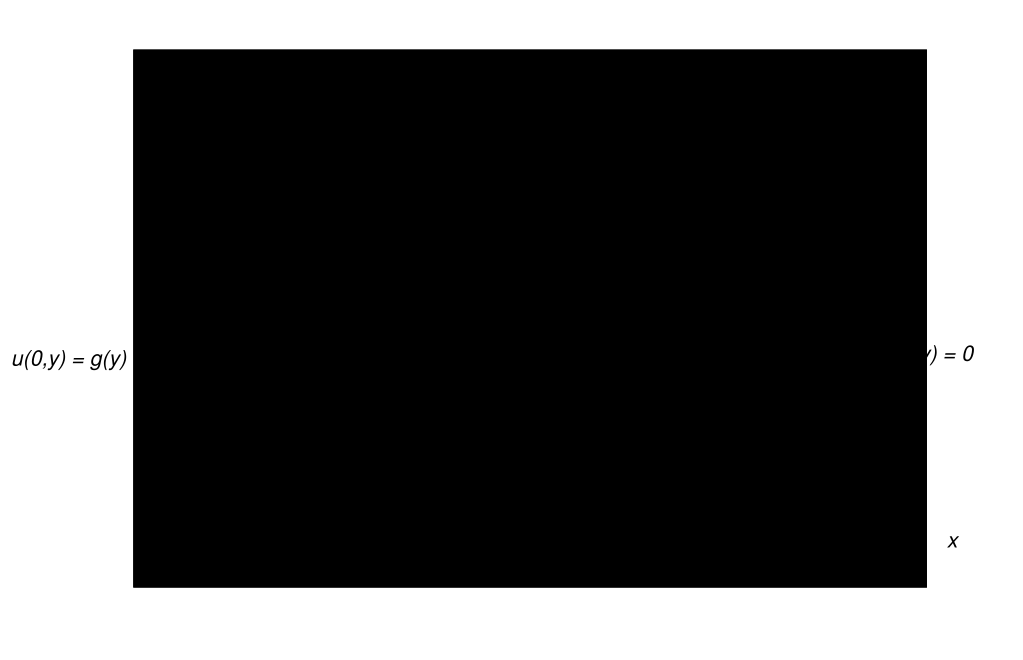
Solution The boundary conditions in (12.3.16) require products \(v(x,y)=X(x)Y(y)\) such that \(Y(0)=Y'(b)=X'(a)=0\); hence, we let \(k=\lambda\) in (12.3.3). Thus, \(X\) and \(Y\) must satisfy
and
From Theorem 11.1.4, the eigenvalues of (12.3.18) are \(\lambda_n=(2n-1)^2\pi^2/4b^2\), with associated eigenfunctions
Substituting \(\lambda=(2n-1)^2\pi^2/4b^2\) into (12.3.17) yields
so we could take
However, because of the nonhomogeneous Dirichlet condition at \(x=0\), it’s better to require that \(X_n(0)=1\), which can be achieved by dividing the right side of (12.3.19) by its value at \(x=0\); thus,
Then
so
Therefore \(v_n\) satisfies (12.3.16) with \(g(y)=\sin(2n-1)\pi y/2b\). More generally, if \(\alpha_1\), …, \(\alpha_m\) are arbitrary constants then
satisfies (12.3.16) with
Thus, if \(g\) is an arbitrary piecewise smooth function on \([0,b]\), we define the formal solution of (12.3.16) to be
where
is the mixed Fourier sine series of \(g\) on \([0,b]\); that is,
Example 12.3.6
Solve (12.3.16) with \(g(y)=y(2y^2-9by+12b^2)\).
Solution From Example 11.3.8,
Therefore
Example 12.3.7
Define the formal solution of
(Figure 12.3.11).
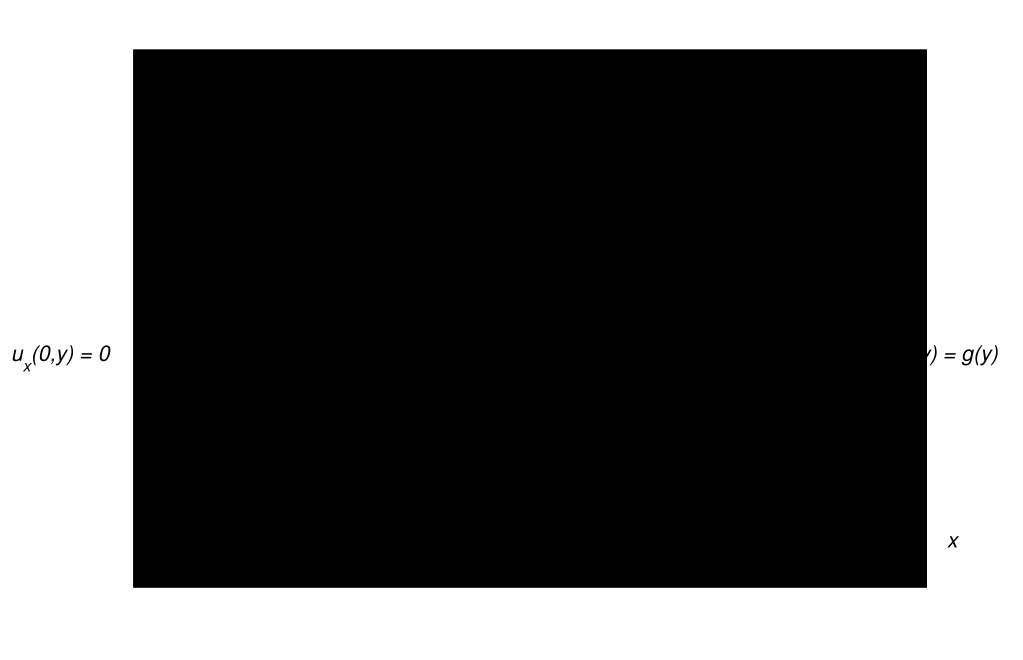
Solution The boundary conditions in (12.3.20) require products \(v(x,y)=X(x)Y(y)\) such that \(Y'(0)=Y(b)=X'(0)=0\); hence, we let \(k=\lambda\) in (12.3.3). Thus, \(X\) and \(Y\) must satisfy
and
From Theorem 11.1.4, the eigenvalues of (12.3.22) are \(\lambda_n=(2n-1)^2\pi^2/4b^2\), with associated eigenfunctions
Substituting \(\lambda=(2n-1)^2\pi^2/4b^2\) into (12.3.21) yields
so we could take
However, because of the nonhomogeneous Neumann condition at \(x=a\), it’s better to require that \(X_n'(a)=1\), which can be achieved by dividing the right side of (12.3.23) by the value of its derivative at \(x=a\); thus,
Then
so
Therefore \(v_n\) satisfies (12.3.20) with \(g(y)=\cos(2n-1)\pi y/2b\). More generally, if \(\alpha_1\), …, \(\alpha_m\) are arbitrary constants then
satisfies (12.3.20) with
Therefore, if \(g\) is an arbitrary piecewise smooth function on \([0,b]\), we define the formal solution of (12.3.20) to be
where
is the mixed Fourier cosine series of \(g\) on \([0,b]\); that is,
Example 12.3.8
Solve (12.3.20) with \(g(y)=y-b\).
Solution From Example 11.3.3,
Therefore
Laplace’s Equation for a Semi-Infinite Strip
We now seek solutions of Laplace’s equation on the semi-infinite strip
(Figure 12.3.12) that satisfy homogeneous boundary conditions at \(x=0\) and \(x=a\), and a nonhomogeneous Dirichlet or Neumann condition at \(y=0\). An example of such a problem is
The boundary conditions in this problem are not sufficient to determine \(u\), for if \(u_0=u_0(x,y)\) is a solution and \(K\) is a constant then
is also a solution. (Verify.) However, if we also require — on physical grounds — that the solution remain bounded for all \((x,y)\) in \(S\) then \(K=0\) and this difficulty is eliminated.
Example 12.3.9
Define the bounded formal solution of (12.3.24).
Solution Proceeding as in the solution of Example 12.3.1, we find that the building block functions are of the form
where
Therefore
where \(c_1\) and \(c_2\) are constants. Although the boundary conditions in (12.3.24) don’t restrict \(c_1\), and \(c_2\), we must set \(c_1=0\) to ensure that \(Y_n\) is bounded. Letting \(c_2=1\) yields
and we define the bounded formal solution of (12.3.24) to be
where
is the Fourier sine series of \(f\) on \([0,a]\). ∎
See Exercises 29-34 for other boundary value problems on a semi-infinite strip.
12.3 Exercises
In Exercises 1-16 apply the definition developed in Example 1 to solve the boundary value problem. (Use Theorem 11.3.5 where it applies.) Where indicated by C , graph the surface \(u=u(x,y)\), \(0\le x\le a\), \(0\le y\le b\).
-
\(u_{xx}+u_{yy}=0,\quad 0<x<1,\quad 0<y<1,\)
\(u(x,0)=x(1-x),\quad u(x,1)=0,\quad 0\le x\le 1,\)
\(u(0,y)=0,\quad u(1,y)=0,\quad 0\le y\le 1\)Show answer
\(u(x,y)=\dst{8\over\pi^3}\sum_{n=1}^\infty{\sinh(2n-1)\pi(1-y) \over(2n-1)^3\sinh(2n-1)\pi} \sin(2n-1)\pi x\)
-
\(u_{xx}+u_{yy}=0,\quad 0<x<2,\quad 0<y<3,\)
\(u(x,0)=x^2(2-x),\quad u(x,3)=0,\quad 0\le x\le 2,\)
\(u(0,y)=0,\quad u(2,y)=0,\quad 0\le y\le 3\)Show answer
\(u(x,y)=\dst-{32\over\pi^3}\sum_{n=1}^\infty{(1+(-1)^n2)\sinh n\pi(3-y)/2\over n^3\sinh3n\pi/2} \sin{n\pi x\over 2}\)
-
C \(u_{xx}+u_{yy}=0,\quad 0<x<2,\quad 0<y<2,\)
\(u(x,0)= \left\{\begin{array}{cl} x,& 0\le x\le 1,\\ 2-x,&1\le x\le2, \end{array}\right. \quad u(x,2)=0,\quad 0\le x\le 2,\)
\(u(0,y)=0,\quad u(2,y)=0,\quad 0\le y\le 2\)Show answer
\(u(x,y)=\dst{8\over\pi^2}\sum_{n=1}^\infty(-1)^{n+1}{ \sinh(2n-1)\pi(1-y/2)\over(2n-1)^2\sinh(2n-1)\pi} \sin{(2n-1)\pi x\over 2}\)
-
\(u_{xx}+u_{yy}=0,\quad 0<x<\pi,\quad 0<y<1,\)
\(u(x,0)=x\sin x,\quad u(x,\pi)=0,\quad 0\le x\le \pi,\)
\(u(0,y)=0,\quad u(\pi,y)=0,\quad 0\le y\le 1\)Show answer
\(u(x,y)=\dst{\pi\over2}{\sinh(1-y)\over\sinh1}\sin x-{16\over\pi}\sum_{n=1}^\infty{n\sinh2n(1-y)\over(4n^2-1)^2\sinh2n}\sin2nx\)
-
\(u_{xx}+u_{yy}=0,\quad 0<x<3,\quad 0<y<2,\)
\(u(x,0)=0,\quad u_y(x,2)=x^2,\quad 0\le x\le 3,\)
\(u_x(0,y)=0,\quad u_x(3,y)=0,\quad 0\le y\le 2\)Show answer
\(u(x,y)=\dst3y+{108\over\pi^3}\sum_{n=1}^\infty(-1)^n{\sinh n\pi y/3\over n^3\cosh2n\pi/3}\cos{n\pi x\over 3}\)
-
\(u_{xx}+u_{yy}=0,\quad 0<x<1,\quad 0<y<2,\)
\(u(x,0)=0,\quad u_y(x,2)=1-x,\quad 0\le x\le 1,\)
\(u_x(0,y)=0,\quad u_x(1,y)=0,\quad 0\le y\le 2\)Show answer
\(u(x,y)=\dst{y\over2}+{4\over\pi^3}\sum_{n=1}^\infty{ \sinh(2n-1)\pi y\over(2n-1)^3\cosh2(2n-1)\pi} \cos(2n-1)\pi x\)
-
\(u_{xx}+u_{yy}=0,\quad 0<x<2,\quad 0<y<2,\)
\(u(x,0)=0,\quad u_y(x,2)=x^2-4,\quad 0\le x\le 2,\)
\(u_x(0,y)=0,\quad u_x(2,y)=0,\quad 0\le y\le 2\)Show answer
\(u(x,y)=\dst-{8y\over3}+{32\over\pi^3}\sum_{n=1}^\infty(-1)^n{ \sinh n\pi y/2\over n^3\cosh n\pi}\cos{n\pi x\over 2}\)
-
\(u_{xx}+u_{yy}=0,\quad 0<x<1,\quad 0<y<1,\)
\(u(x,0)=0,\quad u_y(x,1)=(x-1)^2,\quad 0\le x\le 1,\)
\(u_x(0,y)=0,\quad u_x(1,y)=0,\quad 0\le y\le 1\)Show answer
\(u(x,y)=\dst{y\over3}+{4\over\pi^3}\sum_{n=1}^\infty{\sinh n\pi y\over n^3\cosh n\pi}\cos n\pi x\)
-
C \(u_{xx}+u_{yy}=0,\quad 0<x<3,\quad 0<y<2,\)
\(u(x,0)=0,\quad u_y(x,2)=0,\quad 0\le x\le 3,\)
\(u(0,y)=y(4-y),\quad u_x(3,y)=0,\quad 0\le y\le 2\)Show answer
\(u(x,y)=\dst {128\over\pi^3}\sum_{n=1}^\infty{\cosh(2n-1)\pi(x-3)/4\over (2n-1)^3\cosh3(2n-1)\pi/4} \sin{(2n-1)\pi y\over4}\)
-
\(u_{xx}+u_{yy}=0,\quad 0<x<2,\quad 0<y<1,\)
\(u(x,0)=0,\quad u_y(x,1)=0,\quad 0\le x\le 2,\)
\(u(0,y)=y^2(3-2y),\quad u_x(2,y)=0,\quad 0\le y\le 1\)Show answer
\(u(x,y) =\dst-{96\over\pi^3}\sum_{n=1}^\infty \left[1+(-1)^n{4\over(2n-1)\pi}\right] {\cosh(2n-1)\pi(x-2)/2\over(2n-1)^3\cosh(2n-1)\pi} \sin{(2n-1)\pi y\over2}\)
-
\(u_{xx}+u_{yy}=0,\quad 0<x<2,\quad 0<y<2,\)
\(u(x,0)=0,\quad u_y(x,2)=0,\quad 0\le x\le 2,\)
\(u(0,y)=(y-2)^3+8,\quad u_x(2,y)=0,\quad 0\le y\le 2\)Show answer
\(u(x,y) =\dst{768\over\pi^3}\sum_{n=1}^\infty \left[1+(-1)^n{2\over(2n-1)\pi}\right] {\cosh(2n-1)\pi(x-2)/4\over(2n-1)^3\cosh(2n-1)\pi/2} \sin{(2n-1)\pi y\over4}\)
-
\(u_{xx}+u_{yy}=0,\quad 0<x<3,\quad 0<y<1,\)
\(u(x,0)=0,\quad u_y(x,1)=0,\quad 0\le x\le 3,\)
\(u(0,y)=y(2y^2-9y+12),\quad u_x(3,y)=0,\quad 0\le y\le 1\)Show answer
\(u(x,y) =\dst{96\over\pi^3}\sum_{n=1}^\infty \left[3+(-1)^n{4\over(2n-1)\pi}\right] {\cosh(2n-1)\pi(x-3)/2\over(2n-1)^3\cosh3(2n-1)\pi/2} \sin{(2n-1)\pi y\over2}\)
-
C \(u_{xx}+u_{yy}=0,\quad 0<x<1,\quad 0<y<\pi,\)
\(u_y(x,0)=0,\quad u(x,\pi)=0,\quad 0\le x\le 1,\)
\(u_x(0,y)=0,\quad u_x(1,y)=\sin y,\quad 0\le y\le \pi\)Show answer
\(u(x,y)= -\dst{16\over\pi}\sum_{n=1}^\infty{\cosh(2n-1)x/2\over (2n-3)(2n+1)(2n-1)\sinh(2n-1)/2} \cos{(2n-1) y\over2}\)
-
\(u_{xx}+u_{yy}=0,\quad 0<x<2,\quad 0<y<3,\)
\(u_y(x,0)=0,\quad u(x,3)=0,\quad 0\le x\le 2,\)
\(u_x(0,y)=0,\quad u_x(2,y)=y(3-y),\quad 0\le y\le 3\)Show answer
\(u(x,y)=-\dst{432\over\pi^3}\sum_{n=1}^\infty \left[1+{4(-1)^n\over(2n-1)\pi}\right] {\cosh(2n-1)\pi x/6\over(2n-1)^3\sinh(2n-1)\pi/3} \cos{(2n-1)\pi y\over6}\)
-
\(u_{xx}+u_{yy}=0,\quad 0<x<1,\quad 0<y<\pi,\)
\(u_y(x,0)=0,\quad u(x,\pi)=0,\quad 0\le x\le 1,\)
\(u_x(0,y)=0,\quad u_x(1,y)=\pi^2-y^2,\quad 0\le y\le \pi\)Show answer
\(u(x,y)=-\dst {64\over\pi}\sum_{n=1}^\infty(-1)^n{\cosh(2n-1)x/2\over (2n-1)^4\sinh(2n-1)/2}\cos{(2n-1) y\over2}\).
-
\(u_{xx}+u_{yy}=0,\quad 0<x<1,\quad 0<y<1,\)
\(u_y(x,0)=0,\quad u(x,1)=0,\quad 0\le x\le 1,\)
\(u_x(0,y)=0,\quad u_x(1,y)=1-y^3,\quad 0\le y\le 1\)Show answer
\(u(x,y)=-\dst{192\over\pi^4}\sum_{n=1}^\infty {\cosh(2n-1)\pi x/2\over(2n-1)^4\sinh(2n-1)\pi/2} \left[(-1)^n+{2\over(2n-1)\pi}\right] \cos{(2n-1)\pi y\over2}\)
In Exercises 17-28 define the formal solution of
that satisfies the given boundary conditions for general \(a\), \(b\), and \(f\) or \(g\). Then solve the boundary value problem for the specified \(a\), \(b\), and \(f\) or \(g\). (Use Theorem 11.3.5 where it applies.) Where indicated by C , graph the surface \(u=u(x,y)\), \(0\le x\le a\), \(0\le y\le b\).
-
C \(u(x,0)=0,\quad u(x,b)=f(x),\quad 0<x<a,\\ u(0,y)=0,\quad u(a,y)=0,\quad 0<y<b\)
\(a=3\), \(b=2\), \(f(x)=x(3-x)\)Show answer
\(\dst u(x,y)=\sum_{n=1}^\infty\alpha_n{\sinh n\pi y/a\over \sinh n\pi b/a}\sin {n\pi x\over a},\quad \alpha_n={2\over a}\int_0^a f(x)\sin {n\pi x\over a}\,dx\)
\(u(x,y)=\dst{72\over\pi^3}\sum_{n=1}^\infty {\sinh(2n-1)\pi y/3\over(2n-1)^3\sinh2(2n-1)\pi/3} \sin{(2n-1)\pi x\over 3}\)
-
\(u(x,0)=f(x),\quad u(x,b)=0,\quad 0<x<a,\\ u_x(0,y)=0,\quad u_x(a,y)=0,\quad 0<y<b\)
\(a=2\), \(b=1\), \(f(x)=x^2(x-2)^2\)Show answer
\(\dst u(x,y)=\alpha_0(1-y/b)+\sum_{n=1}^\infty\alpha_n{\sinh n\pi(b-y)/ a\over\sinh n\pi b/a}\cos {n\pi x\over a}\), \(\dst\alpha_0={1\over a}\int_0^a f(x)\,dx\),
\(\dst\alpha_n={2\over a}\int_0^a f(x)\cos {n\pi x\over a}\,dx,\quad n\ge1\)
\(\dst u(x,y)={8(1-y)\over15}-{48\over\pi^4}\sum_{n=1}^\infty{1\over n^4}{\sinh n\pi(1-y)\over\sinh n\pi}\cos n\pi x\)
-
\(u(x,0)=f(x),\quad u(x,b)=0,\quad 0<x<a,\\ u_x(0,y)=0,\quad u(a,y)=0,\quad 0<y<b\)
\(a=1\), \(b=2\), \(f(x)=3x^3-4x^2+1\)Show answer
\(\dst u(x,y)=\sum_{n=1}^\infty\alpha_n{\sinh(2n-1)\pi(b-y)/2a \over\sinh(2n-1)\pi b/2a}\cos {(2n-1)\pi x\over2a}\),
\(\dst\alpha_n={2\over a}\int_0^a f(x)\cos {(2n-1)\pi x\over2a}\,dx\)
\(u(x,y)=\dst {288\over\pi^3}\sum_{n=1}^\infty{\sinh(2n-1)\pi(2-y)/6\over (2n-1)^3\sinh(2n-1)\pi/3}\sin{(2n-1)\pi x\over6}\)
-
\(u(x,0)=f(x),\quad u(x,b)=0,\quad 0<x<a,\\ u(0,y)=0,\quad u_x(a,y)=0,\quad 0<y<b\)
\(a=3\), \(b=2\), \(f(x)=x(6-x)\)Show answer
\(\dst u(x,y)=\sum_{n=1}^\infty\alpha_n{\sinh(2n-1)\pi(b-y)/2a\over \sinh(2n-1)\pi b/2a}\sin {(2n-1)\pi x\over2a}\),
\(\dst\alpha_n={2\over a}\int_0^a f(x)\sin {(2n-1)\pi x\over2a}\,dx\)
\(u(x,y)=\dst{32\over\pi^3}\sum_{n=1}^\infty\left[ (-1)^n5+{18\over(2n-1)\pi}\right] {\sinh(2n-1)\pi(2-y)/2\over(2n-1)^3\sinh(2n-1)\pi} \cos{(2n-1)\pi x\over2}\).
-
\(u(x,0)=f(x),\quad u_y(x,b)=0,\quad 0<x<a,\\ u(0,y)=0,\quad u(a,y)=0,\quad 0<y<b\)
\(a=\pi\), \(b=2\), \(f(x)=x(\pi^2-x^2)\)Show answer
\(\dst u(x,y)=\sum_{n=1}^\infty\alpha_n{\cosh n\pi(y-b)/a\over \cosh n\pi b/a}\sin {n\pi x\over a}\), \(\dst\alpha_n={2\over a}\int_0^a f(x)\sin {n\pi x\over a}\,dx\)
\(u(x,y)=\dst-12\sum_{n=1}^\infty(-1)^n{\cosh n(y-2)\over n^3\cosh2n} \sin nx\)
-
\(u_y(x,0)=0,\quad u(x,b)=f(x),\quad 0<x<a,\\ u_x(0,y)=0,\quad u_x(a,y)=0,\quad 0<y<b\)
\(a=\pi\), \(b=1\), \(f(x)=x^2(x-\pi)^2\)Show answer
\(\dst u(x,y)=\alpha_0+\sum_{n=1}^\infty\alpha_n{\cosh n\pi y/a \over\cosh n\pi b/a}\cos {n\pi x\over a}\), \(\dst\alpha_0={1\over a}\int_0^a f(x)\,dx\),
\(\dst\alpha_n={2\over a}\int_0^a f(x)\cos {n\pi x\over a}\,dx,\quad n\ge1\)
\(\dst u(x,y)={\pi^4\over30}-3\sum_{n=1}^\infty{1\over n^4}{\cosh2ny\over\cos2n}\cos 2nx\)
-
C \(u_y(x,0)=f(x),\quad u(x,b)=0,\quad 0<x<a,\\ u(0,y)=0,\quad u(a,y)=0,\quad 0<y<b\)
\(a=\pi\), \(b=1\), \(f(x)= \left\{\begin{array}{cl} x,&0\le x\le{\pi\over2},\\\pi-x,&{\pi\over2}\le x\le \pi \end{array}\right.\)Show answer
\(\dst u(x,y)={a\over\pi}\sum_{n=1}^\infty\alpha_n{\sinh n\pi (y-b)/a\over n\cosh n\pi b/a}\sin {n\pi x\over a}\), \(\dst\alpha_n={2\over a}\int_0^a f(x)\sin {n\pi x\over a}\,dx\)
\(u(x,y)=\dst{4\over\pi}\sum_{n=1}^\infty(-1)^{n+1} {\sinh(2n-1)(y-1)\over(2n-1)^3\cosh(2n-1)} \sin(2n-1)x\)
-
\(u(x,0)=0,\quad u(x,b)=0,\quad 0<x<a,\\ u_x(0,y)=0,\quad u(a,y)=g(y),\quad 0<y<b\)
\(a=1\), \(b=1\), \(g(y)=y(y^3-2y^2+1)\)Show answer
\(\dst u(x,y)=\sum_{n=1}^\infty\alpha_n{\cosh n\pi x/b\over \cosh n\pi a/b} \sin{n\pi y\over b}\), \(\dst\alpha_n={2\over b}\int_0^b g(y)\sin {n\pi y\over b}\,dy\)
\(u(x,y)=\dst{96\over\pi^5}\sum_{n=1}^\infty{\cosh(2n-1)\pi x \over(2n-1)^5\cosh(2n-1)\pi}\sin(2n-1)\pi y\).
-
C \(u_y(x,0)=0,\quad u(x,b)=0,\quad 0<x<a,\\ u_x(0,y)=0,\quad u(a,y)=g(y),\quad 0<y<b\)
\(a=2\), \(b=2\), \(g(y)=4-y^2\)Show answer
\(\dst u(x,y)=\sum_{n=1}^\infty\alpha_n{\cosh(2n-1)\pi x/2b\over \cosh(2n-1)\pi a/2b} \cos{(2n-1)\pi y\over2b}\),
\(\dst\alpha_n={2\over b}\int_0^b g(y)\cos {(2n-1)\pi y\over2b}\,dy\)
\(u(x,y)=-\dst {128\over\pi^3}\sum_{n=1}^\infty(-1)^n{\cosh(2n-1)\pi x/4\over (2n-1)^3\cosh(2n-1)\pi/2}\cos{(2n-1)\pi y\over4}\).
-
\(u(x,0)=0,\quad u(x,b)=0,\quad 0<x<a,\\ u_x(0,y)=0,\quad u_x(a,y)=g(y),\quad 0<y<b\)
\(a=1\), \(b=4\), \(g(y)= \left\{\begin{array}{cl} y,&0\le y\le2,\\4-y,&2\le y\le 4 \end{array}\right.\)Show answer
\(\dst u(x,y)={b\over \pi}\sum_{n=1}^\infty\alpha_n {\cosh n\pi x/b\over n \sinh n\pi a/b} \sin{n\pi y\over b}\), \(\dst\alpha_n={2\over b}\int_0^b g(y)\sin {n\pi y\over b}\,dy\)
\(u(x,y)=\dst{64\over\pi^3}\sum_{n=1}^\infty(-1)^{n+1} {\cosh(2n-1)\pi x/4\over(2n-1)^3\sinh(2n-1)\pi/4} \sin{(2n-1)\pi y\over 4}\)
-
\(u(x,0)=0,\quad u_y(x,b)=0,\quad 0<x<a,\\ u_x(0,y)=g(y),\quad u_x(a,y)=0,\quad 0<y<b\)
\(a=1\), \(b=\pi\), \(g(y)=y^2(3\pi-2y)\)Show answer
\(\dst u(x,y)=-{2b\over\pi}\sum_{n=1}^\infty\alpha_n{\cosh(2n-1)\pi(x-a)/2b \over(2n-1)\sinh(2n-1)\pi a/2b} \sin{(2n-1) y\over2b}\),
\(\dst\alpha_n={2\over b}\int_0^b g(y)\sin {(2n-1)\pi y\over2b}\,dy\)
\(u(x,y)=\dst192\sum_{n=1}^\infty \left[1+(-1)^n{4\over(2n-1)\pi}\right] {\cosh(2n-1)(x-1)/2\over(2n-1)^4\sinh(2n-1)/2} \sin{(2n-1)y\over2}\).
-
\(u_y(x,0)=0,\quad u_y(x,b)=0,\quad 0<x<a,\\ u_x(0,y)=g(y),\quad u(a,y)=0,\quad 0<y<b\)
\(a=2\), \(b=\pi\), \(g(y)=y\)Show answer
\(\dst u(x,y)=\alpha_0(x-a)+{b\over\pi}\sum_{n=1}^\infty\alpha_n{\sinh n\pi(x-a)/b \over n\cosh n\pi a/b} \cos{n\pi y\over b}\), \(\dst\alpha_0={1\over b}\int_0^bg(y)\cos{n\pi y\over b}\,dy\),
\(\dst\alpha_n={2\over b}\int_0^b g(y)\cos {n\pi y\over b}\,dy\)
\(u(x,y)=\dst{\pi(x-2)\over2}-{4\over\pi}\sum_{n=1}^\infty {\sinh(2n-1)(x-2)\over(2n-1)^3\cosh2(2n-1)} \cos(2n-1)y\).
In Exercises 29-34 define the bounded formal solution of
that satisfies the given boundary conditions for general \(a\) and \(f\). Then solve the boundary value problem for the specified \(a\) and \(f\).
-
\(u(x,0)=f(x),\quad 0<x<a\),
\(u_x(0,y)=0,\quad u_x(a,y)=0,\quad y>0\)
\(a=\pi\) \(f(x)=x^2(3\pi-2x)\)Show answer
\(u(x,y)=\dst\alpha_0+\sum_{n=1}^\infty\alpha_n e^{-n\pi y/a}\cos {n\pi x\over a}\), \(\alpha_0=\dst{1\over a}\int_0^a f(x)\,dx\),
\(\alpha_n=\dst{2\over a}\int_0^a f(x)\cos {n\pi x\over a}\,dx,\quad n\ge1\)
\(u(x,y)={\pi^3\over2}-{48\over\pi}\sum_{n=1}^\infty{1\over (2n-1)^4}e^{-(2n-1)y}\cos(2n-1)x\)
-
\(u(x,0)=f(x),\quad 0<x<a\),
\(u_x(0,y)=0,\quad u(a,y)=0,\quad y>0\)
\(a=3\), \(f(x)=9-x^2\)Show answer
\(u(x,y)=\dst\sum_{n=1}^\infty\alpha_n e^{-(2n-1)\pi y/2a}\cos {(2n-1)\pi x\over2a}\), \(\alpha_n=\dst{2\over a}\int_0^a f(x)\cos {(2n-1)\pi x\over2a}\,dx\)
\(u(x,y)=-\dst {288\over\pi^3}\sum_{n=1}^\infty{(-1)^n\over (2n-1)^3}e^{-(2n-1)\pi y/6}\cos{(2n-1)\pi x\over6}\)
-
\(u(x,0)=f(x),\quad 0<x<a\),
\(u(0,y)=0,\quad u_x(a,y)=0,\quad y>0\)
\(a=\pi\), \(f(x)=x(2\pi-x)\)Show answer
\(u(x,y)=\dst\sum_{n=1}^\infty\alpha_ne^{-(2n-1)\pi y/2a}\sin {(2n-1)\pi x\over2a}\), \(\alpha_n=\dst{2\over a}\int_0^a f(x)\sin {(2n-1)\pi x\over2a}\,dx\)
\(u(x,y)=\dst {32\over\pi}\sum_{n=1}^\infty{1\over (2n-1)^3}e^{-(2n-1)y/2}\sin{(2n-1) x\over2}\).
-
\(u_y(x,0)=f(x),\quad 0<x<a\),
\(u(0,y)=0,\quad u(a,y)=0,\quad y>0\)
\(a=\pi\), \(f(x)=x^2(\pi-x)\)Show answer
\(u(x,y)=-\dst{a\over \pi}\sum_{n=1}^\infty{\alpha_n\over n} e^{-n\pi y/a}\sin {n\pi x\over a}\), \(\alpha_n=\dst{2\over a}\int_0^a f(x)\sin {n\pi x\over a}\,dx\)
\(u(x)=\dst4\sum_{n=1}^\infty{(1+(-1)^n2)\over n^4} e^{-ny}\sin nx\)
-
\(u_y(x,0)=f(x),\quad 0<x<a\),
\(u_x(0,y)=0,\quad u(a,y)=0,\quad y>0\)
\(a=7\), \(f(x)=x(7-x)\)Show answer
\(u(x,y)=-\dst{2a\over\pi}\sum_{n=1}^\infty{\alpha_n\over2n-1} e^{-(2n-1)\pi y/2a}\cos {(2n-1)\pi x\over2a}\), \(\alpha_n=\dst{2\over a}\int_0^a f(x)\cos {(2n-1)\pi x\over2a}\,dx\)
\(u(x,y)=\dst{5488\over\pi^3}\sum_{n=1}^\infty{1\over(2n-1)^3}\left[ 1+{4(-1)^n\over(2n-1)\pi}\right]e^{-(2n-1)\pi y/14}\cos{(2n-1)\pi x\over14}\)
-
\(u_y(x,0)=f(x),\quad 0<x<a\),
\(u(0,y)=0,\quad u_x(a,y)=0,\quad y>0\)
\(a=5\), \(f(x)=x(5-x)\)Show answer
\(u(x,y)=\dst-{2a\over\pi}\sum_{n=1}^\infty{\alpha_n\over2n-1}e^{-(2n-1)\pi y/2a}\sin {(2n-1)\pi x\over2a}\), \(\alpha_n=\dst{2\over a}\int_0^a f(x)\sin {(2n-1)\pi x\over2a}\,dx\)
\(u(x,y)=-\dst{2000\over\pi^3}\sum_{n=1}^\infty{1\over(2n-1)^3}\left[ (-1)^n+{4\over(2n-1)\pi}\right]e^{-(2n-1)\pi y/10}\sin{(2n-1)\pi x\over10}\)
-
Define the formal solution of the Dirichlet problem
\[ \begin{array}{c} u_{xx}+u_{yy}=0,\quad 0<x<a,\quad 0<y<b,\\ u(x,0)=f_0(x),\quad u(x,b)=f_1(x),\quad 0\le x\le a,\\ u(0,y)=g_0(y),\quad u(a,y)=g_1(y),\quad 0\le y\le b \end{array} \]Show answer
\(u(x,y)=\dst \sum_{n=1}^\infty{A_n\sinh n\pi(b-y)/a+B_n\sinh n\pi y/a\over \sinh n\pi b/a}\sin{n\pi x\over a}\\ \hspace*{6.25em}+\sum_{n=1}^\infty {C_n\sinh n\pi(a-x)/b+D_n\sinh n\pi x/b \over \sinh n\pi a/b}\sin{n\pi y\over b}\)
-
Show that the Neumann Problem
\[ \begin{array}{c} u_{xx}+u_{yy}=0,\quad 0<x<a,\quad 0<y<b,\\ u_y(x,0)=f_0(x),\quad u_y(x,b)=f_1(x),\quad 0\le x\le a,\\ u_x(0,y)=g_0(y),\quad u_x(a,y)=g_1(y),\quad 0\le y\le b \end{array} \]has no solution unless
\[ \int_0^af_0(x)\,dx= \int_0^af_1(x)\,dx= \int_0^bg_0(y)\,dy= \int_0^bg_1(y)\,dy=0. \]In this case it has infinitely many formal solutions. Find them.
Show answer
\(\dst u(x,y)=C+ {a\over\pi}\sum_{n=1}^\infty{B_n\cosh n\pi y/a-A_n\cosh n\pi(y-b)/a\over n\sinh n\pi b/a}\cos{n\pi x\over a}\\ \hspace*{6.5em}+{b\over\pi}\sum_{n=1}^\infty{D_n\cosh n\pi x/b-C_n\cosh n\pi(x-a)/b\over n\sinh n\pi a/b}\cos{n\pi y\over b}\)
-
In this exercise take it as given that the infinite series \(\sum_{n=1}^\infty n^pe^{-qn}\) converges for all \(p\) if \(q>0\), and, where appropriate, use the comparison test for absolute convergence of an infinite series.
Let
\[ u(x,y)=\sum_{n=1}^\infty \alpha_n {\sinh n\pi(b-y)/a\over\sinh n\pi b/a} \sin{n\pi x\over a}, \]where
\[ \alpha_n={2\over a}\int_0^a f(x)\sin{n\pi x\over a}\,dx \]and \(f\) is piecewise smooth on \([0,a]\).
Verify the approximations
\[ {\sinh n\pi(b-y)/a\over\sinh n\pi b/a}\approx e^{-n\pi y/a},\quad y<b, \tag*{\rm(A)} \]and
\[ {\cosh n\pi(b-y)/a\over\sinh n\pi b/a}\approx e^{-n\pi y/a},\quad y<b \tag*{\rm(B)} \]for large \(n\).
Use (A) to show that \(u\) is defined for \((x,y)\) such that \(0<y<b\).
For fixed \(y\) in \((0,b)\), use (A) and Theorem 12.1.2 with \(z=x\) to show that
\[ u_x(x,y)={\pi\over a}\sum_{n=1}^\infty n\alpha_n {\sinh n\pi(b-y)/a\over\sinh n\pi b/a} \cos{n\pi x\over a},\quad -\infty<x< \infty. \]Starting from the result of (b), use (A) and Theorem 12.1.2 with \(z=x\) to show that, for a fixed \(y\) in \((0,b)\),
\[ u_{xx}(x,y)=-{\pi^2\over a^2}\sum_{n=1}^\infty n^2\alpha_n {\sinh n\pi(b-y)/a\over\sinh n\pi b/a} \sin{n\pi x\over a},\quad -\infty<x< \infty. \]For fixed but arbitrary \(x\), use (B) and Theorem 12.1.2 with \(z=y\) to show that
\[ u_y(x,y)=-{\pi\over a}\sum_{n=1}^\infty n\alpha_n {\cosh n\pi(b-y)/a\over\sinh n\pi b/a} \sin{n\pi x\over a} \]if \(0<y_0<y<b\), where \(y_0\) is an arbitrary number in \((0,b)\). Then argue that since \(y_0\) can be chosen arbitrarily small, the conclusion holds for all \(y\) in \((0,b)\).
Starting from the result of (e), use (A) and Theorem 12.1.2 to show that
\[ u_{yy}(x,y)={\pi^2\over a^2}\sum_{n=1}^\infty n^2\alpha_n {\sinh n\pi(b-y)/a\over\sinh n\pi b/a} \sin{n\pi x\over a},\quad 0<y<b. \]Conclude that \(u\) satisfies Laplace’s equation for all \((x,y)\) such that \(0<y<b\).
By repeatedly applying the arguments in (c)–(f), it can be shown that \(u\) can be differentiated term by term any number of times with respect to \(x\) and/or \(y\) if \(0<y<b\).