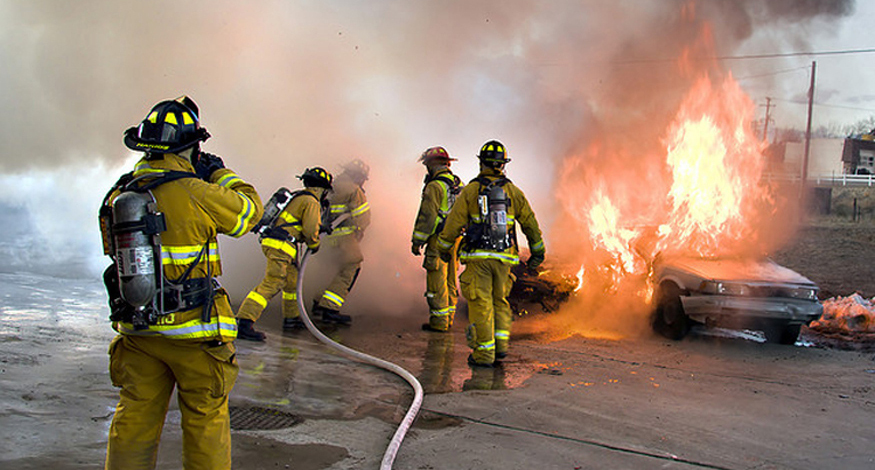
How do planes fly? How do we model blood flow? How do sprayers work for paints or aerosols? What is the purpose of a water tower? To answer these questions, we will examine fluid dynamics. The equations governing fluid dynamics are derived from the same equations that represent energy conservation. One of the most powerful equations in fluid dynamics is Bernoulli's equation, which governs the relationship between fluid pressure, kinetic energy, and potential energy (Essential Knowledge 5.B.10). We will see how Bernoulli's equation explains the pressure difference that provides lift for airplanes and provides the means for fluids (like water or paint or perfume) to move in useful ways.
The content in this chapter supports:
Big Idea 5 Changes that occur as a result of interactions are constrained by conservation laws.
Enduring Understanding 5.B The energy of a system is conserved.
Essential Knowledge 5.B.10 Bernoulli's equation describes the conservation of energy in a fluid flow.
Enduring Understanding 5.F Classically, the mass of a system is conserved.
Essential Knowledge 5.F.1 The continuity equation describes conservation of mass flow rate in fluids.
OpenStax AP Physics Chapter 12: Fluid Flow (Physics Concept Trailer™)
Glossary
- fluid dynamics
- the physics of fluids in motion