Learning Objectives
By the end of this section, you will be able to:
- Define density.
- Calculate the mass of a reservoir from its density.
- Compare and contrast the densities of various substances.
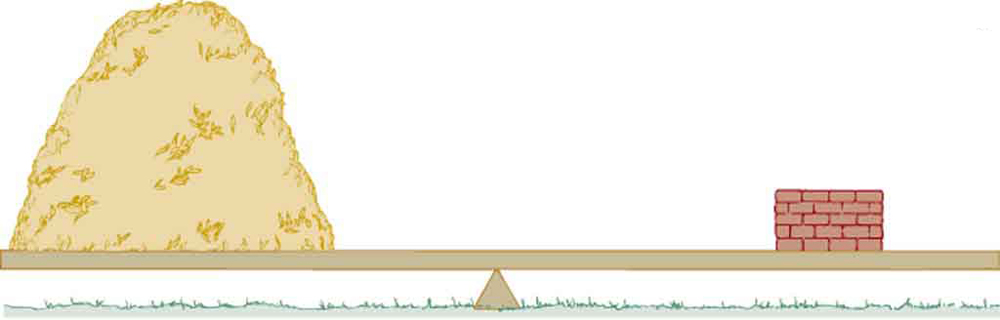
Which weighs more, a ton of feathers or a ton of bricks? This old riddle plays with the distinction between mass and density. A ton is a ton, of course; but bricks have much greater density than feathers, and so we are tempted to think of them as heavier. (See Figure 11.3.)
Density, as you will see, is an important characteristic of substances. It is crucial, for example, in determining whether an object sinks or floats in a fluid. Density is the mass per unit volume of a substance or object. In equation form, density is defined as
where the Greek letter (rho) is the symbol for density, is the mass, and is the volume occupied by the substance.
Density is mass per unit volume.
where is the symbol for density, is the mass, and is the volume occupied by the substance.
In the riddle regarding the feathers and bricks, the masses are the same, but the volume occupied by the feathers is much greater, since their density is much lower. The SI unit of density is , representative values are given in Table 11.1. The metric system was originally devised so that water would have a density of , equivalent to . Thus the basic mass unit, the kilogram, was first devised to be the mass of 1000 mL of water, which has a volume of 1000 cm3.
| Substance | or | Substance | or | Substance | or |
|---|---|---|---|---|---|
| Solids | Liquids | Gases | |||
| Aluminum | 2.7 | Water (4ºC) | 1.000 | Air | |
| Brass | 8.44 | Blood | 1.05 | Carbon dioxide | |
| Copper (average) | 8.8 | Sea water | 1.025 | Carbon monoxide | |
| Gold | 19.32 | Mercury | 13.6 | Hydrogen | |
| Iron or steel | 7.8 | Ethyl alcohol | 0.79 | Helium | |
| Lead | 11.3 | Gasoline | 0.68 | Methane | |
| Polystyrene | 0.10 | Glycerin | 1.26 | Nitrogen | |
| Tungsten | 19.30 | Olive oil | 0.92 | Nitrous oxide | |
| Uranium | 18.70 | Oxygen | |||
| Concrete | 2.30–3.0 | Steam | |||
| Cork | 0.24 | ||||
| Glass, common (average) | 2.6 | ||||
| Granite | 2.7 | ||||
| Earth’s crust | 3.3 | ||||
| Wood | 0.3–0.9 | ||||
| Ice (0°C) | 0.917 | ||||
| Bone | 1.7–2.0 | ||||
| Silver | 10.49 |
The table shows the value of density in units of kilogram per meter cubed for certain solids, liquids, and gases.
As you can see by examining Table 11.1, the density of an object may help identify its composition. The density of gold, for example, is about 2.5 times the density of iron, which is about 2.5 times the density of aluminum. Density also reveals something about the phase of the matter and its substructure. Notice that the densities of liquids and solids are roughly comparable, consistent with the fact that their atoms are in close contact. The densities of gases are much less than those of liquids and solids, because the atoms in gases are separated by large amounts of empty space.
A pile of sugar and a pile of salt look pretty similar, but which weighs more? If the volumes of both piles are the same, any difference in mass is due to their different densities (including the air space between crystals). Which do you think has the greater density? What values did you find? What method did you use to determine these values?
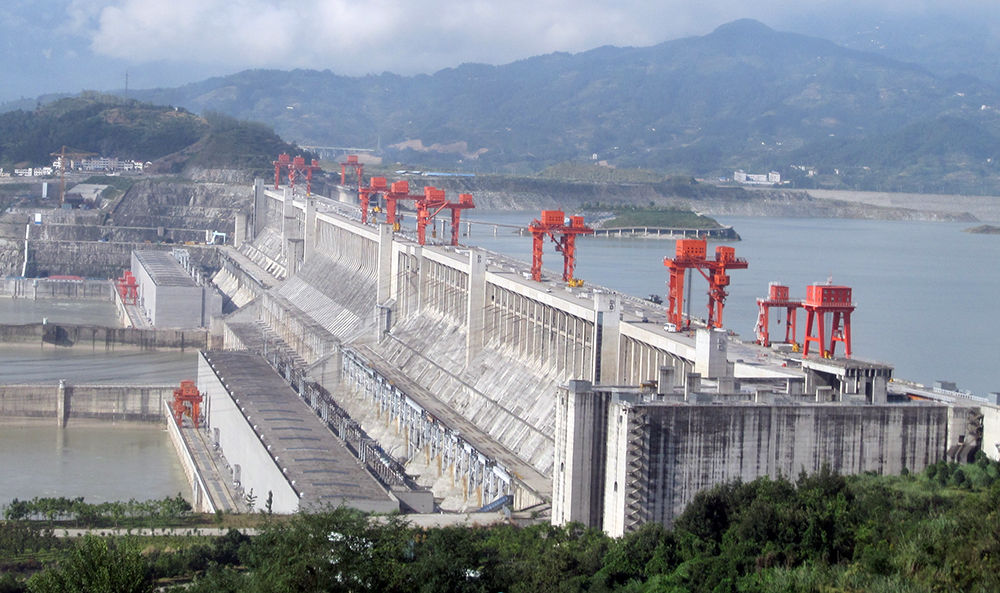
A reservoir has a surface area of and an average depth of 40.0 m. What mass of water is held behind the dam? (See Figure 11.4 for a view of a large reservoir—the Three Gorges Dam site on the Yangtze River in central China.)
We can calculate the volume of the reservoir from its dimensions, and find the density of water in Table 11.1. Then the mass can be found from the definition of density
Solution
Solving equation for gives .
The volume of the reservoir is its surface area times its average depth :
The density of water from Table 11.1 is . Substituting and into the expression for mass gives
Discussion
A large reservoir contains a very large mass of water. In this example, the weight of the water in the reservoir is , where is the acceleration due to the Earth’s gravity (about ). It is reasonable to ask whether the dam must supply a force equal to this tremendous weight. The answer is no. As we shall see in the following sections, the force the dam must supply can be much smaller than the weight of the water it holds back.
Test Prep for AP Courses
An under-inflated volleyball is pumped full of air so that its radius increases by 10%. Ignoring the mass of the air inserted into the ball, what will happen to the volleyball's density?
- The density of the volleyball will increase by approximately 25%.
- The density of the volleyball will increase by approximately 10%.
- The density of the volleyball will decrease by approximately 10%.
- The density of the volleyball will decrease by approximately 17%.
- The density of the volleyball will decrease by approximately 25%.
(e)
A piece of aluminum foil has a known surface density of 15 g/cm2. If a 100-gram hollow cube were constructed using this foil, determine the approximate side length of this cube.
- 1.05 cm
- 1.10 cm
- 2.6 cm
- 6.67 cm
- 15 cm
A cube of polystyrene measuring 10 cm per side lies partially submerged in a large container of water.
- If 90% of the polystyrene floats above the surface of the water, what is the density of the polystyrene? (Note: The density of water is 1000 kg/m3.)
- A 0.5 kg mass is placed on the block of polystyrene. What percentage of the block now remains above water?
- The water is poured out of the container and replaced with ethyl alcohol (density = 790 kg/m3).
- Will the block be able to remain partially submerged in this new fluid? Explain.
- Will the block be able to remain partially submerged in this new fluid with the 0.5 kg mass placed on top? Explain.
- Without using a container of water, explain how you could determine the density of the polystyrene mentioned above if the material instead were spherical.
(a) 100 kg/m3 (b) 60% (c) yes; yes (76% will be submerged) (d) answers vary
Four spheres are hung from a variety of different springs. The table below describes the characteristics of both the spheres and the springs from which they are hung. Use this information to rank the density of each sphere from least to greatest. Show work supporting your ranking.
| Material Type | Radius of Sphere | Stretch of Spring (from equilibrium) | Spring Constant |
|---|---|---|---|
| A | 10 cm | 5 cm | 2 N/m |
| B | 5 cm | 8 cm | 8 N/m |
| C | 8 cm | 10 cm | 6 N/m |
| D | 8 cm | 12 cm | 10 N/m |
Table showing the radius of the sphere, the stretch of the spring from equilibrium, and the spring constant for the spring for four materials. Material A has sphere radius 10 centimeters, stretch 5 centimeters, and spring constant 2 newtons per meter. Material B has sphere radius 5 centimeters, stretch 8 centimeters, and spring constant 8 newtons per meters. Material C has sphere radius 8 centimeters, stretch 10 centimeters, and spring constant 6 newtons per meters. Material D has sphere radius 8 centimeters, stretch 12 centimeters, and spring constant 10 newtons per meter.
Rank the densities of the objects listed above, from greatest to least. Show work supporting your ranking.
Section Summary
- Density is the mass per unit volume of a substance or object. In equation form, density is defined as
11.6
- The SI unit of density is .
Conceptual Questions
Approximately how does the density of air vary with altitude?
Give an example in which density is used to identify the substance composing an object. Would information in addition to average density be needed to identify the substances in an object composed of more than one material?
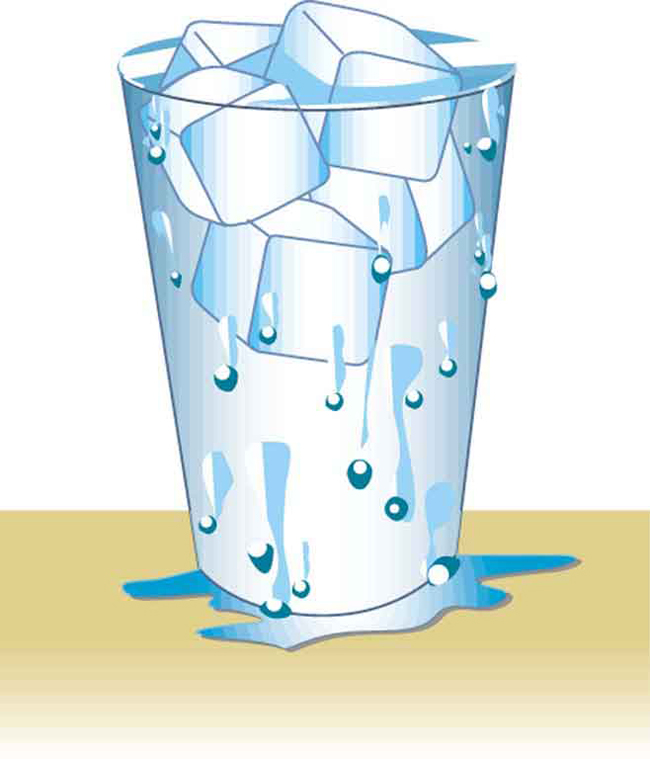
Figure 11.5 shows a glass of ice water filled to the brim. Will the water overflow when the ice melts? Explain your answer.
Problems & Exercises
Gold is sold by the troy ounce (31.103 g). What is the volume of 1 troy ounce of pure gold?
Mercury is commonly supplied in flasks containing 34.5 kg (about 76 lb). What is the volume in liters of this much mercury?
(a) What is the mass of a deep breath of air having a volume of 2.00 L? (b) Discuss the effect taking such a breath has on your body’s volume and density.
(a) 2.58 g
(b) The volume of your body increases by the volume of air you inhale. The average density of your body decreases when you take a deep breath, because the density of air is substantially smaller than the average density of the body before you took the deep breath.
A straightforward method of finding the density of an object is to measure its mass and then measure its volume by submerging it in a graduated cylinder. What is the density of a 240-g rock that displaces of water? (Note that the accuracy and practical applications of this technique are more limited than a variety of others that are based on Archimedes’ principle.)
Suppose you have a coffee mug with a circular cross section and vertical sides (uniform radius). What is its inside radius if it holds 375 g of coffee when filled to a depth of 7.50 cm? Assume coffee has the same density as water.
(a) A rectangular gasoline tank can hold 50.0 kg of gasoline when full. What is the depth of the tank if it is 0.500-m wide by 0.900-m long? (b) Discuss whether this gas tank has a reasonable volume for a passenger car.
(a) 0.163 m
(b) Equivalent to 19.4 gallons, which is reasonable
A trash compactor can reduce the volume of its contents to 0.350 their original value. Neglecting the mass of air expelled, by what factor is the density of the rubbish increased?
A 2.50-kg steel gasoline can holds 20.0 L of gasoline when full. What is the average density of the full gas can, taking into account the volume occupied by steel as well as by gasoline?
What is the density of 18.0-karat gold that is a mixture of 18 parts gold, 5 parts silver, and 1 part copper? (These values are parts by mass, not volume.) Assume that this is a simple mixture having an average density equal to the weighted densities of its constituents.
There is relatively little empty space between atoms in solids and liquids, so that the average density of an atom is about the same as matter on a macroscopic scale—approximately . The nucleus of an atom has a radius about that of the atom and contains nearly all the mass of the entire atom. (a) What is the approximate density of a nucleus? (b) One remnant of a supernova, called a neutron star, can have the density of a nucleus. What would be the radius of a neutron star with a mass 10 times that of our Sun (the radius of the Sun is )?
(a)
(b)
Glossary
- density
- the mass per unit volume of a substance or object