Learning Objectives
By the end of this section, you will be able to:
- Understand Newton's third law of motion.
- Apply Newton's third law to define systems and solve problems of motion.
Baseball relief pitcher Mariano Rivera was so highly regarded that during his retirement year, opposing teams conducted farewell presentations when he played at their stadiums. The Minnesota Twins offered a unique gift: A chair made of broken bats. Any pitch can break a bat, but with Rivera's signature pitch—known as a cutter—the ball and the bat frequently came together at a point that shattered the hardwood. Typically, we think of a baseball or softball hitter exerting a force on the incoming ball, and baseball analysts focus on the resulting "exit velocity" as a key statistic. But the force of the ball can do its own damage. This is exactly what happens whenever one body exerts a force on another—the first also experiences a force (equal in magnitude and opposite in direction). Numerous common experiences, such as stubbing a toe or pushing off the floor during a jump, confirm this. It is precisely stated in Newton’s third law of motion.
Whenever one body exerts a force on a second body, the first body experiences a force that is equal in magnitude and opposite in direction to the force that it exerts.
This law represents a certain symmetry in nature: Forces always occur in pairs, and one body cannot exert a force on another without experiencing a force itself. We sometimes refer to this law loosely as “action-reaction,” where the force exerted is the action and the force experienced as a consequence is the reaction. Newton’s third law has practical uses in analyzing the origin of forces and understanding which forces are external to a system.
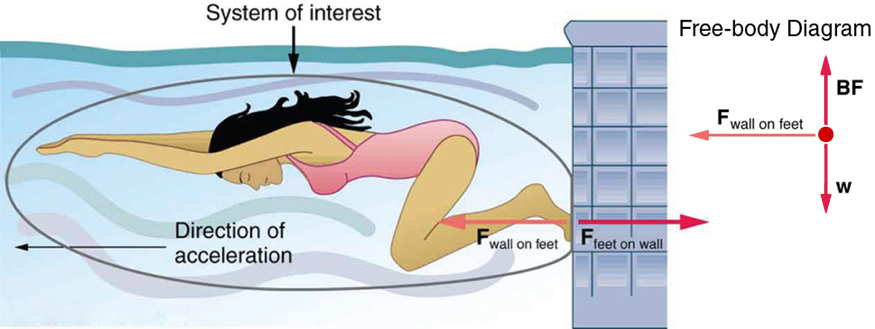
We can readily see Newton’s third law at work by taking a look at how people move about. Consider a swimmer pushing off from the side of a pool, as illustrated in Figure 4.15. She pushes against the pool wall with her feet and accelerates in the direction opposite to that of her push. The wall has exerted an equal and opposite force back on the swimmer. You might think that two equal and opposite forces would cancel, but they do not because they act on different systems. In this case, there are two systems that we could investigate: the swimmer or the wall. If we select the swimmer to be the system of interest, as in the figure, then is an external force on this system and affects its motion. The swimmer moves in the direction of . In contrast, the force acts on the wall and not on our system of interest. Thus does not directly affect the motion of the system and does not cancel . Note that the swimmer pushes in the direction opposite to that in which she wishes to move. The reaction to her push is thus in the desired direction.
Other examples of Newton’s third law are easy to find. As a professor walks in front of a whiteboard, she exerts a force backward on the floor. The floor exerts a reaction force forward on the professor that causes her to accelerate forward. Similarly, a car accelerates because the ground pushes forward on the drive wheels in reaction to the drive wheels pushing backward on the ground. You can see evidence of the wheels pushing backward when tires spin on a gravel road and throw rocks backward. In another example, rockets move forward by expelling gas backward at high velocity. This means the rocket exerts a large backward force on the gas in the rocket combustion chamber, and the gas therefore exerts a large reaction force forward on the rocket. This reaction force is called thrust. It is a common misconception that rockets propel themselves by pushing on the ground or on the air behind them. They actually work better in a vacuum, where they can more readily expel the exhaust gases. Helicopters similarly create lift by pushing air down, thereby experiencing an upward reaction force. Birds and airplanes also fly by exerting force on air in a direction opposite to that of whatever force they need. For example, the wings of a bird force air downward and backward in order to get lift and move forward. An octopus propels itself in the water by ejecting water through a funnel from its body, similar to a jet ski. Boxers and other martial arts fighters experience reaction forces when they punch, sometimes breaking their hand by hitting an opponent’s body.
A physics professor pushes a cart of demonstration equipment to a lecture hall, as seen in Figure 4.16. Her mass is 65.0 kg, the cart’s is 12.0 kg, and the equipment’s is 7.0 kg. Calculate the acceleration produced when the professor exerts a backward force of 150 N on the floor. All forces opposing the motion, such as friction on the cart’s wheels and air resistance, total 24.0 N.
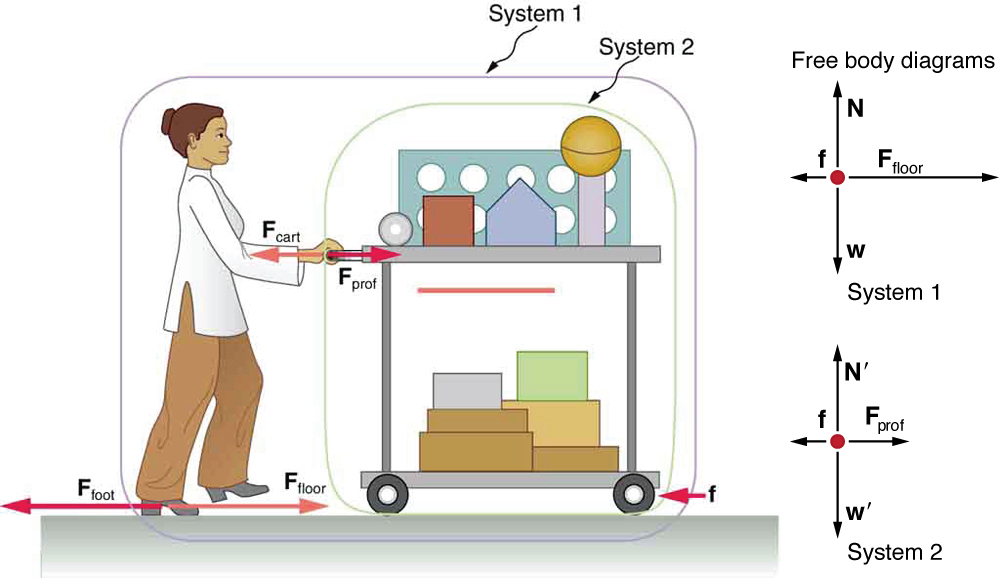
Since they accelerate as a unit, we define the system to be the professor, cart, and equipment. This is System 1 in Figure 4.16. The professor pushes backward with a force of 150 N. According to Newton’s third law, the floor exerts a forward reaction force of 150 N on System 1. Because all motion is horizontal, we can assume there is no net force in the vertical direction. The problem is therefore one-dimensional along the horizontal direction. As noted, opposes the motion and is thus in the opposite direction of . Note that we do not include the forces or because these are internal forces, and we do not include because it acts on the floor, not on the system. There are no other significant forces acting on System 1. If the net external force can be found from all this information, we can use Newton’s second law to find the acceleration as requested. See the free-body diagram in the figure.
Solution
Newton’s second law is given by
The net external force on System 1 is deduced from Figure 4.16 and the discussion above to be
The mass of System 1 is
These values of and produce an acceleration of
Discussion
None of the forces between components of System 1, such as between the professor’s hands and the cart, contribute to the net external force because they are internal to System 1. Another way to look at this is to note that forces between components of a system cancel because they are equal in magnitude and opposite in direction. For example, the force exerted by the professor on the cart results in an equal and opposite force back on her. In this case both forces act on the same system and, therefore, cancel. Thus internal forces (between components of a system) cancel. Choosing System 1 was crucial to solving this problem.
Calculate the force the professor exerts on the cart in Figure 4.16 using data from the previous example if needed.
If we now define the system of interest to be the cart plus equipment (System 2 in Figure 4.16), then the net external force on System 2 is the force the professor exerts on the cart minus friction. The force she exerts on the cart, , is an external force acting on System 2. was internal to System 1, but it is external to System 2 and will enter Newton’s second law for System 2.
Solution
Newton’s second law can be used to find . Starting with
and noting that the magnitude of the net external force on System 2 is
we solve for , the desired quantity:
The value of is given, so we must calculate net . That can be done since both the acceleration and mass of System 2 are known. Using Newton’s second law we see that
where the mass of System 2 is 19.0 kg (= 12.0 kg + 7.0 kg) and its acceleration was found to be in the previous example. Thus,
Now we can find the desired force:
Discussion
It is interesting that this force is significantly less than the 150-N force the professor exerted backward on the floor. Not all of that 150-N force is transmitted to the cart; some of it accelerates the professor.
The choice of a system is an important analytical step both in solving problems and in thoroughly understanding the physics of the situation (which is not necessarily the same thing).
Visualize the gravitational force that two objects exert on each other. Change properties of the objects in order to see how it changes the gravity force.
Test Prep for AP Courses
What object or objects commonly exert forces on the following objects in motion? (a) a soccer ball being kicked, (b) a dolphin jumping, (c) a parachutist drifting to Earth.
(a) A soccer player, gravity, air, and friction commonly exert forces on a soccer ball being kicked.
(b) Gravity and the surrounding water commonly exert forces on a dolphin jumping. (The dolphin moves its muscles to exert a force on the water. The water exerts an equal force on the dolphin, resulting in the dolphin’s motion.)
(c) Gravity and air exert forces on a parachutist drifting to Earth.
A ball with a mass of 0.25 kg hits a gym ceiling with a force of 78.0 N. What is the net force on the ball?
- 2.50 N downward
- 75.5 N downward
- 78.0 N downward
- 80.5 N downward
Which of the following is true?
- Earth exerts a force due to gravity on your body, and your body exerts a smaller force on the Earth, because your mass is smaller than the mass of the Earth.
- The Moon orbits the Earth because the Earth exerts a force on the Moon and the Moon exerts a force equal in magnitude and direction on the Earth.
- A rocket taking off exerts a force on the Earth equal to the force the Earth exerts on the rocket.
- An airplane cruising at a constant speed is not affected by gravity.
(c)
Stationary skater A pushes stationary skater B, who then accelerates at 5.0 m/s2. Skater A does not move. Since forces act in action-reaction pairs, explain why Skater A did not move?
The current in a river exerts a force of 9.0 N on a balloon floating in the river. A wind exerts a force of 13.0 N on the balloon in the opposite direction. Draw a free-body diagram to show the forces acting on the balloon. Use your free-body diagram to predict the effect on the balloon.
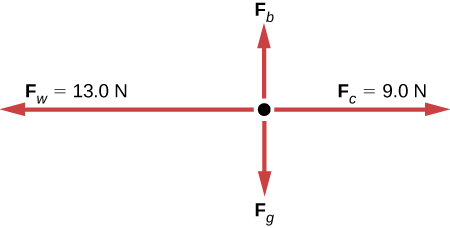
The diagram consists of a black dot in the center and two small red arrows pointing up (Fb) and down (Fg) and two long red arrows pointing right (Fc = 9.0 N) and left (Fw=13.0 N).
In the diagram, Fg represents the force due to gravity on the balloon, and Fb represents the buoyant force. These two forces are equal in magnitude and opposite in direction. Fc represents the force of the current. Fw represents the force of the wind. The net force on the balloon will be N and the balloon will accelerate in the direction the wind is blowing.
A force is applied to accelerate an object on a smooth icy surface. When the force stops, which of the following will be true? (Assume zero friction.)
- The object’s acceleration becomes zero.
- The object’s speed becomes zero.
- The object’s acceleration continues to increase at a constant rate.
- The object accelerates, but in the opposite direction.
A parachutist’s fall to Earth is determined by two opposing forces. A gravitational force of 539 N acts on the parachutist. After 2 s, she opens her parachute and experiences an air resistance of 615 N. At what speed is the parachutist falling after 10 s?
Since , the parachutist has a mass of .
For the first 2 s, the parachutist accelerates at 9.8 m/s2.
Her speed after 2 s is 19.6 m/s.
From 2 s to 10 s, the net force on the parachutist is 539 N – 615 N, or 76 N upward.
Since , .
At 10 s, the parachutist is falling to Earth at 8.4 m/s.
A flight attendant pushes a cart down the aisle of a plane in flight. In determining the acceleration of the cart relative to the plane, which factor do you not need to consider?
- The friction of the cart’s wheels.
- The force with which the flight attendant’s feet push on the floor.
- The velocity of the plane.
- The mass of the items in the cart.
A landscaper is easing a wheelbarrow full of soil down a hill. Define the system you would analyze and list all the forces that you would need to include to calculate the acceleration of the wheelbarrow.
The system includes the gardener and the wheelbarrow with its contents. The following forces are important to include: the weight of the wheelbarrow, the weight of the gardener, the normal force for the wheelbarrow and the gardener, the force of the gardener pushing against the ground and the equal force of the ground pushing back against the gardener, and any friction in the wheelbarrow’s wheels.
Two water-skiers, with masses of 48 kg and 61 kg, are preparing to be towed behind the same boat. When the boat accelerates, the rope the skiers hold onto accelerates with it and exerts a net force of 290 N on the skiers. At what rate will the skiers accelerate?
- 10.8 m/s2
- 2.7 m/s2
- 6.0 m/s2 and 4.8 m/s2
- 5.3 m/s2
A figure skater has a mass of 40 kg and her partner's mass is 50 kg. She pushes against the ice with a force of 120 N, causing her and her partner to move forward. Calculate the pair’s acceleration. Assume that all forces opposing the motion, such as friction and air resistance, total 5.0 N.
The system undergoing acceleration is the two figure skaters together.
Net force = .
Total mass = .
Using Newton’s second law, we have that
The pair accelerates forward at 1.28 m/s2.
Section Summary
- Newton’s third law of motion represents a basic symmetry in nature. It states: Whenever one body exerts a force on a second body, the first body experiences a force that is equal in magnitude and opposite in direction to the force that the first body exerts.
- A thrust is a reaction force that pushes a body forward in response to a backward force. Rockets, airplanes, and cars are pushed forward by a thrust reaction force.
Conceptual Questions
When you take off in a jet aircraft, there is a sensation of being pushed back into the seat. Explain why you move backward in the seat—is there really a force backward on you? (The same reasoning explains whiplash injuries, in which the head is apparently thrown backward.)
A device used since the 1940s to measure the kick or recoil of the body due to heart beats is the “ballistocardiograph.” What physics principle(s) are involved here to measure the force of cardiac contraction? How might we construct such a device?
Describe a situation in which one system exerts a force on another and, as a consequence, experiences a force that is equal in magnitude and opposite in direction. Which of Newton’s laws of motion apply?
Why does an ordinary rifle recoil (kick backward) when fired? The barrel of a recoilless rifle is open at both ends. Describe how Newton’s third law applies when one is fired. Can you safely stand close behind one when it is fired?
An American football lineman reasons that it is senseless to try to out-push the opposing player, since no matter how hard he pushes he will experience an equal and opposite force from the other player. Use Newton’s laws and draw a free-body diagram of an appropriate system to explain how he can still out-push the opposition if he is strong enough.
Newton’s third law of motion tells us that forces always occur in pairs of equal and opposite magnitude. Explain how the choice of the “system of interest” affects whether one such pair of forces cancels.
Problem Exercises
What net external force is exerted on a 1100-kg artillery shell fired from a battleship if the shell is accelerated at ? What is the magnitude of the force exerted on the ship by the artillery shell?
Force on shell:
Force exerted on ship = , by Newton’s third law
A rugby player is being pushed backward by an opposing player who is exerting a force of 800 N on him. The mass of the losing player plus equipment is 90.0 kg, and he is accelerating at backward. (a) What is the force of friction between the losing player’s feet and the grass? (b) What force does the winning player exert on the ground to move forward if his mass plus equipment is 110 kg? (c) Draw a sketch of the situation showing the system of interest used to solve each part. For this situation, draw a free-body diagram and write the net force equation.
Glossary
- Newton’s third law of motion
- whenever one body exerts a force on a second body, the first body experiences a force that is equal in magnitude and opposite in direction to the force that the first body exerts
- thrust
- a reaction force that pushes a body forward in response to a backward force; rockets, airplanes, and cars are pushed forward by a thrust reaction force