- Recognize when a function of two variables is integrable over a general region.
- Evaluate a double integral by computing an iterated integral over a region bounded by two vertical lines and two functions of or two horizontal lines and two functions of
- Simplify the calculation of an iterated integral by changing the order of integration.
- Use double integrals to calculate the volume of a region between two surfaces or the area of a plane region.
- Solve problems involving double improper integrals.
In Double Integrals over Rectangular Regions, we studied the concept of double integrals and examined the tools needed to compute them. We learned techniques and properties to integrate functions of two variables over rectangular regions. We also discussed several applications, such as finding the volume bounded above by a function over a rectangular region, finding area by integration, and calculating the average value of a function of two variables.
In this section we consider double integrals of functions defined over a general bounded region on the plane. Most of the previous results hold in this situation as well, but some techniques need to be extended to cover this more general case.
General Regions of Integration
An example of a general bounded region on a plane is shown in Figure 5.12. Since is bounded on the plane, there must exist a rectangular region on the same plane that encloses the region that is, a rectangular region exists such that is a subset of
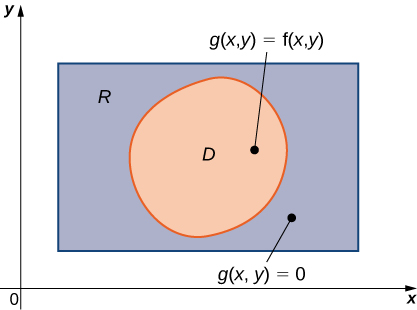
Suppose is defined on a general planar bounded region as in Figure 5.12. In order to develop double integrals of over we extend the definition of the function to include all points on the rectangular region and then use the concepts and tools from the preceding section. But how do we extend the definition of to include all the points on We do this by defining a new function on as follows:
Note that we might have some technical difficulties if the boundary of is complicated. So we assume the boundary to be a piecewise smooth and continuous simple closed curve. Also, since all the results developed in Double Integrals over Rectangular Regions used an integrable function we must be careful about and verify that is an integrable function over the rectangular region This happens as long as the region is bounded by simple closed curves. For now we will concentrate on the descriptions of the regions rather than the function and extend our theory appropriately for integration.
We consider two types of planar bounded regions.
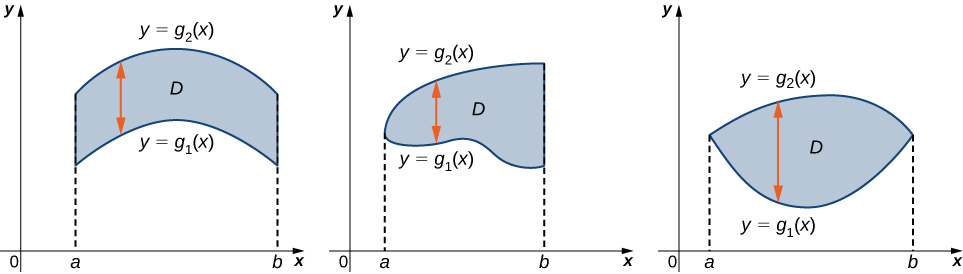
A region in the -plane is of Type I if it lies between two vertical lines and the graphs of two continuous functions and That is (Figure 5.13),
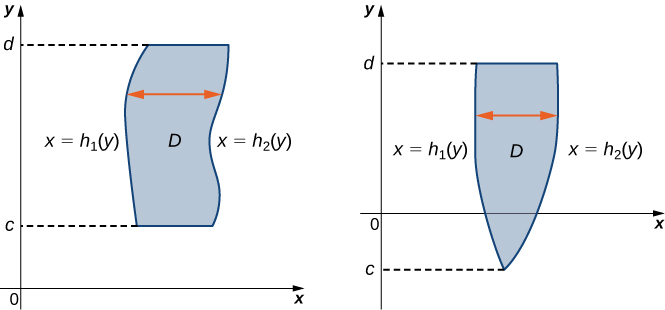
A region in the plane is of Type II if it lies between two horizontal lines and the graphs of two continuous functions That is (Figure 5.14),
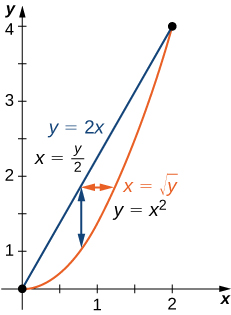
Consider the region in the first quadrant between the functions and (Figure 5.15). Describe the region first as Type I and then as Type II.
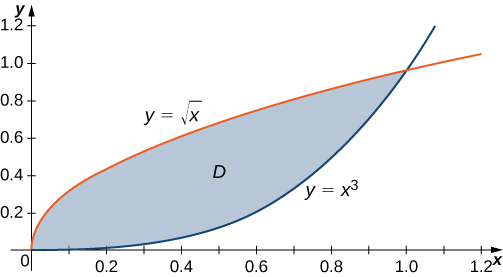
When describing a region as Type I, we need to identify the function that lies above the region and the function that lies below the region. Here, region is bounded above by and below by in the interval for Hence, as Type I, is described as the set
However, when describing a region as Type II, we need to identify the function that lies on the left of the region and the function that lies on the right of the region. Here, the region is bounded on the left by and on the right by in the interval for y in Hence, as Type II, is described as the set
Consider the region in the first quadrant between the functions and Describe the region first as Type I and then as Type II.
Type I and Type II are expressed as and respectively.
Double Integrals over Nonrectangular Regions
To develop the concept and tools for evaluation of a double integral over a general, nonrectangular region, we need to first understand the region and be able to express it as Type I or Type II or a combination of both. Without understanding the regions, we will not be able to decide the limits of integrations in double integrals. As a first step, let us look at the following theorem.
Suppose is the extension to the rectangle of the integrable function defined on the region , where is inside . Sample regions are as shown in Figure 5.12. Then is integrable and we define the double integral of over by
The right-hand side of this equation is what we have seen before, so this theorem is reasonable because is a rectangle and has been discussed in the preceding section. Also, the equality works because the values of are for any point that lies outside and hence these points do not add anything to the integral. However, it is important that the rectangle contains the region
As a matter of fact, if the region is bounded by smooth curves on a plane and we are able to describe it as Type I or Type II or a mix of both, then we can use the following theorem and not have to find a rectangle containing the region.
For a function that is continuous on a region of Type I, we have
Similarly, for a function that is continuous on a region of Type II, we have
The integral in each of these expressions is an iterated integral, similar to those we have seen before. Notice that, in the inner integral in the first expression, we integrate with being held constant and the limits of integration being In the inner integral in the second expression, we integrate with being held constant and the limits of integration are
Evaluate the integral where is shown in Figure 5.16.
First construct the region as a Type I region (Figure 5.16). Here Then we have
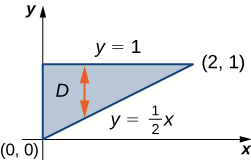
Therefore, we have
In Example 5.12, we could have looked at the region in another way, such as (Figure 5.17).
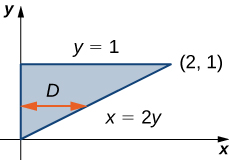
This is a Type II region and the integral would then look like
However, if we integrate first with respect to this integral is lengthy to compute because we have to use integration by parts twice.
Evaluate the integral where
Notice that can be seen as either a Type I or a Type II region, as shown in Figure 5.18. However, in this case describing as Type is more complicated than describing it as Type II. Therefore, we use as a Type II region for the integration.
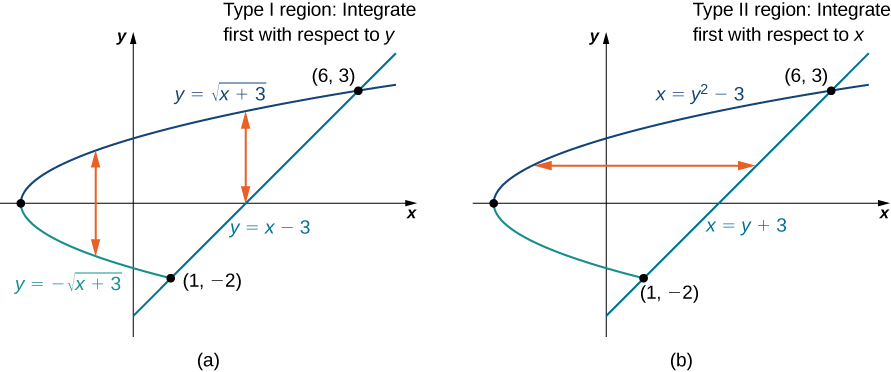
Choosing this order of integration, we have
Sketch the region and evaluate the iterated integral where is the region bounded by the curves and in the interval
Express as a Type I region, and integrate with respect to first.
Recall from Double Integrals over Rectangular Regions the properties of double integrals. As we have seen from the examples here, all these properties are also valid for a function defined on a nonrectangular bounded region on a plane. In particular, property states:
If and except at their boundaries, then
Similarly, we have the following property of double integrals over a nonrectangular bounded region on a plane.
Suppose the region can be expressed as where and do not overlap except at their boundaries. Then
This theorem is particularly useful for nonrectangular regions because it allows us to split a region into a union of regions of Type I and Type II. Then we can compute the double integral on each piece in a convenient way, as in the next example.
Express the region shown in Figure 5.19 as a union of regions of Type I or Type II, and evaluate the integral
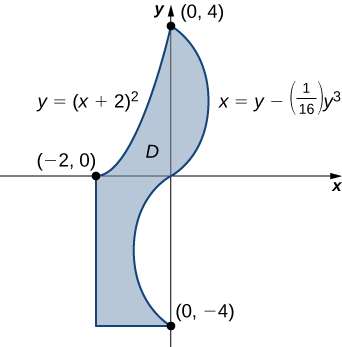
The region is not easy to decompose into any one type; it is actually a combination of different types. So we can write it as a union of three regions where, These regions are illustrated more clearly in Figure 5.20.
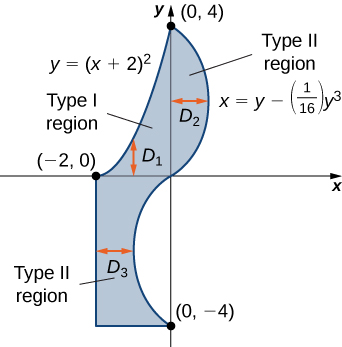
Here is Type and and are both of Type II. Hence,
Now we could redo this example using a union of two Type II regions (see the Checkpoint).
Consider the region bounded by the curves and in the interval Decompose the region into smaller regions of Type II.
Sketch the region, and split it into three regions to set it up.
Changing the Order of Integration
As we have already seen when we evaluate an iterated integral, sometimes one order of integration leads to a computation that is significantly simpler than the other order of integration. Sometimes the order of integration does not matter, but it is important to learn to recognize when a change in order will simplify our work.
Reverse the order of integration in the iterated integral Then evaluate the new iterated integral.
The region as presented is of Type I. To reverse the order of integration, we must first express the region as Type II. Refer to Figure 5.21.
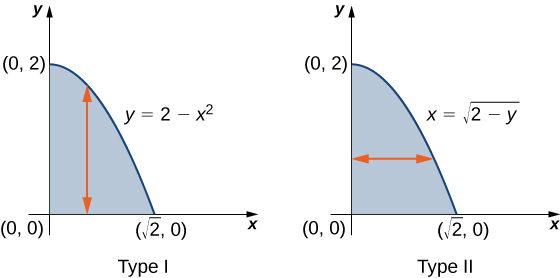
We can see from the limits of integration that the region is bounded above by and below by where is in the interval By reversing the order, we have the region bounded on the left by and on the right by where is in the interval We solved in terms of to obtain
Hence
Consider the iterated integral where over a triangular region that has sides on and the line Sketch the region, and then evaluate the iterated integral by
- integrating first with respect to and then
- integrating first with respect to
A sketch of the region appears in Figure 5.22.
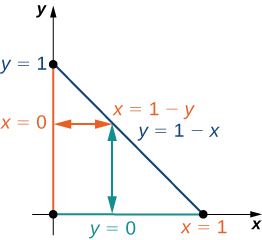
We can complete this integration in two different ways.
- One way to look at it is by first integrating from vertically and then integrating from
- The other way to do this problem is by first integrating from horizontally and then integrating from
Evaluate the iterated integral over the region in the first quadrant between the functions and Evaluate the iterated integral by integrating first with respect to and then integrating first with resect to
Sketch the region and follow Example 5.16.
Calculating Volumes, Areas, and Average Values
We can use double integrals over general regions to compute volumes, areas, and average values. The methods are the same as those in Double Integrals over Rectangular Regions, but without the restriction to a rectangular region, we can now solve a wider variety of problems.
Find the volume of the solid bounded by the planes and
The solid is a tetrahedron with the base on the -plane and a height The base is the region bounded by the lines, and where (Figure 5.23). Note that we can consider the region as Type I or as Type II, and we can integrate in both ways.
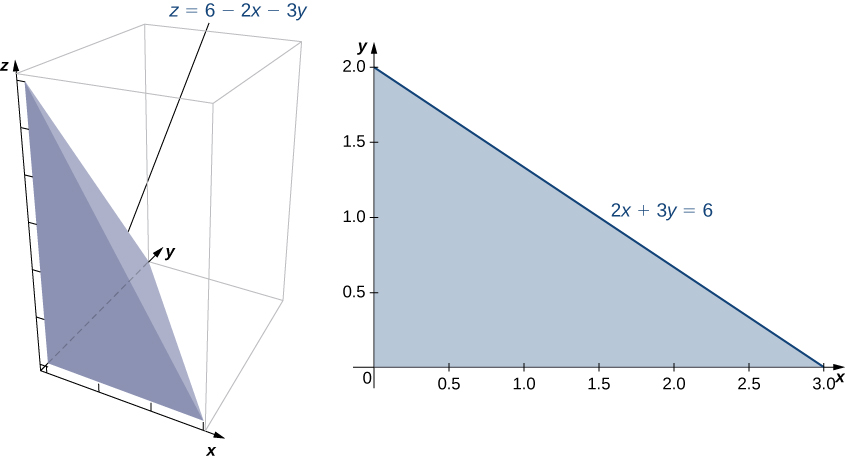
First, consider as a Type I region, and hence
Therefore, the volume is
Now consider as a Type II region, so In this calculation, the volume is
Therefore, the volume is cubic units.
Find the volume of the solid bounded above by over the region enclosed by the curves and where is in the interval
cubic units
Sketch the region, and describe it as Type I.
Finding the area of a rectangular region is easy, but finding the area of a nonrectangular region is not so easy. As we have seen, we can use double integrals to find a rectangular area. As a matter of fact, this comes in very handy for finding the area of a general nonrectangular region, as stated in the next definition.
The area of a plane-bounded region is defined as the double integral
We have already seen how to find areas in terms of single integration. Here we are seeing another way of finding areas by using double integrals, which can be very useful, as we will see in the later sections of this chapter.
Find the area of the region bounded below by the curve and above by the line in the first quadrant (Figure 5.24).
We just have to integrate the constant function over the region. Thus, the area of the bounded region is or
Find the area of a region bounded above by the curve and below by over the interval
square units
Sketch the region.
We can also use a double integral to find the average value of a function over a general region. The definition is a direct extension of the earlier formula.
If is integrable over a plane-bounded region with positive area then the average value of the function is
Note that the area is
Find the average value of the function on the region bounded by the line and the curve (Figure 5.25).
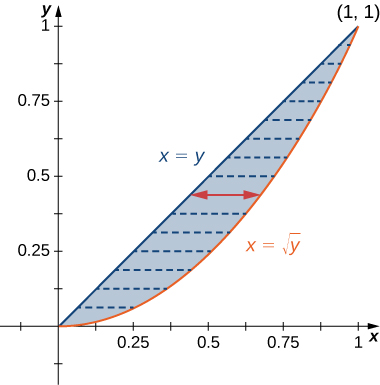
First find the area where the region is given by the figure. We have
Then the average value of the given function over this region is
Find the average value of the function over the triangle with vertices
Express the line joining and as a function
Improper Double Integrals
An improper double integral is an integral where either is an unbounded region or is an unbounded function. For example, is an unbounded region, and the function over the ellipse is an unbounded function. Hence, both of the following integrals are improper integrals:
- where
- where
In this section we would like to deal with improper integrals of functions over rectangles or simple regions such that has only finitely many discontinuities. Not all such improper integrals can be evaluated; however, a form of Fubini’s theorem does apply for some types of improper integrals.
If is a bounded rectangle or simple region in the plane defined by and also by and is a nonnegative function on with finitely many discontinuities in the interior of then
It is very important to note that we required that the function be nonnegative on for the theorem to work. We consider only the case where the function has finitely many discontinuities inside
Consider the function over the region
Notice that the function is nonnegative and continuous at all points on except Use Fubini’s theorem to evaluate the improper integral.
First we plot the region (Figure 5.26); then we express it in another way.
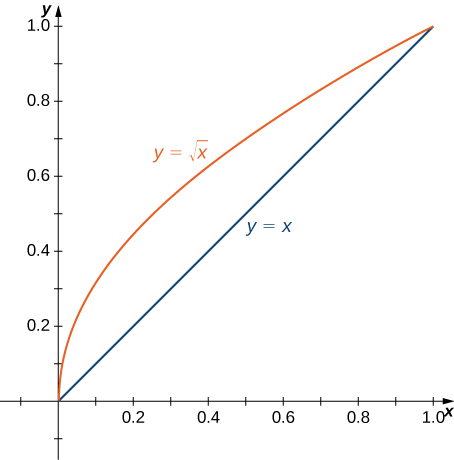
The other way to express the same region is
Thus we can use Fubini’s theorem for improper integrals and evaluate the integral as
Therefore, we have
As mentioned before, we also have an improper integral if the region of integration is unbounded. Suppose now that the function is continuous in an unbounded rectangle
If is an unbounded rectangle such as then when the limit exists, we have
The following example shows how this theorem can be used in certain cases of improper integrals.
Evaluate the integral where is the first quadrant of the plane.
The region is the first quadrant of the plane, which is unbounded. So
Thus, is convergent and the value is
Evaluate the improper integral where
Notice that the integral is nonnegative and discontinuous on Express the region as and integrate using the method of substitution.
In some situations in probability theory, we can gain insight into a problem when we are able to use double integrals over general regions. Before we go over an example with a double integral, we need to set a few definitions and become familiar with some important properties.
Consider a pair of continuous random variables and such as the birthdays of two people or the number of sunny and rainy days in a month. The joint density function of and satisfies the probability that lies in a certain region
Since the probabilities can never be negative and must lie between and the joint density function satisfies the following inequality and equation:
The variables and are said to be independent random variables if their joint density function is the product of their individual density functions:
At Sydney’s Restaurant, customers must wait an average of minutes for a table. From the time they are seated until they have finished their meal requires an additional minutes, on average. What is the probability that a customer spends less than an hour and a half at the diner, assuming that waiting for a table and completing the meal are independent events?
Waiting times are mathematically modeled by exponential density functions, with being the average waiting time, as
If and are random variables for ‘waiting for a table’ and ‘completing the meal,’ then the probability density functions are, respectively,
Clearly, the events are independent and hence the joint density function is the product of the individual functions
We want to find the probability that the combined time is less than minutes. In terms of geometry, it means that the region is in the first quadrant bounded by the line (Figure 5.27).
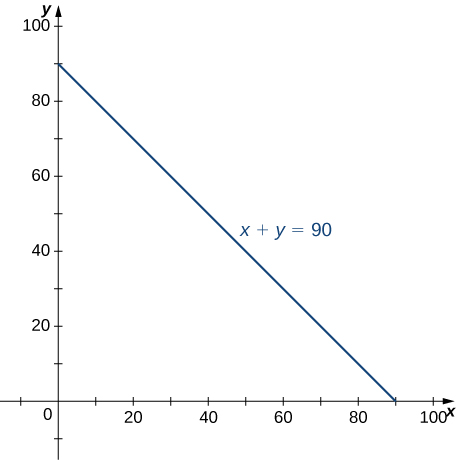
Hence, the probability that is in the region is
Since is the same as we have a region of Type I, so
Thus, there is an chance that a customer spends less than an hour and a half at the restaurant.
Another important application in probability that can involve improper double integrals is the calculation of expected values. First we define this concept and then show an example of a calculation.
In probability theory, we denote the expected values and respectively, as the most likely outcomes of the events. The expected values and are given by
where is the sample space of the random variables and
Find the expected time for the events ‘waiting for a table’ and ‘completing the meal’ in Example 5.22.
Using the first quadrant of the rectangular coordinate plane as the sample space, we have improper integrals for and The expected time for a table is
A similar calculation shows that This means that the expected values of the two random events are the average waiting time and the average dining time, respectively.
The joint density function for two random variables and is given by
Find the probability that is at most and is at least
Compute the probability
Key Concepts
- A general bounded region on the plane is a region that can be enclosed inside a rectangular region. We can use this idea to define a double integral over a general bounded region.
- To evaluate an iterated integral of a function over a general nonrectangular region, we sketch the region and express it as a Type I or as a Type II region or as a union of several Type I or Type II regions that overlap only on their boundaries.
- We can use double integrals to find volumes, areas, and average values of a function over general regions, similarly to calculations over rectangular regions.
- We can use Fubini’s theorem for improper integrals to evaluate some types of improper integrals.
Key Equations
| Iterated integral over a Type I region | |
| Iterated integral over a Type II region |
.
In the following exercises, specify whether the region is of Type I or Type II.
The region bounded by and as given in the following figure.
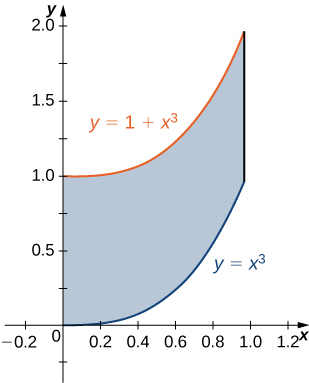
Find the average value of the function on the region graphed in the previous exercise.
Find the area of the region given in the previous exercise.
The region bounded by as given in the following figure.
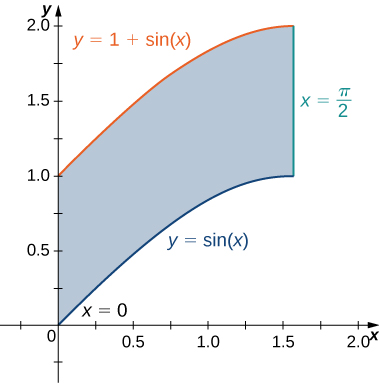
Type I but not Type II
Find the average value of the function on the region graphed in the previous exercise.
Find the area of the region given in the previous exercise.
The region bounded by and as given in the following figure.
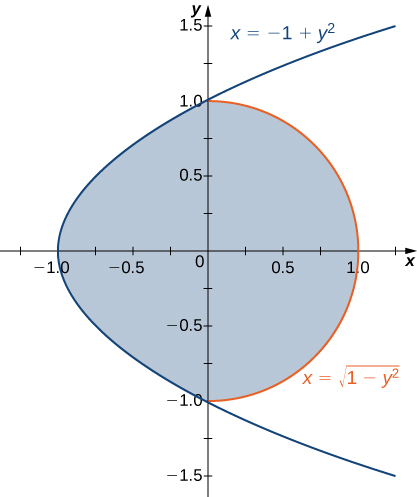
Find the volume of the solid under the graph of the function and above the region in the figure in the previous exercise.
The region bounded by as given in the following figure.
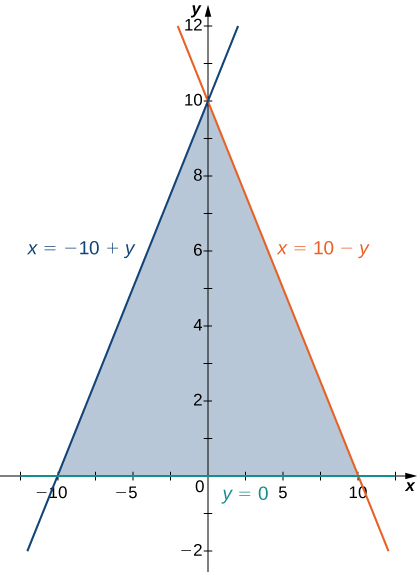
Find the signed volume of the solid under the graph of the function and above the region in the figure from the previous exercise.
The region bounded by as given in the following figure.
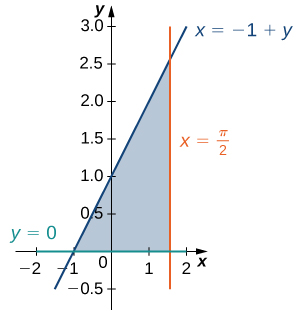
The region bounded by and as given in the following figure.
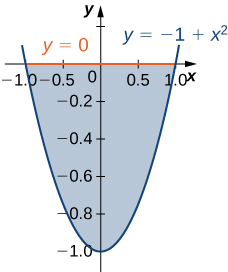
Type I and Type II
Let be the region bounded by the curve and below the equations Explain why is neither of Type I nor II.
Let be the region bounded above by the curve of the equation and below by and the -axis. Explain why is neither of Type I nor II.
The region is not of Type I: it does not lie between two vertical lines and the graphs of two continuous functions and The region is not of Type II: it does not lie between two horizontal lines and the graphs of two continuous functions and
In the following exercises, evaluate the double integral over the region
and
and
and
and
and is the triangular region with vertices
and is the triangular region with vertices
Evaluate the iterated integrals.
Let be the region in the first quadrant bounded by and the - and -axes.
- Show that by dividing the region into two regions of Type I.
- Evaluate the integral
Let be the region bounded by and the -axis.
- Show that by dividing into two regions of Type I.
- Evaluate the integral
a. Answers may vary; b.
- Show that by dividing the region into two regions of Type I, where
- Evaluate the integral
Let be the region bounded by and
- Show that by dividing the region into two regions of Type II, where
- Evaluate the integral
a. Answers may vary; b.
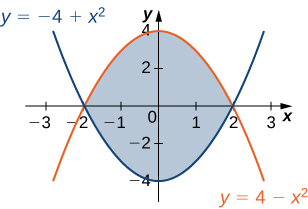
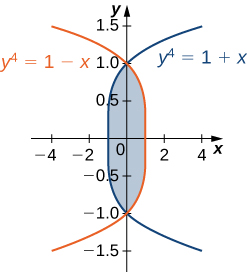
The region bounded by and is shown in the following figure. Find the area of the region
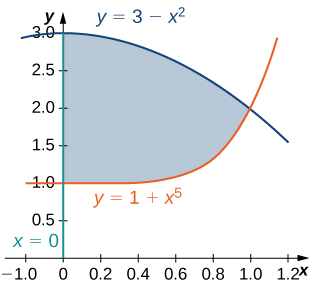
The region bounded by and is shown in the following figure. Find the area of the region
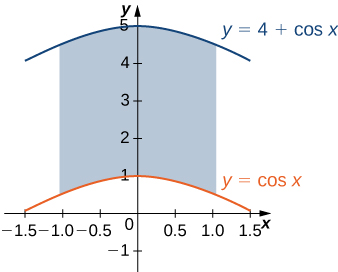
Find the area of the region
Let be the region bounded by and the -axis. Find the area of the region
Find the average value of the function on the triangular region with vertices and
Find the average value of the function on the triangular region with vertices and
In the following exercises, change the order of integration and evaluate the integral.
The region is shown in the following figure. Evaluate the double integral by using the easier order of integration.
The region is given in the following figure. Evaluate the double integral by using the easier order of integration.
Find the volume of the solid under the surface and above the region bounded by and
Find the volume in the first octant of the solid under the plane and above the region determined by and
Find the volume of the solid under the plane and above the region bounded by and
Find the volume of the solid under the surface and above the plane region bounded by and for values of between
Let be a positive, increasing, and differentiable function on the interval Show that the volume of the solid under the surface and above the region bounded by and is given by
Let be a positive, increasing, and differentiable function on the interval and let be a positive real number. Show that the volume of the solid under the surface and above the region bounded by and is given by
Find the volume of the solid situated in the first octant and determined by the planes
Find the volume of the solid situated in the first octant and bounded by the planes
Find the volume of the solid bounded by the planes and
Find the volume of the solid bounded by the planes
Let and be the solids situated in the first octant under the planes and respectively, and let be the solid situated between
- Find the volume of the solid
- Find the volume of the solid
- Find the volume of the solid by subtracting the volumes of the solids
Let be the solids situated in the first octant under the planes and respectively, and let be the solid situated between
- Find the volume of the solid
- Find the volume of the solid
- Find the volume of the solid by subtracting the volumes of the solids
a. b. c.
Let be the solids situated in the first octant under the plane and under the sphere respectively. If the volume of the solid is determine the volume of the solid situated between and by subtracting the volumes of these solids.
Consider the plane and the cylinder in the first octant.
- Find the volume under the plane.
- Find the volume inside the cylinder under the plane .
- Find the volume above the plane, inside the cylinder, and below the plane .
a. b. c.
[T] The following figure shows the region bounded by the curves and Use a graphing calculator or CAS to find the -coordinates of the intersection points of the curves and to determine the area of the region Round your answers to six decimal places.
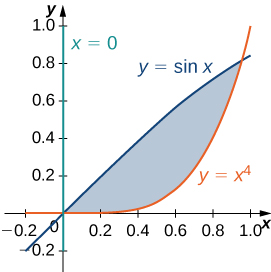
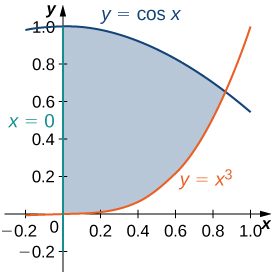
[T] The region bounded by the curves is shown in the following figure. Use a graphing calculator or CAS to find the x-coordinates of the intersection points of the curves and to determine the area of the region Round your answers to six decimal places.
Suppose that is the outcome of an experiment that must occur in a particular region in the -plane. In this context, the region is called the sample space of the experiment and are random variables. If is a region included in then the probability of being in is defined as where is the joint probability density of the experiment. Here, is a nonnegative function for which Assume that a point is chosen arbitrarily in the square with the probability density
Find the probability that the point is inside the unit square and interpret the result.
Consider two random variables of probability densities and respectively. The random variables are said to be independent if their joint density function is given by At a drive-thru restaurant, customers spend, on average, minutes placing their orders and an additional minutes paying for and picking up their meals. Assume that placing the order and paying for/picking up the meal are two independent events and If the waiting times are modeled by the exponential probability densities
respectively, the probability that a customer will spend less than 6 minutes in the drive-thru line is given by where Find and interpret the result.
there is a chance that a customer will spend minutes in the drive-thru line.
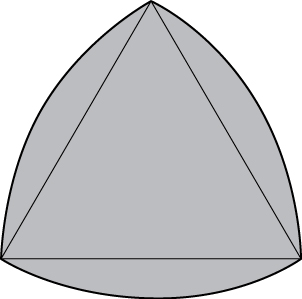
[T] The Reuleaux triangle consists of an equilateral triangle and three regions, each of them bounded by a side of the triangle and an arc of a circle of radius s centered at the opposite vertex of the triangle. Show that the area of the Reuleaux triangle in the following figure of side length is
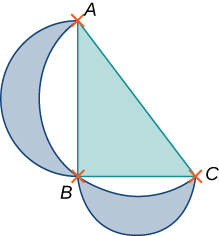
[T] Show that the area of the lunes of Alhazen, the two blue lunes in the following figure, is the same as the area of the right triangle ABC. The outer boundaries of the lunes are semicircles of diameters respectively, and the inner boundaries are formed by the circumcircle of the triangle
Glossary
- improper double integral
- a double integral over an unbounded region or of an unbounded function
- Type I
- a region in the -plane is Type I if it lies between two vertical lines and the graphs of two continuous functions and
- Type II
- a region in the -plane is Type II if it lies between two horizontal lines and the graphs of two continuous functions
Graph the functions, and draw vertical and horizontal lines.