- Determine the equation of a plane tangent to a given surface at a point.
- Use the tangent plane to approximate a function of two variables at a point.
- Explain when a function of two variables is differentiable.
- Use the total differential to approximate the change in a function of two variables.
In this section, we consider the problem of finding the tangent plane to a surface, which is analogous to finding the equation of a tangent line to a curve when the curve is defined by the graph of a function of one variable, The slope of the tangent line at the point is given by what is the slope of a tangent plane? We learned about the equation of a plane in Equations of Lines and Planes in Space; in this section, we see how it can be applied to the problem at hand.
Tangent Planes
Intuitively, it seems clear that, in a plane, only one line can be tangent to a curve at a point. However, in three-dimensional space, many lines can be tangent to a given point. If these lines lie in the same plane, they determine the tangent plane at that point. A tangent plane at a regular point contains all of the lines tangent to that point. A more intuitive way to think of a tangent plane is to assume the surface is smooth at that point (no corners). Then, a tangent line to the surface at that point in any direction does not have any abrupt changes in slope because the direction changes smoothly.
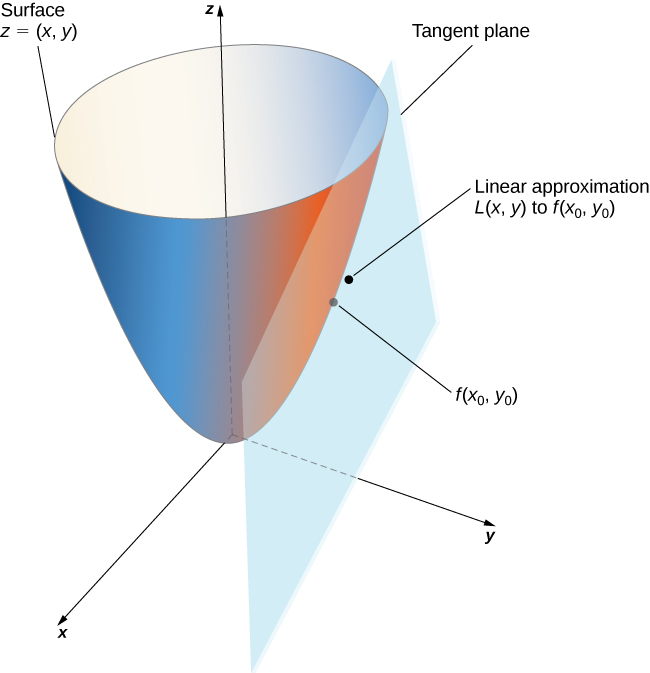
Let be a point on a surface and let be any curve passing through and lying entirely in If the tangent lines to all such curves at lie in the same plane, then this plane is called the tangent plane to at (Figure 4.27).
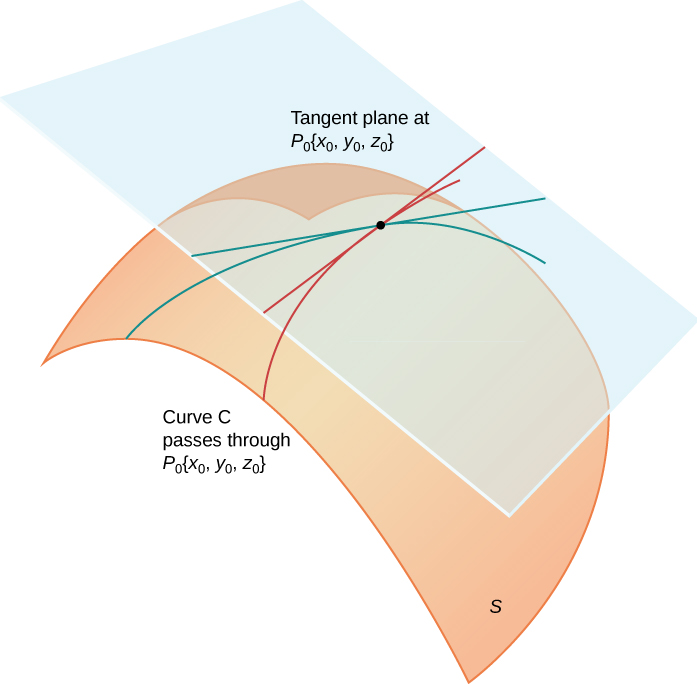
For a tangent plane to a surface to exist at a point on that surface, it is sufficient for the function that defines the surface to be differentiable at that point, defined later in this section. We define the term tangent plane here and then explore the idea intuitively.
Let be a surface defined by a differentiable function and let be a point in the domain of Then, the equation of the tangent plane to at is given by
To see why this formula is correct, let’s first find two tangent lines to the surface The equation of the tangent line to the curve that is represented by the intersection of with the vertical trace given by is Similarly, the equation of the tangent line to the curve that is represented by the intersection of with the vertical trace given by is A parallel vector to the first tangent line is a parallel vector to the second tangent line is We can take the cross product of these two vectors:
This vector is perpendicular to both lines and is therefore perpendicular to the tangent plane. We can use this vector as a normal vector to the tangent plane, along with the point in the equation for a plane:
Solving this equation for gives Equation 4.24.
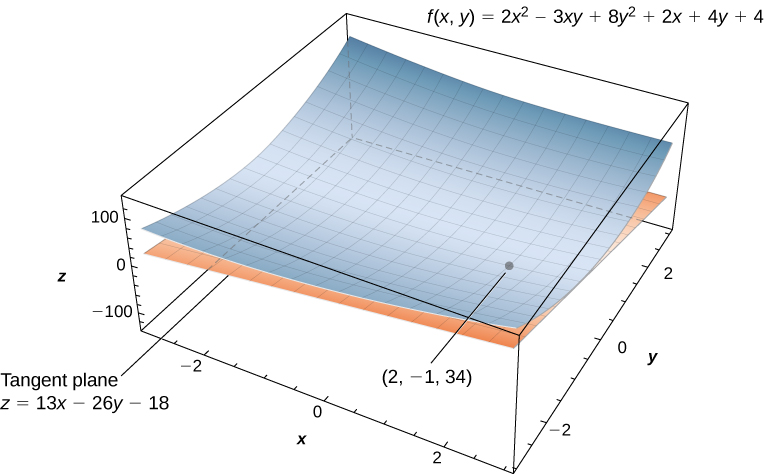
Find an equation of the tangent plane to the surface defined by the function at point
First, we must calculate and then use Equation 4.24 with and
Then Equation 4.24 becomes
(See the following figure).
Find an equation of the tangent plane to the surface defined by the function at point
Find an equation of the tangent plane to the surface defined by the function at the point
First, calculate and then use Equation 4.24 with and
Then Equation 4.24 becomes
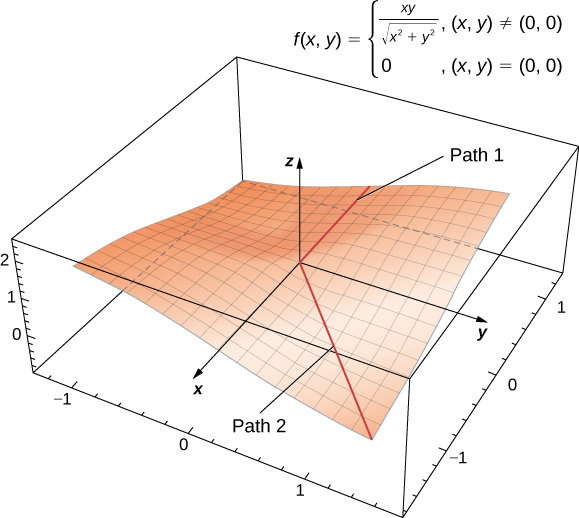
A tangent plane to a surface does not always exist at every point on the surface. Consider the function
The graph of this function follows.
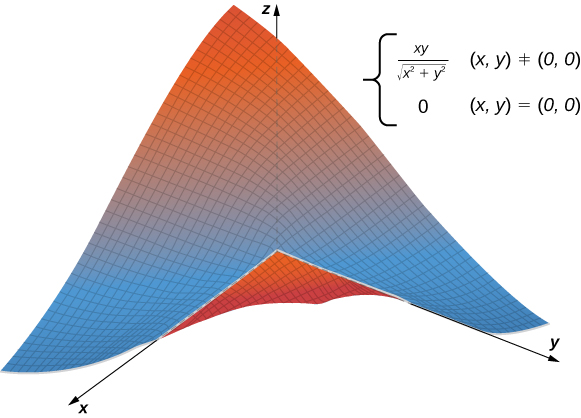
If either or then so the value of the function does not change on either the x- or y-axis. Therefore, so as either approach zero, these partial derivatives stay equal to zero. Substituting them into Equation 4.24 gives as the equation of the tangent line. However, if we approach the origin from a different direction, we get a different story. For example, suppose we approach the origin along the line If we put into the original function, it becomes
When the slope of this curve is equal to when the slope of this curve is equal to This presents a problem. In the definition of tangent plane, we presumed that all tangent lines through point (in this case, the origin) lay in the same plane. This is clearly not the case here. When we study differentiable functions, we will see that this function is not differentiable at the origin.
Linear Approximations
Recall from Linear Approximations and Differentials that the formula for the linear approximation of a function at the point is given by
The diagram for the linear approximation of a function of one variable appears in the following graph.
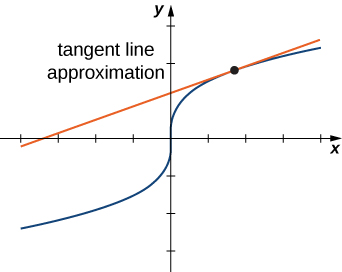
The tangent line can be used as an approximation to the function for values of reasonably close to When working with a function of two variables, the tangent line is replaced by a tangent plane, but the approximation idea is much the same.
Given a function with continuous partial derivatives that exist at the point the linear approximation of at the point is given by the equation
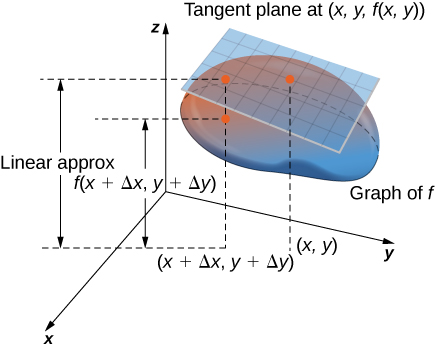
Notice that this equation also represents the tangent plane to the surface defined by at the point The idea behind using a linear approximation is that, if there is a point at which the precise value of is known, then for values of reasonably close to the linear approximation (i.e., tangent plane) yields a value that is also reasonably close to the exact value of (Figure 4.31). Furthermore the plane that is used to find the linear approximation is also the tangent plane to the surface at the point
Given the function approximate using point for What is the approximate value of to four decimal places?
To apply Equation 4.25, we first must calculate and using and
Now we substitute these values into Equation 4.25:
Last, we substitute and into
The approximate value of to four decimal places is
which corresponds to a error in approximation.
Given the function approximate using point for What is the approximate value of to four decimal places?
so
First calculate using and then use Equation 4.25.
Differentiability
When working with a function of one variable, the function is said to be differentiable at a point if exists. Furthermore, if a function of one variable is differentiable at a point, the graph is “smooth” at that point (i.e., no corners exist) and a tangent line is well-defined at that point.
The idea behind differentiability of a function of two variables is connected to the idea of smoothness at that point. In this case, a surface is considered to be smooth at point if a tangent plane to the surface exists at that point. If a function is differentiable at a point, then a tangent plane to the surface exists at that point. Recall the formula for a tangent plane at a point is given by
For a tangent plane to exist at the point the partial derivatives must therefore exist at that point. However, this is not a sufficient condition for smoothness, as was illustrated in Figure 4.29. In that case, the partial derivatives existed at the origin, but the function also had a corner on the graph at the origin.
A function is differentiable at a point if, for all points in a disk around we can write
where the error term satisfies
The last term in Equation 4.26 is referred to as the error term and it represents how closely the tangent plane comes to the surface in a small neighborhood disk) of point For the function to be differentiable at the function must be smooth—that is, the graph of must be close to the tangent plane for points near
Show that the function is differentiable at point
First, we calculate using and then we use Equation 4.26:
Therefore and and Equation 4.26 becomes
Next, we calculate
Since for any value of the original limit must be equal to zero. Therefore, is differentiable at point
Show that the function is differentiable at point
First, calculate using and then use Equation 4.26 to find Last, calculate the limit.
The function is not differentiable at the origin. We can see this by calculating the partial derivatives. This function appeared earlier in the section, where we showed that Substituting this information into Equation 4.26 using and we get
Calculating gives
Depending on the path taken toward the origin, this limit takes different values. Therefore, the limit does not exist and the function is not differentiable at the origin as shown in the following figure.
Differentiability and continuity for functions of two or more variables are connected, the same as for functions of one variable. In fact, with some adjustments of notation, the basic theorem is the same.
Let be a function of two variables with in the domain of If is differentiable at then is continuous at
Differentiability shows that if a function is differentiable at a point, then it is continuous there. However, if a function is continuous at a point, then it is not necessarily differentiable at that point. For example,
is continuous at the origin, but it is not differentiable at the origin. This observation is also similar to the situation in single-variable calculus.
Differentiability further explores the connection between continuity and differentiability at a point. This theorem says that if the function and its partial derivatives are continuous at a point, the function is differentiable.
Let be a function of two variables with in the domain of If and all exist in a neighborhood of and are continuous at then is differentiable there.
Recall that earlier we showed that the function
was not differentiable at the origin. Let’s calculate the partial derivatives and
The contrapositive of the preceding theorem states that if a function is not differentiable, then at least one of the hypotheses must be false. Let’s explore the condition that must be continuous. For this to be true, it must be true that
Let Then
If then this expression equals if then it equals In either case, the value depends on so the limit fails to exist.
Differentials
In Linear Approximations and Differentials we first studied the concept of differentials. The differential of written is defined as The differential is used to approximate where Extending this idea to the linear approximation of a function of two variables at the point yields the formula for the total differential for a function of two variables.
Let be a function of two variables with in the domain of and let and be chosen so that is also in the domain of If is differentiable at the point then the differentials and are defined as
The differential also called the total differential of at is defined as
Notice that the symbol is not used to denote the total differential; rather, appears in front of Now, let’s define We use to approximate so
Therefore, the differential is used to approximate the change in the function at the point for given values of and Since this can be used further to approximate
See the following figure.
One such application of this idea is to determine error propagation. For example, if we are manufacturing a gadget and are off by a certain amount in measuring a given quantity, the differential can be used to estimate the error in the total volume of the gadget.
Find the differential of the function and use it to approximate at point Use and What is the exact value of
First, we must calculate using and
Then, we substitute these quantities into Equation 4.27:
This is the approximation to The exact value of is given by
Find the differential of the function and use it to approximate at point Use and What is the exact value of
First, calculate and using and then use Equation 4.27.
Differentiability of a Function of Three Variables
All of the preceding results for differentiability of functions of two variables can be generalized to functions of three variables. First, the definition:
A function is differentiable at a point if for all points in a disk around we can write
where the error term E satisfies
If a function of three variables is differentiable at a point then it is continuous there. Furthermore, continuity of first partial derivatives at that point guarantees differentiability.
Key Concepts
- The analog of a tangent line to a curve is a tangent plane to a surface for functions of two variables.
- Tangent planes can be used to approximate values of functions near known values.
- A function is differentiable at a point if it is ”smooth” at that point (i.e., no corners or discontinuities exist at that point).
- The total differential can be used to approximate the change in a function at the point for given values of and
Key Equations
| Tangent plane | |
| Linear approximation | |
| Total differential | |
| Differentiability (two variables) | where the error term satisfies |
| Differentiability (three variables) | where the error term satisfies |
.
For the following exercises, find a unit normal vector to the surface at the indicated point.
when
For the following exercises, as a useful review for techniques used in this section, find a normal vector and a tangent vector at point
Normal vector: tangent vector:
Normal vector: tangent vector:
For the following exercises, find the equation for the tangent plane to the surface at the indicated point. (Hint: Solve for in terms of and
For the following exercises, find parametric equations for the normal line to the surface at the indicated point. (Recall that to find the equation of a line in space, you need a point on the line, and a vector that is parallel to the line. Then the equation of the line is
at point
For the following exercises, use the figure shown here.
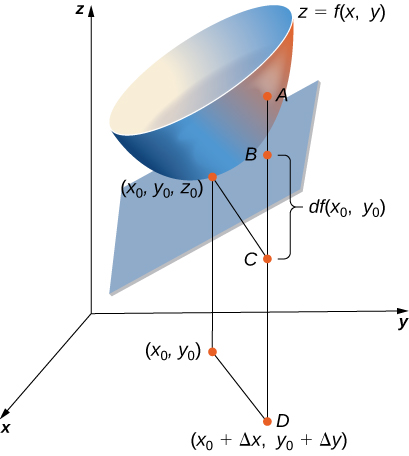
The length of line segment is equal to what mathematical expression?
The length of line segment is equal to what mathematical expression?
The differential of the function
Using the figure, explain what the length of line segment represents.
For the following exercises, complete each task.
Show that is differentiable at point
Using the definition of differentiability, we have
Find the total differential of the function
Show that is differentiable at every point. In other words, show that where both and approach zero as approaches
for small and satisfies the definition of differentiability.
Find the total differential of the function where changes from and changes from
Let Compute from to and then find the approximate change in from point to point Recall and and are approximately equal.
and They are relatively close.
The volume of a right circular cylinder is given by Find the differential Interpret the formula geometrically.
See the preceding problem. Use differentials to estimate the volume of aluminum in an enclosed aluminum can with diameter and height if the aluminum is cm thick.
cm3
Use the differential to approximate the change in as moves from point to point Compare this approximation with the actual change in the function.
Let Find the exact change in the function and the approximate change in the function as changes from and changes from
exact change approximate change is The two values are close.
The centripetal acceleration of a particle moving in a circle is given by where is the velocity and is the radius of the circle. Approximate the maximum percent error in measuring the acceleration resulting from errors of in and in (Recall that the percentage error is the ratio of the amount of error over the original amount. So, in this case, the percentage error in is given by
The radius and height of a right circular cylinder are measured with possible errors of respectively. Approximate the maximum possible percentage error in measuring the volume (Recall that the percentage error is the ratio of the amount of error over the original amount. So, in this case, the percentage error in is given by
The base radius and height of a right circular cone are measured as in. and in., respectively, with a possible error in measurement of as much as in. each. Use differentials to estimate the maximum error in the calculated volume of the cone.
The electrical resistance produced by wiring resistors and in parallel can be calculated from the formula If and are measured to be and respectively, and if these measurements are accurate to within estimate the maximum possible error in computing (The symbol represents an ohm, the unit of electrical resistance.)
The area of an ellipse with axes of length and is given by the formula
Approximate the percent change in the area when increases by and increases by
The period of a simple pendulum with small oscillations is calculated from the formula where is the length of the pendulum and is the acceleration resulting from gravity. Suppose that and have errors of, at most, and respectively. Use differentials to approximate the maximum percentage error in the calculated value of
Electrical power is given by where is the voltage and is the resistance. Approximate the maximum percentage error in calculating power if is applied to a resistor and the possible percent errors in measuring and are and respectively.
For the following exercises, find the linear approximation of each function at the indicated point.
[T] Find an equation of the tangent plane to the surface at point and graph the surface and the tangent plane at the point.
[T] Find the equation for the tangent plane to the surface at the indicated point, and graph the surface and the tangent plane:
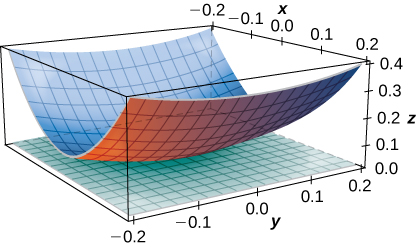
[T] Find an equation of the tangent plane to the surface at point and graph the surface and the tangent plane.
Glossary
- differentiable
- a function is differentiable at if can be expressed in the form
where the error term satisfies - linear approximation
- given a function and a tangent plane to the function at a point we can approximate for points near using the tangent plane formula
- tangent plane
- given a function that is differentiable at a point the equation of the tangent plane to the surface is given by
- total differential
- the total differential of the function at is given by the formula
First, calculate and then use Equation 4.24.