- Use the alternating series test to test an alternating series for convergence.
- Estimate the sum of an alternating series.
- Explain the meaning of absolute convergence and conditional convergence.
So far in this chapter, we have primarily discussed series with positive terms. In this section we introduce alternating series—those series whose terms alternate in sign. We will show in a later chapter that these series often arise when studying power series. After defining alternating series, we introduce the alternating series test to determine whether such a series converges.
The Alternating Series Test
A series whose terms alternate between positive and negative values is an alternating series. For example, the series
and
are both alternating series.
Any series whose terms alternate between positive and negative values is called an alternating series. An alternating series can be written in the form
or
Where for all positive integers n.
Series (1), shown in Equation 5.11, is a geometric series. Since the series converges. Series (2), shown in Equation 5.12, is called the alternating harmonic series. We will show that whereas the harmonic series diverges, the alternating harmonic series converges.
To prove this, we look at the sequence of partial sums (Figure 5.17).
Proof
Consider the odd terms for Since
Therefore, is a decreasing sequence. Also,
Therefore, is bounded below. Since is a decreasing sequence that is bounded below, by the Monotone Convergence Theorem, converges. Similarly, the even terms form an increasing sequence that is bounded above because
and
Therefore, by the Monotone Convergence Theorem, the sequence also converges. Since
we know that
Letting and using the fact that we conclude that Since the odd terms and the even terms in the sequence of partial sums converge to the same limit it can be shown that the sequence of partial sums converges to and therefore the alternating harmonic series converges to
It can also be shown that and we can write
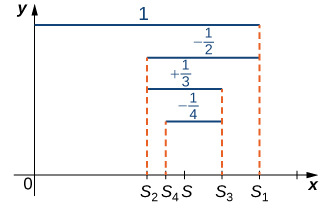
□
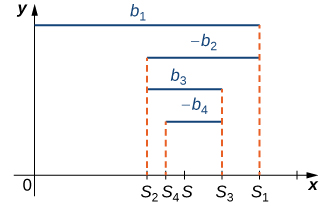
More generally, any alternating series of form (3) (Equation 5.13) or (4) (Equation 5.14) converges as long as and (Figure 5.18). The proof is similar to the proof for the alternating harmonic series.
An alternating series of the form
converges if
- for all and
This is known as the alternating series test.
We remark that this theorem is true more generally as long as there exists some integer such that for all
For each of the following alternating series, determine whether the series converges or diverges.
- Since
the series converges. - Since as we cannot apply the alternating series test. Instead, we use the nth term test for divergence. Since
the series diverges.
Determine whether the series converges or diverges.
The series converges.
Remainder of an Alternating Series
It is difficult to explicitly calculate the sum of most alternating series, so typically the sum is approximated by using a partial sum. When doing so, we are interested in the amount of error in our approximation. Consider an alternating series
satisfying the hypotheses of the alternating series test. Let denote the sum of this series and be the corresponding sequence of partial sums. From Figure 5.18, we see that for any integer the remainder satisfies
Consider an alternating series of the form
that satisfies the hypotheses of the alternating series test. Let denote the sum of the series and denote the partial sum. For any integer the remainder satisfies
In other words, if the conditions of the alternating series test apply, then the error in approximating the infinite series by the partial sum is in magnitude at most the size of the next term
Consider the alternating series
Use the remainder estimate to determine a bound on the error if we approximate the sum of the series by the partial sum
From the theorem stated above,
Find a bound for when approximating by
Absolute and Conditional Convergence
Consider a series and the related series Here we discuss possibilities for the relationship between the convergence of these two series. For example, consider the alternating harmonic series The series whose terms are the absolute value of these terms is the harmonic series, since Since the alternating harmonic series converges, but the harmonic series diverges, we say the alternating harmonic series exhibits conditional convergence.
By comparison, consider the series The series whose terms are the absolute values of the terms of this series is the series Since both of these series converge, we say the series exhibits absolute convergence.
A series exhibits absolute convergence if converges. A series exhibits conditional convergence if converges but diverges.
As shown by the alternating harmonic series, a series may converge, but may diverge. In the following theorem, however, we show that if converges, then converges.
If converges, then converges.
Proof
Suppose that converges. We show this by using the fact that or and therefore or Therefore, Consequently, by the comparison test, since converges, the series
converges. By using the algebraic properties for convergent series, we conclude that
converges.
□
For each of the following series, determine whether the series converges absolutely, converges conditionally, or diverges.
- We can see that
diverges by using the limit comparison test with the harmonic series.
Thus, applying Theorem 5.13, the series cannot converge absolutely. Moreover, because of the alternating series test, we can see that the series converges.
We can conclude that converges conditionally. - Noting that to determine whether the series converges absolutely, compare
with the series Since converges, by the comparison test, converges, and therefore converges absolutely.
Determine whether the series converges absolutely, converges conditionally, or diverges.
The series converges absolutely.
Check for absolute convergence first.
To see the difference between absolute and conditional convergence, look at what happens when we rearrange the terms of the alternating harmonic series We show that we can rearrange the terms so that the new series diverges. Certainly if we rearrange the terms of a finite sum, the sum does not change. When we work with an infinite sum, however, interesting things can happen.
Begin by adding enough of the positive terms to produce a sum that is larger than some real number For example, let and find an integer such that
(We can do this because the series diverges to infinity.) Then subtract Then add more positive terms until the sum reaches 100. That is, find another integer such that
Then subtract Continuing in this way, we have found a way of rearranging the terms in the alternating harmonic series so that the sequence of partial sums for the rearranged series is unbounded and therefore diverges.
The terms in the alternating harmonic series can also be rearranged so that the new series converges to a different value. In Example 5.22, we show how to rearrange the terms to create a new series that converges to We point out that the alternating harmonic series can be rearranged to create a series that converges to any real number however, the proof of that fact is beyond the scope of this text.
In general, any series that converges conditionally can be rearranged so that the new series diverges or converges to a different real number. A series that converges absolutely does not have this property. For any series that converges absolutely, the value of is the same for any rearrangement of the terms. This result is known as the Riemann Rearrangement Theorem, which is beyond the scope of this book.
Use the fact that
to rearrange the terms in the alternating harmonic series so the sum of the rearranged series is
Let
Since by the algebraic properties of convergent series,
Now introduce the series such that for all and Then
Then using the algebraic limit properties of convergent series, since and converge, the series converges and
Now adding the corresponding terms, and we see that
We notice that the series on the right side of the equal sign is a rearrangement of the alternating harmonic series. Since we conclude that
Therefore, we have found a rearrangement of the alternating harmonic series having the desired property.
Key Concepts
- For an alternating series if for all and as the alternating series converges.
- If converges, then converges.
Key Equations
| Alternating series |
.
State whether each of the following series converges absolutely, conditionally, or not at all.
Does not converge by divergence test. Terms do not tend to zero.
Converges conditionally by alternating series test, since is decreasing. Does not converge absolutely by comparison with p-series,
Converges absolutely by limit comparison to for example.
Diverges by divergence test since
Does not converge. Terms do not tend to zero.
Diverges by divergence test.
Converges by alternating series test.
Converges conditionally by alternating series test. Does not converge absolutely by limit comparison with p-series,
Diverges; terms do not tend to zero.
(Hint: for large
(Hint: for large
Converges by alternating series test. Does not converge absolutely by limit comparison with harmonic series.
(Hint: Rationalize the numerator.)
(Hint: Find common denominator then rationalize numerator.)
Converges absolutely by limit comparison with p-series, after applying the hint.
(Hint: Use Mean Value Theorem.)
Converges by alternating series test since is decreasing to zero for large Does not converge absolutely by limit comparison with harmonic series after applying hint.
Converges absolutely, since are terms of a telescoping series.
Terms do not tend to zero. Series diverges by divergence test.
Converges by alternating series test. Does not converge absolutely by limit comparison with harmonic series.
In each of the following problems, use the estimate to find a value of that guarantees that the sum of the first terms of the alternating series differs from the infinite sum by at most the given error. Calculate the partial sum for this
[T] error
[T] error
[T] error
[T] error
or or
[T] error
[T] error
or
For the following exercises, indicate whether each of the following statements is true or false. If the statement is false, provide an example in which it is false.
If is decreasing and then converges absolutely.
If is decreasing, then converges absolutely.
True. need not tend to zero since if then
If and then converges.
If is decreasing and converges then converges.
True. so convergence of follows from the comparison test.
If is decreasing and converges conditionally but not absolutely, then does not tend to zero.
Let if and if (Also, and If converges conditionally but not absolutely, then neither nor converge.
True. If one converges, then so must the other, implying absolute convergence.
Suppose that is a sequence of positive real numbers and that converges.
Suppose that is an arbitrary sequence of ones and minus ones. Does necessarily converge?
Suppose that is a sequence such that converges for every possible sequence of zeros and ones. Does converge absolutely?
Yes. Take if and if Then converges. Similarly, one can show converges. Since both series converge, the series must converge absolutely.
The following series do not satisfy the hypotheses of the alternating series test as stated.
In each case, state which hypothesis is not satisfied. State whether the series converges absolutely.
Not decreasing. Does not converge absolutely.
Not alternating. Can be expressed as which diverges by comparison with
Show that the alternating series does
not converge. What hypothesis of the alternating series test is not met?
Suppose that converges absolutely. Show that the series consisting of the positive terms also converges.
Let if and if Then for all so the sequence of partial sums of is increasing and bounded above by the sequence of partial sums of which converges; hence, converges.
Show that the alternating series does not converge. What hypothesis of the alternating series test is not met?
The formula will be derived in the next chapter. Use the remainder to find a bound for the error in estimating by the fifth partial sum for and
For one has When When When
The formula will be derived in the next chapter. Use the remainder to find a bound for the error in estimating by the fifth partial sum for and
How many terms in are needed to approximate accurate to an error of at most
Let Then when or and whereas
How many terms in are needed to approximate accurate to an error of at most
Sometimes the alternating series converges to a certain fraction of an absolutely convergent series at a faster rate. Given that find Which of the series and gives a better estimation of using terms?
Let Then so
The alternating series is more accurate for terms.
The following alternating series converge to given multiples of Find the value of predicted by the remainder estimate such that the partial sum of the series accurately approximates the left-hand side to within the given error. Find the minimum for which the error bound holds, and give the desired approximate value in each case. Up to decimals places,
[T] error
[T] error
[T] The series plays an important role in signal processing. Show that converges whenever (Hint: Use the formula for the sine of a sum of angles.)
[T] If what is
The partial sum is the same as that for the alternating harmonic series.
[T] Plot the series for Explain why diverges when How does the series behave for other
[T] Plot the series for and comment on its behavior
The series jumps rapidly near the endpoints. For away from the endpoints, the graph looks like
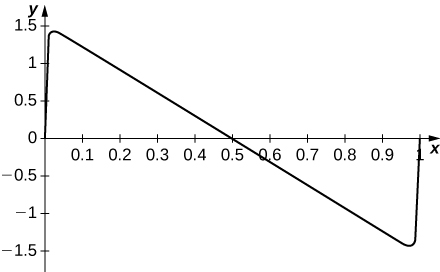
[T] Plot the series for and describe its graph.
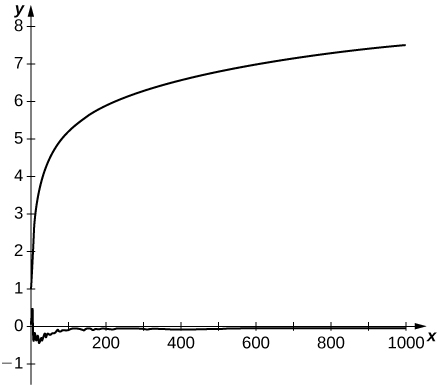
[T] The alternating harmonic series converges because of cancellation among its terms. Its sum is known because the cancellation can be described explicitly. A random harmonic series is one of the form where is a randomly generated sequence of in which the values are equally likely to occur. Use a random number generator to produce random and plot the partial sums of your random harmonic sequence for to Compare to a plot of the first partial sums of the harmonic series.
Here is a typical result. The top curve consists of partial sums of the harmonic series. The bottom curve plots partial sums of a random harmonic series.
[T] Estimates of can be accelerated by writing its partial sums as and recalling that converges to one as Compare the estimate of using the sums with the estimate using
[T] The Euler transform rewrites as For the alternating harmonic series, it takes the form Compute partial sums of until they approximate accurate to within How many terms are needed? Compare this answer to the number of terms of the alternating harmonic series are needed to estimate
By the alternating series test, so one needs terms of the alternating harmonic series to estimate to within The first partial sums of the series are (up to four decimals) and the tenth partial sum is within of
[T] In the text it was stated that a conditionally convergent series can be rearranged to converge to any number. Here is a slightly simpler, but similar, fact. If is such that as but diverges, then, given any number there is a sequence of such that Show this for as follows.
- Recursively define by if and otherwise.
- Explain why eventually and for any larger than this
- Explain why this implies that as
Glossary
- absolute convergence
- if the series converges, the series is said to converge absolutely
- alternating series
- a series of the form or where is called an alternating series
- alternating series test
- for an alternating series of either form, if for all integers and then an alternating series converges
- conditional convergence
- if the series converges, but the series diverges, the series is said to converge conditionally
Is decreasing? What is