- Use the comparison test to test a series for convergence.
- Use the limit comparison test to determine convergence of a series.
We have seen that the integral test allows us to determine the convergence or divergence of a series by comparing it to a related improper integral. In this section, we show how to use comparison tests to determine the convergence or divergence of a series by comparing it to a series whose convergence or divergence is known. Typically these tests are used to determine convergence of series that are similar to geometric series or p-series.
Comparison Test
In the preceding two sections, we discussed two large classes of series: geometric series and p-series. We know exactly when these series converge and when they diverge. Here we show how to use the convergence or divergence of these series to prove convergence or divergence for other series, using a method called the comparison test.
For example, consider the series
This series looks similar to the convergent series
Since the terms in each of the series are positive, the sequence of partial sums for each series is monotone increasing. Furthermore, since
for all positive integers the partial sum of satisfies
(See Figure 5.16(a) and Table 5.1.) Since the series on the right converges, the sequence is bounded above. We conclude that is a monotone increasing sequence that is bounded above. Therefore, by the Monotone Convergence Theorem, converges, and thus
converges.
Similarly, consider the series
This series looks similar to the divergent series
The sequence of partial sums for each series is monotone increasing and
for every positive integer Therefore, the partial sum of satisfies
(See Figure 5.16(b) and Table 5.2.) Since the series diverges to infinity, the sequence of partial sums is unbounded. Consequently, is an unbounded sequence, and therefore diverges. We conclude that
diverges.
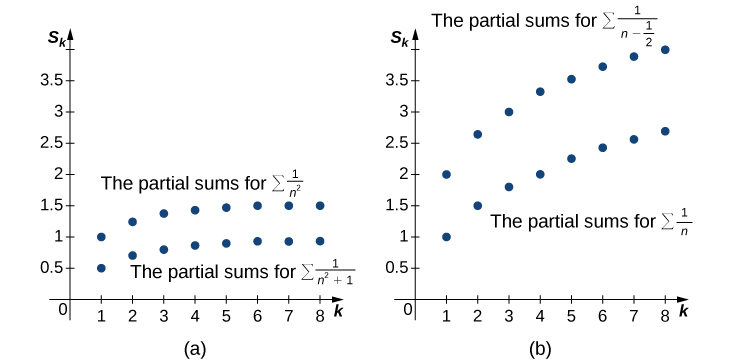
This is a table with three rows and nine columns. The first row contains the label “k” and the values 1 through 8. The second row contains the label “the sum from n = 1 to k of 1 / (n^2 + 1).” The values are 0.5, 0.7, 0.8, 0.8588, 0.8973, 0.9243, 0.9443, and 0.9597. The last row contains the label “the sum from n = 1 to k of 1 / n^2” and the values 1, 1.25, 1.3611, 1.4236, 1.4636, 1.4914, 1.5118, and 1.5274.
This shows a table with three rows and nine columns. The first row contains the label “k” and the values 1 through 8. The second row contains the label “the sum from n = 1 to k of 1 / (n - 0.5) and the values 2, 2.6667, 3.0667, 3.3524, 3.5746, 3.7564, 3.9103, and 4.0436. The last row contains the label “the sum from n = 1 to k of 1/n” and the values 1, 1.5, 1.8333, 2.0933, 2.2833, 2.45, 2.5929, and 2.7179.
- Suppose there exists an integer such that for all If converges, then converges.
- Suppose there exists an integer such that for all If diverges, then diverges.
Proof
We prove part i. The proof of part ii. is the contrapositive of part i. Let be the sequence of partial sums associated with and let Since the terms
Therefore, the sequence of partial sums is increasing. Further, since for all then
Therefore, for all
Since is a finite number, we conclude that the sequence is bounded above. Therefore, is an increasing sequence that is bounded above. By the Monotone Convergence Theorem, we conclude that converges, and therefore the series converges.
□
To use the comparison test to determine the convergence or divergence of a series it is necessary to find a suitable series with which to compare it. Since we know the convergence properties of geometric series and p-series, these series are often used. If there exists an integer such that for all each term is less than each corresponding term of a known convergent series, then converges. Similarly, if there exists an integer such that for all each term is greater than each corresponding term of a known divergent series, then diverges.
For each of the following series, use the comparison test to determine whether the series converges or diverges.
- Compare to Since is a p-series with it converges. Further,
for every positive integer Therefore, we can conclude that converges. - Compare to Since is a geometric series with and it converges. Also,
for every positive integer Therefore, we see that converges. - Compare to Since
for every integer and diverges, we have that diverges.
Use the comparison test to determine if the series converges or diverges.
The series converges.
Limit Comparison Test
The comparison test works nicely if we can find a comparable series satisfying the hypothesis of the test. However, sometimes finding an appropriate series can be difficult. Consider the series
It is natural to compare this series with the convergent series
However, this series does not satisfy the hypothesis necessary to use the comparison test because
for all integers Although we could look for a different series with which to compare instead we show how we can use the limit comparison test to compare
Let us examine the idea behind the limit comparison test. Consider two series and with positive terms and evaluate
If
then, for sufficiently large, Therefore, either both series converge or both series diverge. For the series and we see that
Since converges, we conclude that
converges.
The limit comparison test can be used in two other cases. Suppose
In this case, is a bounded sequence. As a result, there exists a constant such that Therefore, if converges, then converges. On the other hand, suppose
In this case, is an unbounded sequence. Therefore, for every constant there exists an integer such that for all Therefore, if diverges, then diverges as well.
Let for all
- If then and both converge or both diverge.
- If and converges, then converges.
- If and diverges, then diverges.
Note that if and diverges, the limit comparison test gives no information. Similarly, if and converges, the test also provides no information. For example, consider the two series and These series are both p-series with and respectively. Since the series diverges. On the other hand, since the series converges. However, suppose we attempted to apply the limit comparison test, using the convergent as our comparison series. First, we see that
Similarly, we see that
Therefore, if when converges, we do not gain any information on the convergence or divergence of
For each of the following series, use the limit comparison test to determine whether the series converges or diverges. If the test does not apply, say so.
- Compare this series to Calculate
By the limit comparison test, since diverges, then diverges. - Compare this series to We see that
Therefore,
Since converges, we conclude that converges. - Since compare with We see that
In order to evaluate evaluate the limit as of the real-valued function These two limits are equal, and making this change allows us to use L’Hôpital’s rule. We obtain
Therefore, and, consequently,
Since the limit is but diverges, the limit comparison test does not provide any information.
Compare with instead. In this case,
Since the limit is but converges, the test still does not provide any information.
So now we try a series between the two we already tried. Choosing the series we see that
As above, in order to evaluate evaluate the limit as of the real-valued function Using L’Hôpital’s rule,
Since the limit is and converges, we can conclude that converges.
Use the limit comparison test to determine whether the series converges or diverges.
The series diverges.
Compare with a geometric series.
Key Concepts
- The comparison tests are used to determine convergence or divergence of series with positive terms.
- When using the comparison tests, a series is often compared to a geometric or p-series.
Use the comparison test to determine whether the following series converge.
where
where
Converges by comparison with
The sum is one half times a harmonic series, which diverges.
Converges by comparison with p-series,
so converges by comparison with p-series,
so converges by comparison with p-series,
Since series converges by comparison with p-series for
Use the limit comparison test to determine whether each of the following series converges or diverges.
Converges by limit comparison with p-series for
Converges by limit comparison with p-series,
Converges by limit comparison with
Converges by limit comparison with
Diverges by limit comparison with harmonic series.
Converges by limit comparison with p-series,
Converges by limit comparison with p-series,
(Hint:
(Hint: so
Diverges by limit comparison with
Does converge if is large enough? If so, for which
Does converge if is large enough? If so, for which
Converges for by comparison with a series for slightly smaller
For which does the series converge?
For which does the series converge?
Converges for all
For which does the series converge?
For which does the series converge?
Converges for all If then say, once and then the series converges by limit comparison with a geometric series with ratio
Find all values of and such that converges.
Does converge or diverge? Explain.
The numerator is equal to when is odd and when is even, so the series can be rewritten which diverges by limit comparison with the harmonic series.
Explain why, for each at least one of is larger than Use this relation to test convergence of
Suppose that and and that and converge. Prove that converges and
or so convergence follows from comparison of with Since the partial sums on the left are bounded by those on the right, the inequality holds for the infinite series.
Does converge? (Hint: Write as a power of
Does converge? (Hint: Use to compare to a
If is sufficiently large, then so and the series converges by comparison to a
Does converge? (Hint: Compare to
Show that if and converges, then converges. If converges, does necessarily converge?
so for large Convergence follows from limit comparison. converges, but does not, so the fact that converges does not imply that converges.
Suppose that for all and that converges. Suppose that is an arbitrary sequence of zeros and ones. Does necessarily converge?
Suppose that for all and that diverges. Suppose that is an arbitrary sequence of zeros and ones with infinitely many terms equal to one. Does necessarily diverge?
No. diverges. Let unless for some Then converges.
Complete the details of the following argument: If converges to a finite sum then and Why does this lead to a contradiction?
Show that if and converges, then converges.
so the result follows from the comparison test.
Suppose that in the comparison test, where and Prove that if converges, then converges.
Let be an infinite sequence of zeros and ones. What is the largest possible value of
By the comparison test,
Let be an infinite sequence of digits, meaning takes values in What is the largest possible value of that converges?
Explain why, if then cannot be written
If then, by comparison,
[T] Evelyn has a perfect balancing scale, an unlimited number of weights, and one each of and so on weights. She wishes to weigh a meteorite of unspecified origin to arbitrary precision. Assuming the scale is big enough, can she do it? What does this have to do with infinite series?
[T] Robert wants to know his body mass to arbitrary precision. He has a big balancing scale that works perfectly, an unlimited collection of weights, and nine each of and so on weights. Assuming the scale is big enough, can he do this? What does this have to do with infinite series?
Yes. Keep adding weights until the balance tips to the side with the weights. If it balances perfectly, with Robert standing on the other side, stop. Otherwise, remove one of the weights, and add weights one at a time. If it balances after adding some of these, stop. Otherwise if it tips to the weights, remove the last weight. Start adding weights. If it balances, stop. If it tips to the side with the weights, remove the last weight that was added. Continue in this way for the weights, and so on. After a finite number of steps, one has a finite series of the form where is the number of full kg weights and is the number of weights that were added. If at some state this series is Robert’s exact weight, the process will stop. Otherwise it represents the partial sum of an infinite series that gives Robert’s exact weight, and the error of this sum is at most
The series is half the harmonic series and hence diverges. It is obtained from the harmonic series by deleting all terms in which is odd. Let be fixed. Show, more generally, that deleting all terms where for some integer also results in a divergent series.
In view of the previous exercise, it may be surprising that a subseries of the harmonic series in which about one in every five terms is deleted might converge. A depleted harmonic series is a series obtained from by removing any term if a given digit, say appears in the decimal expansion of Argue that this depleted harmonic series converges by answering the following questions.
- How many whole numbers have digits?
- How many whole numbers do not contain as one or more of their digits?
- What is the smallest number
- Explain why the deleted harmonic series is bounded by
- Show that converges.
a. b. c. d. Group the terms in the deleted harmonic series together by number of digits. bounds the number of terms, and each term is at most One can actually use comparison to estimate the value to smaller than The actual value is smaller than
Suppose that a sequence of numbers has the property that and where Can you determine whether converges? (Hint: is monotone.)
Suppose that a sequence of numbers has the property that and where Can you determine whether converges? (Hint: etc. Look at and use
Continuing the hint gives Then Since is bounded by a constant times when one has which converges by comparison to the p-series for
Glossary
- comparison test
- if for all and converges, then converges; if for all and diverges, then diverges
- limit comparison test
- suppose for all If then and both converge or both diverge; if and converges, then converges. If and diverges, then diverges
Find a value such that