- Use the divergence test to demonstrate that a series diverges.
- Use the integral test to determine the convergence of a series.
- Estimate the value of a series by finding bounds on its remainder term.
In the previous section, we determined the convergence or divergence of several series by explicitly calculating the limit of the sequence of partial sums In practice, explicitly calculating this limit can be difficult or impossible. Luckily, several tests exist that allow us to determine convergence or divergence for many types of series. In this section, we discuss two of these tests: the divergence test and the integral test. We will examine several other tests in the rest of this chapter and then summarize how and when to use them.
Divergence Test
A series being convergent is equivalent to the convergence of the sequence of partial sums () as
To verify this, notice that from the algebraic properties,
Therefore, if converges, the term as An important consequence of this fact is the following statement:
This test is known as the divergence test because it provides a way of proving that a series diverges.
If or does not exist, then the series diverges.
It is important to note that the converse of this theorem is not true. That is, if we cannot make any conclusion about the convergence of For example, but the harmonic series diverges. In this section and the remaining sections of this chapter, we show many more examples of such series. Consequently, although we can use the divergence test to show that a series diverges, we cannot use it to prove that a series converges. Specifically, if the divergence test is inconclusive.
For each of the following series, apply the divergence test. If the divergence test proves that the series diverges, state so. Otherwise, indicate that the divergence test is inconclusive.
- Since by the divergence test, we can conclude that
diverges. - Since the divergence test is inconclusive.
- Since by the divergence test, the series
diverges.
What does the divergence test tell us about the series
The series diverges.
Integral Test
In the previous section, we proved that the harmonic series diverges by looking at the sequence of partial sums and showing that for all positive integers In this section we use a different technique to prove the divergence of the harmonic series. This technique is important because it is used to prove the divergence or convergence of many other series. This test, called the integral test, compares an infinite sum to an improper integral. It is important to note that this test can only be applied when we are considering a series whose terms are all positive.
To illustrate how the integral test works, use the harmonic series as an example. In Figure 5.12, we depict the harmonic series by sketching a sequence of rectangles with areas along with the function From the graph, we see that
Therefore, for each the partial sum satisfies
Since we see that the sequence of partial sums is unbounded. Therefore, diverges, and, consequently, the series also diverges.
![This is a graph in quadrant 1 of a decreasing concave up curve approaching the x axis – f(x) = 1/x. Five rectangles are drawn with base 1 over the interval [1, 6]. The height of each rectangle is determined by the value of the function at the left endpoint of the rectangle’s base. The areas for each are marked: 1, 1/2, 1/3, 1/4, and 1/5.](/calculus-bundle/media/CNX_Calc_Figure_09_03_001.jpg)
Now consider the series We show how an integral can be used to prove that this series converges. In Figure 5.13, we sketch a sequence of rectangles with areas along with the function From the graph we see that
Therefore, for each the partial sum satisfies
We conclude that the sequence of partial sums is bounded. We also see that is an increasing sequence:
Since is increasing and bounded, by the Monotone Convergence Theorem, it converges. Therefore, the series converges.
![This is a graph in quadrant 1 of the decreasing concave up curve f(x) = 1/(x^2), which approaches the x axis. Rectangles of base 1 are drawn over the interval [0, 5]. The height of each rectangle is determined by the value of the function at the right endpoint of its base. The areas of each are marked: 1, 1/(2^2), 1/(3^2), 1/(4^2) and 1/(5^2).](/calculus-bundle/media/CNX_Calc_Figure_09_03_004.jpg)
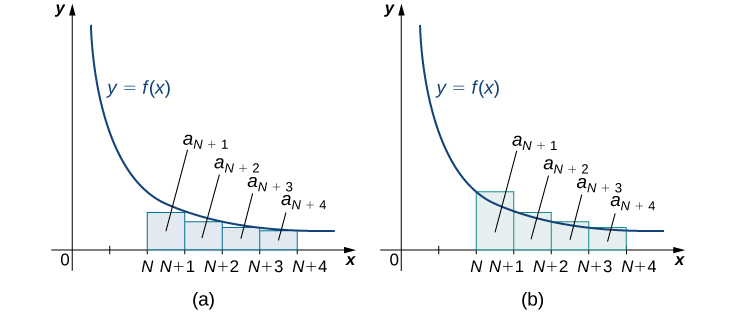
We can extend this idea to prove convergence or divergence for many different series. Suppose is a series with positive terms such that there exists a continuous, positive, decreasing function where for all positive integers. Then, as in Figure 5.14(a), for any integer the partial sum satisfies
Therefore, if converges, then the sequence of partial sums is bounded. Since is an increasing sequence, if it is also a bounded sequence, then by the Monotone Convergence Theorem, it converges. We conclude that if converges, then the series also converges. On the other hand, from Figure 5.14(b), for any integer the partial sum satisfies
If then is an unbounded sequence and therefore diverges. As a result, the series also diverges. We conclude that if diverges, then diverges.
![This shows two graphs side by side of the same function y = f(x), a decreasing concave up curve approaching the x axis. Rectangles are drawn with base 1 over the intervals [0, 6] and [1, 6]. For the graph on the left, the height of each rectangle is determined by the value of the function at the right endpoint of its base. For the graph on the right, the height of each rectangle is determined by the value of the function at the left endpoint of its base. Areas a_1 through a_6 are marked in the graph on the left, and the same for a_1 to a_5 on the right.](/calculus-bundle/media/CNX_Calc_Figure_09_03_002.jpg)
Suppose is a series with positive terms Suppose there exists a function and a positive integer such that the following three conditions are satisfied:
- is continuous,
- is decreasing, and
- for all integers
Then
both converge or both diverge (see Figure 5.14).
Although convergence of implies convergence of the related series it does not imply that the value of the integral and the series are the same. They may be different, and often are. For example,
is a geometric series with initial term and ratio which converges to
However, the related integral satisfies
For each of the following series, use the integral test to determine whether the series converges or diverges. Assume that all conditions for the integral test are met.
- Compare
We have
Thus the integral converges, and therefore so does the series
- Compare
Since
the integral diverges, and therefore
diverges.
Use the integral test to determine whether the series converges or diverges.
The series diverges.
Compare to the integral
The p-Series
The harmonic series and the series are both examples of a type of series called a p-series.
For any real number the series
is called a p-series.
We know the p-series converges if and diverges if What about other values of In general, it is difficult, if not impossible, to compute the exact value of most -series. However, we can use the tests presented thus far to prove whether a -series converges or diverges.
If then and if then Therefore, by the divergence test,
If then is a positive, continuous, decreasing function. Therefore, for we use the integral test, comparing
We have already considered the case when Here we consider the case when For this case,
Because
we conclude that
Therefore, converges if and diverges if
In summary,
For each of the following series, determine whether it converges or diverges.
- This is a p-series with so the series converges.
- Since the series diverges.
Does the series converge or diverge?
The series converges.
Estimating the Value of a Series
Suppose we know that a series converges and we want to estimate the sum of that series. Certainly we can approximate that sum using any finite sum where is any positive integer. The question we address here is, for a convergent series how good is the approximation More specifically, if we let
be the remainder when the sum of an infinite series is approximated by the partial sum, how large is For some types of series, we are able to use the ideas from the integral test to estimate
Suppose is a convergent series with positive terms. Suppose there exists a function satisfying the following three conditions:
- is continuous,
- is decreasing, and
- for all integers
Let be the Nth partial sum of For all positive integers
In other words, the remainder satisfies the following estimate:
This is known as the remainder estimate.
We illustrate Estimating the Value of a Series in Figure 5.15. In particular, by representing the remainder as the sum of areas of rectangles, we see that the area of those rectangles is bounded above by and bounded below by In other words,
and
We conclude that
Since
where is the partial sum, we conclude that
Consider the series
- Calculate and estimate the error.
- Determine the least value of necessary such that will estimate to within
- Using a calculating utility, we have
By the remainder estimate, we know
We have
Therefore, the error is - Find such that In part a. we showed that Therefore, the remainder as long as That is, we need Solving this inequality for we see that we need To ensure that the remainder is within the desired amount, we need to round up to the nearest integer. Therefore, the minimum necessary value is
For calculate and estimate the error
Use the remainder estimate
Key Concepts
- If then the series diverges.
- If the series may converge or diverge.
- If is a series with positive terms and is a continuous, decreasing function such that for all positive integers then
either both converge or both diverge. Furthermore, if converges, then the partial sum approximation is accurate up to an error where - The p-series converges if and diverges if
Key Equations
| Divergence test | |
| p-series | |
| Remainder estimate from the integral test |
.
For each of the following series, if the divergence test applies, either state that does not exist or find If the divergence test does not apply, state why.
Divergence test does not apply.
Series diverges.
(does not exist). Series diverges.
Series diverges.
does not exist. Series diverges.
Series diverges.
Divergence test does not apply.
State whether the given -series converges.
Series converges,
Series converges,
Series converges,
Use the integral test to determine whether the following sums converge.
Series diverges by comparison with
Series diverges by comparison with
Series converges by comparison with
Express the following sums as -series and determine whether each converges.
(Hint: .)
Since diverges by -series.
(Hint: .)
Since diverges by -series.
Use the estimate to find a bound for the remainder where
[T] Find the minimum value of such that the remainder estimate guarantees that estimates accurate to within the given error.
error
error
error
error
error
In the following exercises, find a value of such that is smaller than the desired error. Compute the corresponding sum and compare it to the given estimate of the infinite series.
error
error
okay if Estimate agrees with to five decimal places.
error
error
okay if
Estimate agrees with the sum to three decimal places.
error
Find the limit as of (Hint: Compare to
Find the limit as of
The next few exercises are intended to give a sense of applications in which partial sums of the harmonic series arise.
In certain applications of probability, such as the so-called Watterson estimator for predicting mutation rates in population genetics, it is important to have an accurate estimate of the number Recall that is decreasing. Compute to four decimal places. (Hint: .)
[T] Complete sampling with replacement, sometimes called the coupon collector’s problem, is phrased as follows: Suppose you have unique items in a bin. At each step, an item is chosen at random, identified, and put back in the bin. The problem asks what is the expected number of steps that it takes to draw each unique item at least once. It turns out that . . Find for .
[T] The simplest way to shuffle cards is to take the top card and insert it at a random place in the deck, called top random insertion, and then repeat. We will consider a deck to be randomly shuffled once enough top random insertions have been made that the card originally at the bottom has reached the top and then been randomly inserted. If the deck has cards, then the probability that the insertion will be below the card initially at the bottom (call this card is Thus the expected number of top random insertions before is no longer at the bottom is n. Once one card is below there are two places below and the probability that a randomly inserted card will fall below is The expected number of top random insertions before this happens is The two cards below are now in random order. Continuing this way, find a formula for the expected number of top random insertions needed to consider the deck to be randomly shuffled.
The expected number of random insertions to get to the top is Then one more insertion puts back in at random. Thus, the expected number of shuffles to randomize the deck is
Suppose a scooter can travel km on a full tank of fuel. Assuming that fuel can be transferred from one scooter to another but can only be carried in the tank, present a procedure that will enable one of the scooters to travel km, where
Show that for the remainder estimate to apply on it is sufficient that be decreasing on but need not be decreasing on
Set and such that is decreasing on
[T] Use the remainder estimate and integration by parts to approximate within an error smaller than
Does converge if is large enough? If so, for which
The series converges for by integral test using change of variable.
[T] Suppose a computer can sum one million terms per second of the divergent series Use the integral test to approximate how many seconds it will take to add up enough terms for the partial sum to exceed
[T] A fast computer can sum one million terms per second of the divergent series Use the integral test to approximate how many seconds it will take to add up enough terms for the partial sum to exceed
terms are needed.
Glossary
- divergence test
- if then the series diverges
- integral test
- for a series with positive terms if there exists a continuous, decreasing function such that for all positive integers then
either both converge or both diverge - p-series
- a series of the form
- remainder estimate
- for a series with positive terms and a continuous, decreasing function such that for all positive integers the remainder satisfies the following estimate:
Look at