- Integrate functions involving exponential functions.
- Integrate functions involving logarithmic functions.
Exponential and logarithmic functions are used to model population growth, cell growth, and financial growth, as well as depreciation, radioactive decay, and resource consumption, to name only a few applications. In this section, we explore integration involving exponential and logarithmic functions.
Integrals of Exponential Functions
The exponential function is perhaps the most efficient function in terms of the operations of calculus. The exponential function, is its own derivative and its own integral.
Exponential functions can be integrated using the following formulas.
Find the antiderivative of the exponential function e−x.
Use substitution, setting and then Multiply the du equation by −1, so you now have Then,
Find the antiderivative of the function using substitution:
A common mistake when dealing with exponential expressions is treating the exponent on e the same way we treat exponents in polynomial expressions. We cannot use the power rule for the exponent on e. This can be especially confusing when we have both exponentials and polynomials in the same expression, as in the previous checkpoint. In these cases, we should always double-check to make sure we’re using the right rules for the functions we’re integrating.
Find the antiderivative of the exponential function
First rewrite the problem using a rational exponent:
Using substitution, choose Then, We have (Figure 5.37)
Then
![A graph of the function f(x) = e^x * sqrt(1 + e^x), which is an increasing concave up curve, over [-3, 1]. It begins close to the x axis in quadrant two, crosses the y axis at (0, sqrt(2)), and continues to increase rapidly.](/calculus-bundle/media/CNX_Calc_Figure_05_06_001.jpg)
Find the antiderivative of
Let
Use substitution to evaluate the indefinite integral
Here we choose to let u equal the expression in the exponent on e. Let and Again, du is off by a constant multiplier; the original function contains a factor of 3x2, not 6x2. Multiply both sides of the equation by so that the integrand in u equals the integrand in x. Thus,
Integrate the expression in u and then substitute the original expression in x back into the u integral:
Evaluate the indefinite integral
Let
As mentioned at the beginning of this section, exponential functions are used in many real-life applications. The number e is often associated with compounded or accelerating growth, as we have seen in earlier sections about the derivative. Although the derivative represents a rate of change or a growth rate, the integral represents the total change or the total growth. Let’s look at an example in which integration of an exponential function solves a common business application.
A price–demand function tells us the relationship between the quantity of a product demanded and the price of the product. In general, price decreases as quantity demanded increases. The marginal price–demand function is the derivative of the price–demand function and it tells us how fast the price changes at a given level of production. These functions are used in business to determine the price–elasticity of demand, and to help companies determine whether changing production levels would be profitable.
Find the price–demand equation for a particular brand of toothpaste at a supermarket chain when the demand is 50 tubes per week at $2.35 per tube, given that the marginal price—demand function, for x number of tubes per week, is given as
If the supermarket chain sells 100 tubes per week, what price should it set?
To find the price–demand equation, integrate the marginal price–demand function. First find the antiderivative, then look at the particulars. Thus,
Using substitution, let and Then, divide both sides of the du equation by −0.01. This gives
The next step is to solve for C. We know that when the price is $2.35 per tube, the demand is 50 tubes per week. This means
Now, just solve for C:
Thus,
If the supermarket sells 100 tubes of toothpaste per week, the price would be
The supermarket should charge $1.99 per tube if it is selling 100 tubes per week.
Evaluate the definite integral
Again, substitution is the method to use. Let so or Then Next, change the limits of integration. Using the equation we have
The integral then becomes
See Figure 5.38.
![A graph of the function f(x) = e^(1-x) over [0, 3]. It crosses the y axis at (0, e) as a decreasing concave up curve and symptotically approaches 0 as x goes to infinity.](/calculus-bundle/media/CNX_Calc_Figure_05_06_002.jpg)
Evaluate
Let
Suppose the rate of growth of bacteria in a Petri dish is given by where t is given in hours and is given in thousands of bacteria per hour. If a culture starts with 10,000 bacteria, find a function that gives the number of bacteria in the Petri dish at any time t. How many bacteria are in the dish after 2 hours?
We have
Then, at we have so and we get
At time we have
After 2 hours, there are 17,282 bacteria in the dish.
From Example 5.42, suppose the bacteria grow at a rate of Assume the culture still starts with 10,000 bacteria. Find How many bacteria are in the dish after 3 hours?
There are 20,099 bacteria in the dish after 3 hours.
Use the procedure from Example 5.42 to solve the problem.
Suppose a population of fruit flies increases at a rate of in flies per day. If the initial population of fruit flies is 100 flies, how many flies are in the population after 10 days?
Let represent the number of flies in the population at time t. Applying the net change theorem, we have
There are 122 flies in the population after 10 days.
Suppose the rate of growth of the fly population is given by and the initial fly population is 100 flies. How many flies are in the population after 15 days?
There are 116 flies.
Use the process from Example 5.43 to solve the problem.
Evaluate the definite integral using substitution:
This problem requires some rewriting to simplify applying the properties. First, rewrite the exponent on e as a power of x, then bring the x2 in the denominator up to the numerator using a negative exponent. We have
Let the exponent on e. Then
Bringing the negative sign outside the integral sign, the problem now reads
Next, change the limits of integration:
Notice that now the limits begin with the larger number, meaning we must multiply by −1 and interchange the limits. Thus,
Evaluate the definite integral using substitution:
Let
Integrals Involving Logarithmic Functions
Integrating functions of the form result in the absolute value of the natural log function, as shown in the following rule. Integral formulas for other logarithmic functions, such as and are also included in the rule.
The following formulas can be used to evaluate integrals involving logarithmic functions.
Find the antiderivative of the function
First factor the 3 outside the integral symbol. Then use the u−1 rule. Thus,
See Figure 5.39.
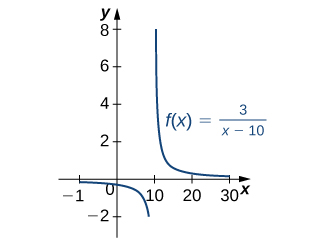
Find the antiderivative of
This can be rewritten as Use substitution. Let then Alter du by factoring out the 2. Thus,
Rewrite the integrand in u:
Then we have
Find the antiderivative of the log function
Follow the format in the formula listed in the rule on integration formulas involving logarithmic functions. Based on this format, we have
Find the antiderivative of
Follow Example 5.47 and refer to the rule on integration formulas involving logarithmic functions.
Example 5.48 is a definite integral of a trigonometric function. With trigonometric functions, we often have to apply a trigonometric property or an identity before we can move forward. Finding the right form of the integrand is usually the key to a smooth integration.
Find the definite integral of
We need substitution to evaluate this problem. Let so Rewrite the integral in terms of u, changing the limits of integration as well. Thus,
Then
Key Concepts
- Exponential and logarithmic functions arise in many real-world applications, especially those involving growth and decay.
- Substitution is often used to evaluate integrals involving exponential functions or logarithms.
Key Equations
| Integrals of Exponential Functions | |
| Integration Formulas Involving Logarithmic Functions |
.
In the following exercises, compute each indefinite integral.
In the following exercises, find each indefinite integral by using appropriate substitutions.
In the following exercises, verify by differentiation that then use appropriate changes of variables to compute the integral.
Write an integral to express the area under the graph of from to ex and evaluate the integral.
Write an integral to express the area under the graph of between and and evaluate the integral.
In the following exercises, use appropriate substitutions to express the trigonometric integrals in terms of compositions with logarithms.
In the following exercises, evaluate the definite integral.
In the following exercises, integrate using the indicated substitution.
In the following exercises, does the right-endpoint approximation overestimate or underestimate the exact area? Calculate the right endpoint estimate R50 and solve for the exact area.
[T] over
[T] over
Exact solution: Since f is decreasing, the right endpoint estimate underestimates the area.
[T] over
[T] over
Exact solution: Since f is increasing, the right endpoint estimate overestimates the area.
[T] over
[T] over
Exact solution: Since f is negative and increasing on the interval, the right-endpoint estimate overestimates the value of the integral, but it underestimates the area of the region (absolute value of the integral).
In the following exercises, for Find the area under the graph of between the given values a and b by integrating.
Find the area under the graph of the function between and
Compute the integral of and find the smallest value of N such that the area under the graph between and is, at most, 0.01.
The quantity is less than 0.01 when
Find the limit, as N tends to infinity, of the area under the graph of between and
Show that when
Suppose that for all x and that f and g are differentiable. Use the identity and the chain rule to find the derivative of
Use the previous exercise to find the antiderivative of and evaluate
23
Show that if then the integral of from ac to bc is the same as the integral of from a to b.
The following exercises are intended to derive the fundamental properties of the natural log starting from the definition using properties of the definite integral and making no further assumptions.
Use the identity to derive the identity
We may assume that Then, Now make the substitution so and and change endpoints:
Use a change of variable in the integral to show that
Use the identity to show that is an increasing function of x on and use the previous exercises to show that the range of is Without any further assumptions, conclude that has an inverse function defined on
Answers will vary.
Pretend, for the moment, that we do not know that is the inverse function of but keep in mind that has an inverse function defined on Call it E. Use the identity to deduce that for any real numbers a, b.
Pretend, for the moment, that we do not know that is the inverse function of but keep in mind that has an inverse function defined on Call it E. Show that
Then, Since any number t can be written for some x, and for such t we have it follows that for any
The sine integral, defined as is an important quantity in engineering. Although it does not have a simple closed formula, it is possible to estimate its behavior for large x. Show that for
[T] The normal distribution in probability is given by where σ is the standard deviation and μ is the average. The standard normal distribution in probability, corresponds to Compute the right endpoint estimates of
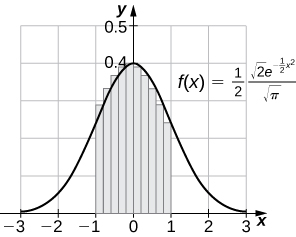
[T] Compute the right endpoint estimates of
Let u equal the exponent on e.