- Recognize when to apply L’Hôpital’s rule.
- Identify indeterminate forms produced by quotients, products, subtractions, and powers, and apply L’Hôpital’s rule in each case.
- Describe the relative growth rates of functions.
In this section, we examine a powerful tool for evaluating limits. This tool, known as L’Hôpital’s rule, uses derivatives to calculate limits. With this rule, we will be able to evaluate many limits we have not yet been able to determine. Instead of relying on numerical evidence to conjecture that a limit exists, we will be able to show definitively that a limit exists and to determine its exact value.
Applying L’Hôpital’s Rule
L’Hôpital’s rule can be used to evaluate limits involving the quotient of two functions. Consider
If then
However, what happens if and We call this one of the indeterminate forms, of type This is considered an indeterminate form because we cannot determine the exact behavior of as without further analysis. We have seen examples of this earlier in the text. For example, consider
For the first of these examples, we can evaluate the limit by factoring the numerator and writing
For we were able to show, using a geometric argument, that
Here we use a different technique for evaluating limits such as these. Not only does this technique provide an easier way to evaluate these limits, but also, and more important, it provides us with a way to evaluate many other limits that we could not calculate previously.
The idea behind L’Hôpital’s rule can be explained using local linear approximations. Consider two differentiable functions and such that and such that For near we can write
and
Therefore,
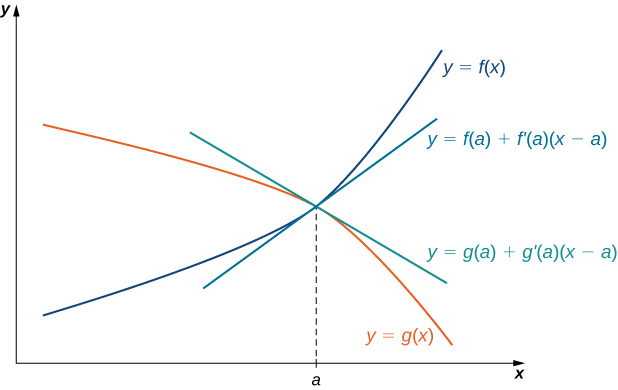
Since is differentiable at then is continuous at and therefore Similarly, If we also assume that and are continuous at then and Using these ideas, we conclude that
Note that the assumption that and are continuous at and can be loosened. We state L’Hôpital’s rule formally for the indeterminate form Also note that the notation does not mean we are actually dividing zero by zero. Rather, we are using the notation to represent a quotient of limits, each of which is zero.
Suppose and are differentiable functions over an open interval containing except possibly at If and then
assuming the limit on the right exists or is or This result also holds if we are considering one-sided limits, or if
Proof
We provide a proof of this theorem in the special case when and are all continuous over an open interval containing In that case, since and and are continuous at it follows that Therefore,
Note that L’Hôpital’s rule states we can calculate the limit of a quotient by considering the limit of the quotient of the derivatives It is important to realize that we are not calculating the derivative of the quotient
□
Evaluate each of the following limits by applying L’Hôpital’s rule.
- Since the numerator and the denominator we can apply L’Hôpital’s rule to evaluate this limit. We have
- As the numerator and the denominator Therefore, we can apply L’Hôpital’s rule. We obtain
- As the numerator and the denominator Therefore, we can apply L’Hôpital’s rule. We obtain
- As both the numerator and denominator approach zero. Therefore, we can apply L’Hôpital’s rule. We obtain
Since the numerator and denominator of this new quotient both approach zero as we apply L’Hôpital’s rule again. In doing so, we see that
Therefore, we conclude that
Evaluate
We can also use L’Hôpital’s rule to evaluate limits of quotients in which and Limits of this form are classified as indeterminate forms of type Again, note that we are not actually dividing by Since is not a real number, that is impossible; rather, is used to represent a quotient of limits, each of which is or
Suppose and are differentiable functions over an open interval containing except possibly at Suppose (or and (or Then,
assuming the limit on the right exists or is or This result also holds if the limit is infinite, if or or the limit is one-sided.
Evaluate each of the following limits by applying L’Hôpital’s rule.
- Since and are first-degree polynomials with positive leading coefficients, and Therefore, we apply L’Hôpital’s rule and obtain
Note that this limit can also be calculated without invoking L’Hôpital’s rule. Earlier in the chapter we showed how to evaluate such a limit by dividing the numerator and denominator by the highest power of in the denominator. In doing so, we saw that
L’Hôpital’s rule provides us with an alternative means of evaluating this type of limit. - Here, and Therefore, we can apply L’Hôpital’s rule and obtain
Now as Therefore, the first term in the denominator is approaching zero and the second term is getting really large. In such a case, anything can happen with the product. Therefore, we cannot make any conclusion yet. To evaluate the limit, we use the definition of to write
Now and so we apply L’Hôpital’s rule again. We find
We conclude that
Evaluate
As mentioned, L’Hôpital’s rule is an extremely useful tool for evaluating limits. It is important to remember, however, that to apply L’Hôpital’s rule to a quotient it is essential that the limit of be of the form or Consider the following example.
Consider Show that the limit cannot be evaluated by applying L’Hôpital’s rule.
Because the limits of the numerator and denominator are not both zero and are not both infinite, we cannot apply L’Hôpital’s rule. If we try to do so, we get
and
At which point we would conclude erroneously that
However, since and we actually have
We can conclude that
Explain why we cannot apply L’Hôpital’s rule to evaluate Evaluate by other means.
Therefore, we cannot apply L’Hôpital’s rule. The limit of the quotient is
Determine the limits of the numerator and denominator separately.
Other Indeterminate Forms
L’Hôpital’s rule is very useful for evaluating limits involving the indeterminate forms and However, we can also use L’Hôpital’s rule to help evaluate limits involving other indeterminate forms that arise when evaluating limits. The expressions and are all considered indeterminate forms. These expressions are not real numbers. Rather, they represent forms that arise when trying to evaluate certain limits. Next we realize why these are indeterminate forms and then understand how to use L’Hôpital’s rule in these cases. The key idea is that we must rewrite the indeterminate forms in such a way that we arrive at the indeterminate form or
Indeterminate Form of Type
Suppose we want to evaluate where and (or as Since one term in the product is approaching zero but the other term is becoming arbitrarily large (in magnitude), anything can happen to the product. We use the notation to denote the form that arises in this situation. The expression is considered indeterminate because we cannot determine without further analysis the exact behavior of the product as For example, let be a positive integer and consider
As and However, the limit as of varies, depending on If then If then If then Here we consider another limit involving the indeterminate form and show how to rewrite the function as a quotient to use L’Hôpital’s rule.
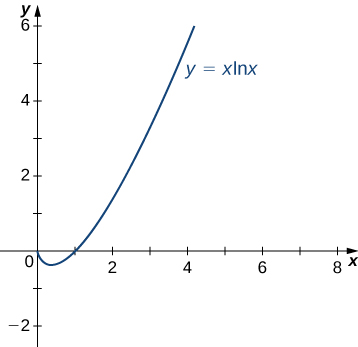
Evaluate
First, rewrite the function as a quotient to apply L’Hôpital’s rule. If we write
we see that as and as Therefore, we can apply L’Hôpital’s rule and obtain
We conclude that
Evaluate
Write
Indeterminate Form of Type
Another type of indeterminate form is Consider the following example. Let be a positive integer and let and As and We are interested in Depending on whether grows faster, grows faster, or they grow at the same rate, as we see next, anything can happen in this limit. Since and we write to denote the form of this limit. As with our other indeterminate forms, has no meaning on its own and we must do more analysis to determine the value of the limit. For example, suppose the exponent in the function is then
On the other hand, if then
However, if then
Therefore, the limit cannot be determined by considering only Next we see how to rewrite an expression involving the indeterminate form as a fraction to apply L’Hôpital’s rule.
Evaluate
By combining the fractions, we can write the function as a quotient. Since the least common denominator is we have
As the numerator and the denominator Therefore, we can apply L’Hôpital’s rule. Taking the derivatives of the numerator and the denominator, we have
As and Since the denominator is positive as approaches zero from the right, we conclude that
Therefore,
Evaluate
Rewrite the difference of fractions as a single fraction.
Another type of indeterminate form that arises when evaluating limits involves exponents. The expressions and are all indeterminate forms. On their own, these expressions are meaningless because we cannot actually evaluate these expressions as we would evaluate an expression involving real numbers. Rather, these expressions represent forms that arise when finding limits. Now we examine how L’Hôpital’s rule can be used to evaluate limits involving these indeterminate forms.
Since L’Hôpital’s rule applies to quotients, we use the natural logarithm function and its properties to reduce a problem evaluating a limit involving exponents to a related problem involving a limit of a quotient. For example, suppose we want to evaluate and we arrive at the indeterminate form (The indeterminate forms and can be handled similarly.) We proceed as follows. Let
Then,
Therefore,
Since we know that Therefore, is of the indeterminate form and we can use the techniques discussed earlier to rewrite the expression in a form so that we can apply L’Hôpital’s rule. Suppose where may be or Then
Since the natural logarithm function is continuous, we conclude that
which gives us
Evaluate
Let Then,
We need to evaluate Applying L’Hôpital’s rule, we obtain
Therefore, Since the natural logarithm function is continuous, we conclude that
which leads to
Hence,
Evaluate
Let and apply the natural logarithm to both sides of the equation.
Evaluate
Let
Therefore,
We now evaluate Since and we have the indeterminate form To apply L’Hôpital’s rule, we need to rewrite as a fraction. We could write
or
Let’s consider the first option. In this case, applying L’Hôpital’s rule, we would obtain
Unfortunately, we not only have another expression involving the indeterminate form but the new limit is even more complicated to evaluate than the one with which we started. Instead, we try the second option. By writing
and applying L’Hôpital’s rule, we obtain
Using the fact that and we can rewrite the expression on the right-hand side as
We conclude that Therefore, and we have
Hence,
Evaluate
Let and take the natural logarithm of both sides of the equation.
Growth Rates of Functions
Suppose the functions and both approach infinity as Although the values of both functions become arbitrarily large as the values of become sufficiently large, sometimes one function is growing more quickly than the other. For example, and both approach infinity as However, as shown in the following table, the values of are growing much faster than the values of
This table has three rows and five columns. The first column is a header column, and it reads from top to bottom x, f(x) = x2, and g(x) = x3. To the right of the header, the first row reads 10, 100, 1000, and 10,000. The second row reads 100, 10,000, 1,000,000, and 100,000,000. The third row reads 1000, 1,000,000, 1,000,000,000, and 1,000,000,000,000.
In fact,
As a result, we say is growing more rapidly than as On the other hand, for and although the values of are always greater than the values of for each value of is roughly three times the corresponding value of as as shown in the following table. In fact,
This table has three rows and five columns. The first column is a header column, and it reads from top to bottom x, f(x) = x2, and g(x) = 3x2 + 4x + 1. To the right of the header, the first row reads 10, 100, 1000, and 10,000. The second row reads 100, 10,000, 1,000,000, and 100,000,000. The third row reads 341, 30,401, 3,004,001, and 300,040,001.
In this case, we say that and are growing at the same rate as
More generally, suppose and are two functions that approach infinity as We say grows more rapidly than as if
On the other hand, if there exists a constant such that
we say and grow at the same rate as
Next we see how to use L’Hôpital’s rule to compare the growth rates of power, exponential, and logarithmic functions.
For each of the following pairs of functions, use L’Hôpital’s rule to evaluate
- Since and we can use L’Hôpital’s rule to evaluate We obtain
Since and we can apply L’Hôpital’s rule again. Since
we conclude that
Therefore, grows more rapidly than as (See Figure 4.73 and Table 4.9).
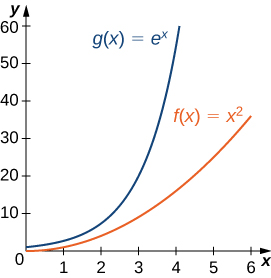
Figure 4.73 An exponential function grows at a faster rate than a power function. Table 4.9 Growth rates of a power function and an exponential function. This table has three rows and five columns. The first column is a header column, and it reads from top to bottom x, x2, and ex. To the right of the header, the first row reads 5, 10, 15, and 20. The second row reads 25, 100, 225, and 400. The third row reads 148, 22,026, 3,269,017, and 485,165,195.
- Since and we can use L’Hôpital’s rule to evaluate We obtain
Thus, grows more rapidly than as (see Figure 4.74 and Table 4.10).
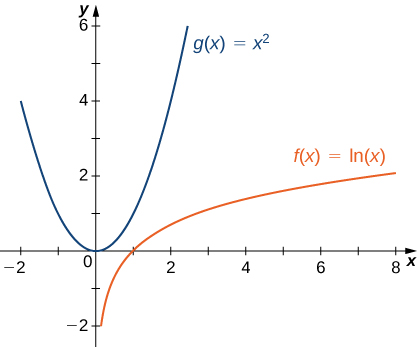
Figure 4.74 A power function grows at a faster rate than a logarithmic function. Table 4.10 Growth rates of a power function and a logarithmic function This table has three rows and five columns. The first column is a header column, and it reads from top to bottom x, ln(x), and x2. To the right of the header, the first row reads 10, 100, 1000, and 10,000. The second row reads 2.303, 4.605, 6.908, and 9.210. The third row reads 100, 10,000, 1,000,000, and 100,000,000.
Compare the growth rates of and
The function grows faster than
Apply L’Hôpital’s rule to
Using the same ideas as in Example 4.45a. it is not difficult to show that grows more rapidly than for any In Figure 4.75 and Table 4.11, we compare with and as
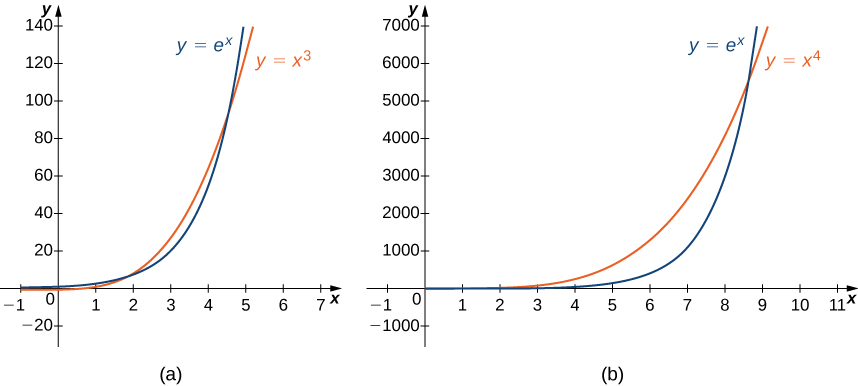
This table has four rows and five columns. The first column is a header column, and it reads from top to bottom x, x3, x4, and ex. To the right of the header, the first row reads 5, 10, 15, and 20. The second row reads 125, 1000, 3375, and 8000. The third row reads 625, 10,000, 50,625, and 160,000. The fourth row reads 148, 22,026, 3,269,017, and 485,165,195.
Similarly, it is not difficult to show that grows more rapidly than for any In Figure 4.76 and Table 4.12, we compare with and
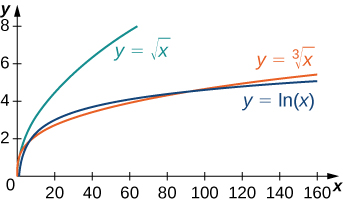
This table has four rows and five columns. The first column is a header column, and it reads from top to bottom x, ln(x), the cube root of x, and the square root of x. To the right of the header, the first row reads 10, 100, 1000, and 10,000. The second row reads 2.303, 4.605, 6.908, and 9.210. The third row reads 2.154, 4.642, 10, and 21.544. The fourth row reads 3.162, 10, 31.623, and 100.
Key Concepts
- L’Hôpital’s rule can be used to evaluate the limit of a quotient when the indeterminate form or arises.
- L’Hôpital’s rule can also be applied to other indeterminate forms if they can be rewritten in terms of a limit involving a quotient that has the indeterminate form or
- The exponential function grows faster than any power function
- The logarithmic function grows more slowly than any power function
For the following exercises, evaluate the limit.
Evaluate the limit
Evaluate the limit
Evaluate the limit
Evaluate the limit .
Evaluate the limit .
Evaluate the limit .
For the following exercises, determine whether you can apply L’Hôpital’s rule directly. Explain why or why not. Then, indicate if there is some way you can alter the limit so you can apply L’Hôpital’s rule.
Cannot apply directly; use logarithms
Cannot apply directly; rewrite as
For the following exercises, evaluate the limits with either L’Hôpital’s rule or previously learned methods.
For the following exercises, use a calculator to graph the function and estimate the value of the limit, then use L’Hôpital’s rule to find the limit directly.
[T]
[T]
[T]
[T]
[T]
[T]
[T]
[T]
[T]
[T]
Glossary
- indeterminate forms
- when evaluating a limit, the forms and are considered indeterminate because further analysis is required to determine whether the limit exists and, if so, what its value is
- L’Hôpital’s rule
- if and are differentiable functions over an interval except possibly at and or and are infinite, then assuming the limit on the right exists or is or