Learning Objectives
By the end of this section, you will be able to:
- Describe the next generation of ground- and space-based observatories
- Explain some of the challenges involved in building these observatories
If you’ve ever gone on a hike, you have probably been eager to see what lies just around the next bend in the path. Researchers are no different, and astronomers and engineers are working on the technologies that will allow us to explore even more distant parts of the universe and to see them more clearly.
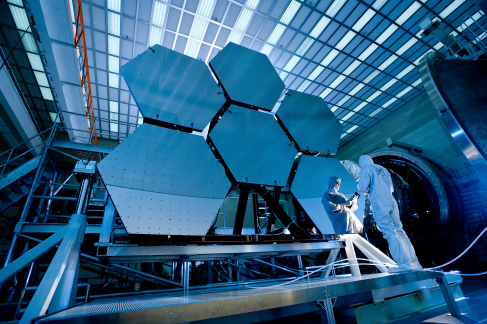
As we saw earlier, the premier space facility for the coming decade will be the James Webb Space Telescope (Figure 6.27). Its work is just beginning, but its flawless deployment in the first half of 2022 has given astronomers a strong sense of optimism about its ability to probe the infrared universe. The smaller Hubble Space Telescope is still functioning after more than 30 years in space. NASA is also looking at launching (around 2027) the Nancy Grace Roman Space Telescope, an infrared instrument which will have a smaller mirror but a wider field of view than the Webb.
On the ground, astronomers have built the Vera Rubin Observatory, which has an 8.4-meter telescope with a significantly larger field of view than any existing telescopes and the largest digital camera ever built. From its location in Chile, it will photograph the entire southern sky in only three nights, and then start again, essentially making a movie of the sky for ten years. Astronomers are looking for transients, phenomena that change quickly, such as exploding stars and chunks of rock that orbit near Earth. The observatory saw first light in 2025. By the way, the observatory is named after the American astronomer whose work led us to the understanding that much of the universe is made of a mysterious substance that scientists call dark matter (which we explain in The Mass of the Galaxy).
The international gamma-ray community is planning the Cherenkov Telescope Array (CTA), two arrays of telescopes, one in each hemisphere, which will indirectly measure gamma rays from the ground. The CTA will measure gamma-ray energies a thousand times as great as the Fermi telescope can detect.
Several groups of astronomers around the globe interested in studying visible light and the infrared are exploring the feasibility of building ground-based telescopes with mirrors larger than 30 meters across. Stop and think what this means: 30 meters is one-third the length of a football field. It is technically impossible to build and transport a single astronomical mirror that is 30 meters or larger in diameter. The primary mirror of these giant telescopes will consist of smaller mirrors, all aligned so that they act as a very large mirror in combination.
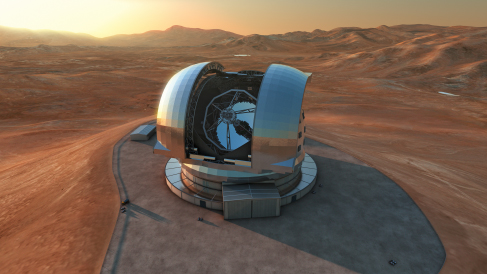
The most ambitious of these projects is the European Extremely Large Telescope (ELT) (Figure 6.28). (Astronomers try to outdo each other not only with the size of these telescopes, but also their names!) The design of the European ELT calls for a 39.3-meter primary mirror, which will follow the Keck design and be made up of 798 hexagonal mirrors, each 1.4 meters in diameter and all held precisely in position so that they form a continuous surface. Construction on the site in the Atacama Desert in Northern Chile started in 2014, and operations are expected to begin in about 2025.
International consortia with major contributions from U.S. astronomers have developed plans for the construction of two large new telescopes. One is a Thirty-Meter Telescope (TMT) for which the preferred site is Maunakea in Hawaii. The design of this telescope is similar to that of the European ELT and will make use of 492 hexagonal elements. Each segment is about 1.44 meters (56.6 inches) across corners. The segments are closely spaced, with gaps between the segments only 2.5 mm (0.1 inch) wide.
The Giant Magellan Telescope (GMT) is the second ELT project with major participation by U.S. astronomers. The GMT is also a segmented mirror telescope that employs seven stiff monolith 8.4-meter mirrors as segments. Construction has started at the selected site, which is near the Las Campanas Observatory on the southern edge of the Atacama Desert.
These giant telescopes will combine light-gathering power with high-resolution imaging. These powerful new instruments will enable astronomers to tackle many important astronomical problems. As just one example, they provide us images and spectra of planets around other stars and thus, perhaps, give us the first real evidence (from the chemistry of these planets’ atmospheres) that life exists elsewhere.
Check out this fun diagram comparing the sizes of the largest planned and existing telescopes to a regulation basketball and tennis court.
The largest space telescope yet, the 6.5-meter James Webb Space Telescope, was launched in December 2021 and is sending back a flood of useful information about the infrared universe. New and even larger telescopes are on the drawing boards. Gamma-ray astronomers are planning to build the CTA to measure very energetic gamma rays. Astronomers built the Vera Rubin Observatory to observe with a field of view that is unprecedented in size, and are planning a new generation of visible-light/infrared telescopes with apertures of 24.5 to 39 meters in diameter.
For Further Exploration
Articles
Bakich, M. “Meet the User-friendly EVScope.” Astronomy (March 2021): 58. Review of an electronically enhanced amateur telescope that lets you see deep-sky objects even with city lights.
Hall, S. “SOFIA’s End.” Sky & Telescope (April 2023): 12. On the discoveries and discontinuation of the flying infrared observatory.
Hannikainen, D. “The Radio Sky.” Sky & Telescope (August 2020): 12. Survey of major radio instruments and projects.
Harrington, P. “First Scopes for Adults.” Astronomy (June 2022): 46. A primer on how to choose a first amateur telescope.
Hyman, R. “Trailblazing Astronomers and Their Observatories.” Astronomy (April 2021): 24. On Nancy Roman and Vera Rubin, their work, and the telescopes named after them.
Irion, R. “Prime Time.” Astronomy (February 2001): 46. On how time is allotted on the major research telescopes. Lazio, Joseph, et al. “Tuning in to the Universe: 21st Century Radio Astronomy” Sky & Telescope (July 2008): 21. About ALMA and the Square Kilometer Array.
Mason, Todd & Robin. “Palomar’s Big Eye.” Sky & Telescope (December 2008): 36. On the Hale 200-inch telescope.
Shilling, G. “Monster Science.” Sky & Telescope (November 2018): 14; (December 2018): 14. On the giant ground-based telescopes that are being planned for the future (in two parts).
Subinsky, R. “Who Really Invented the Telescope.” Astronomy (August 2008): 84. Brief historical introduction, focusing on Hans Lippershey.
Talcott, R. “30 Years of Hubble’s Greatest Hits.” Astronomy (March 2020): 18. 12-page album with explanations.
Talcott, R. “Warm and Not So Fuzzy.” Astronomy (June 2020): 18. Review of the operations of the Spitzer Space Telescope; mostly an album of its images.
Verschuur, G. “Arecibo’s Legacy.” Sky & Telescope (August 2021): 34. A history of the giant radio telescope that was destroyed by a storm in 2020.
Young, M. “The New Space Race (and Problem).” Sky & Telescope (March 2020): 14. A good discussion of the danger that huge numbers of new reflective satellites (to provide Wi-Fi) pose to the darkness of the night sky for astronomers.
Young, M. “X-Ray Explorers: Pioneers of the Invisible Universe.” Sky & Telescope (August 2019): 14. A history of X-ray Astronomy, focusing on the early space telescopes and their discoveries.
James Webb Space Telescope
Geithner, P. “Building the James Webb Space Telescope.” Sky & Telescope (November 2021): 20. The instruments and engineering challenges.
Mather, J. “The James Webb Space Telescope Lives.” Astronomy (October 2021): 14. The senior project scientist previews the giant infrared telescope NASA is launching.
Talcott, R. “How the Webb Telescope is Changing Astronomy.” Astronomy (June 2023): 14. On the work of the Webb in its first year and some of the first images.
Young, M. “First [James Webb Telescope] Images: A Deeper View.” Sky & Telescope (November 2022): 12. A quick overview of the first images released.
Websites
Websites for major telescopes are given in Table 6.1, Table 6.2, Table 6.3, and Table 6.4.
Information on Swarms of Satellites on Low-Earth Orbit
- American Astronomical Society page on the issue with updates and links: https://aas.org/posts/advocacy/2020/12/impacts-large-satellite-constellations-astronomy-live-updates
- Lawler, S. “Space-X’s Starlink Satellites are About to Ruin Stargazing Forever” on the Astronomy magazine website (November 25, 2020): https://astronomy.com/news/2020/11/spacexs-starlink-satellites-are-about-to-ruin-stargazing-for-everyone
- Patel, N. “Satellite Mega-constellations Risk Ruining Astronomy Forever” in Technology Review, September 2, 2020: https://www.technologyreview.com/2020/09/02/1007938/satellite-mega-constellations-risk-ruining-astronomy-forever/
Videos
Catching Light: https://www.eso.org/public/videos/esocast46a/. ESOCast #46: A dramatic introduction to detectors and spectrographs for modern telescopes, made on the occasion of the 50th anniversary of ESO (10:56). See also: https://www.eso.org/public/videos/esocast112a/ (3:58).
Day in the Life of an ESO Astronomer: https://www.eso.org/public/videos/esocast4/. ESOCast #4: What it’s like to observe with a large telescope in our modern era; takes you behind the scenes at the observatory housing the Very Large Telescope (6:00).
First Results from the James Webb Space Telescope: https://www.youtube.com/watch?v=te2zSAbyAo0. Dr. Alex Filippenko of Berkeley gives an excellent insider’s view of what the telescope is expected to do and what it did in the first few months; from the Silicon Valley Astronomy Lectures (1:29:44).
From Silver to Silicon: https://esahubble.org/videos/hubblecast21a/. Hubblecast #21: A history of astronomical detectors from drawings to CCD’s (7:42).
From Ultraviolet to Infrared: Comparing the Hubble and James Webb Telescopes: https://esahubble.org/videos/hubblecast126a/. Hubblecast #126: Contrasts their capabilities in different parts of the electromagnetic spectrum (4:47).
Galaxies Viewed in Full Spectrum of Light: https://www.youtube.com/watch?v=368K0iQv8nE. Scientists with the Spitzer Observatory show how a galaxy looks different at different wavelengths (6:23).
How to Stop a Star’s Twinkle: https://www.eso.org/public/videos/esocast34a/. ESOCast #34: On the adaptive optics technique for getting better resolution, focusing on a laser guide-star instrument (8:50).
Hubble’s History by Hubble Scientists: https://esahubble.org/videos/hubblecast41a/. Hubblecast #42: Interviews with key people show how the Hubble was planned, built, and repaired (9:41).
Introduction to the James Webb Space Telescope Mission: https://www.youtube.com/watch?v=6VqG3Jazrfs. Basic primer for the public on the new space infrared telescope (3:44).
Keck Telescope: https://www.youtube.com/watch?v=EzpGxyuKo_M. A silent film, with captions, about the Keck telescopes and the work being done there, with some nice footage (6:49).
Making the Universe Come to Life: Behind the Hubble Images: https://esahubble.org/videos/hubblecast10a/. Hubblecast #10: Explains how the raw data from Hubble are converted into the beautiful Hubble images that fill our textbook (6:28).
Nancy Roman: The Mother of the Hubble: https://esahubble.org/videos/hubblecast113a/. The life and career of the woman astronomer at NASA whose work led to the Hubble Space Telescope (5:25).
Seeing the Invisible: https://esahubble.org/videos/hubblecast23a/. An introduction to the non-visible bands of the electro-magnetic spectrum, to the telescopes that allow us to detect them, and to what objects are prominent (9:12).
SOFIA: An Airborne Observatory: https://www.youtube.com/watch?v=g5z6fZKOtP4. On the infrared telescope that flies inside a converted 747 airplane (11:25).
Technology to the Rescue: https://esahubble.org/videos/hubblecast20a/. Hubblecast #20: A good discussion of how recent technology has enabled astronomers to build bigger and more efficient telescopes (9:23).
The Atacama Large Millimeter Array (ALMA): https://www.eso.org/public/videos/almatrailer2016a/. A dramatic, musical, visual, and captioned introduction to the giant array of radio telescopes in South America (3:19).
The History of Telescopes: New Views of the Skies: https://esahubble.org/videos/hubblecast17a/ (13:04) and Bigger is Better: https://esahubble.org/videos/hubblecast19a/ (9:35). In these two episodes of the Hubblecast from ESA, host Dr. Joe Liske takes viewers on a good-natured tour of telescopes, how they work, and how they evolved over the years.
Collaborative Group Activities
- Most large telescopes get many more proposals for observing projects than there is night observing time available in a year. Suppose your group is the telescope time allocation committee reporting to an observatory director. What criteria would you use in deciding how to give out time on the telescope? What steps could you take to make sure all your colleagues thought the process was fair and people would still talk to you at future astronomy meetings?
- Your group is a committee of nervous astronomers about to make a proposal to the government ministers of your small European country to chip in with other countries to build the world’s largest telescope in the high, dry desert of the Chilean Andes Mountains. You expect the government ministers to be very skeptical about supporting this project. What arguments would you make to convince them to participate?
- The same government ministers we met in the previous activity ask you to draw up a list of the pros and cons of having the world’s largest telescope in the mountains of Chile (instead of a mountain in Europe). What would your group list in each column?
- Your group should discuss and make a list of all the ways in which an observing session at a large visible-light telescope and a large radio telescope might differ. (Hint: Bear in mind that because the Sun is not especially bright at many radio wavelengths, observations with radio telescopes can often be done during the day.)
- Another “environmental threat” to astronomy (besides light pollution) comes from the spilling of terrestrial communications into the “channels”—wavelengths and frequencies—previously reserved for radio astronomy. For example, the demand for cellular phones means that more and more radio channels will be used for this purpose. The faint signals from cosmic radio sources could be drowned in a sea of earthly conversation (translated and sent as radio waves). Assume your group is a congressional committee being lobbied by both radio astronomers, who want to save some clear channels for doing astronomy, and the companies that stand to make a lot of money from expanding cellular phone use. What arguments would sway you to each side?
- When the site for the new Thirty-Meter Telescope on Hawaii’s Maunakea was dedicated, a group of native Hawaiians announced opposition to the project because astronomers were building too many telescopes on a mountain that native Hawaiians consider a sacred site. You can read more about this controversy at http://www.nytimes.com/2015/12/04/science/space/hawaii-court-rescinds-permit-to-build-thirty-meter-telescope.html?_r=0 and at http://www.nature.com/news/the-mountain-top-battle-over-the-thirty-meter-telescope-1.18446. Once your group has the facts, discuss the claims of each side in the controversy. How do you think it should be resolved?
- If you could propose to use a large modern telescope, what would you want to find out? What telescope would you use and why?
- Light pollution (spilled light in the night sky making it difficult to see the planets and stars) used to be an issue that concerned mostly astronomers. Now spilled light at night is also of concern to environmentalists and those worrying about global warming. Can your group come up with some non-astronomical reasons to be opposed to light pollution?
Review Questions
What are the three basic components of a modern astronomical instrument? Describe each in one to two sentences.
Name the two spectral windows through which electromagnetic radiation easily reaches the surface of Earth and describe the largest-aperture telescope currently in use for each window.
List the largest-aperture single telescope currently in use in each of the following bands of the electromagnetic spectrum: radio, X-ray, gamma ray.
When astronomers discuss the apertures of their telescopes, they say bigger is better. Explain why.
The Hale telescope at Palomar Observatory has a diameter of 5 m, and the Keck I telescope has a diameter of 10 m. How much more light can the Keck telescope collect than the Hale telescope in the same amount of time?
What is meant by “reflecting” and “refracting” telescopes?
Why are the largest visible-light telescopes in the world made with mirrors rather than lenses?
Compare the eye, photographic film, and CCDs as detectors for light. What are the advantages and disadvantages of each?
What is a charge-coupled device (CCD), and how is it used in astronomy?
Why is it difficult to observe at infrared wavelengths? What do astronomers do to address this difficulty?
Radio and radar observations are often made with the same antenna, but otherwise they are very different techniques. Compare and contrast radio and radar astronomy in terms of the equipment needed, the methods used, and the kind of results obtained.
Look back at Figure 6.18 of Cygnus A and read its caption again. The material in the giant lobes at the edges of the image had to have been ejected from the center at least how many years ago?
Why do astronomers place telescopes in Earth’s orbit? What are the advantages for the different regions of the spectrum?
What was the problem with the Hubble Space Telescope and how was it solved?
Describe the techniques radio astronomers use to obtain a resolution comparable to what astronomers working with visible light can achieve.
What kind of visible-light and infrared telescopes on the ground are astronomers planning for the future? Why are they building them on the ground and not in space?
Describe one visible-light or infrared telescope that astronomers are planning to launch into space in the future.
Thought Questions
What happens to the image produced by a lens if the lens is “stopped down” (the aperture reduced, thereby reducing the amount of light passing through the lens) with an iris diaphragm—a device that covers its periphery?
What would be the properties of an ideal astronomical detector? How closely do the actual properties of a CCD approach this ideal?
Many decades ago, the astronomers on the staff of Mount Wilson and Palomar Observatories each received about 60 nights per year for their observing programs. Today, an astronomer feels fortunate to get 10 nights per year on a large telescope. Can you suggest some reasons for this change?
The largest observatory complex in the world is on Maunakea, the tallest mountain on Earth. What are some factors astronomers consider when selecting an observatory site? Don’t forget practical ones. Should astronomers, for example, consider building an observatory on Denali (Mount McKinley) or Mount Everest?
Suppose you are looking for sites for a visible-light observatory, an infrared observatory, and a radio observatory. What are the main criteria of excellence for each? What sites are actually considered the best today?
Radio astronomy involves wavelengths much longer than those of visible light, and many orbiting observatories have probed the universe for radiation of very short wavelengths. What sorts of objects and physical conditions would you expect to be associated with emission of radiation at very long and very short wavelengths?
The dean of a university located near the ocean (who was not a science major in college) proposes building an infrared telescope right on campus and operating it in a nice heated dome so that astronomers will be comfortable on cold winter nights. Criticize this proposal, giving your reasoning.
Figuring for Yourself
What is the area, in square meters, of a 10-m telescope?
Approximately 9000 stars are visible to the naked eye in the whole sky (imagine that you could see around the entire globe and both the northern and southern hemispheres), and there are about 41,200 square degrees on the sky. How many stars are visible per square degree? Per square arcsecond?
Theoretically (that is, if seeing were not an issue), the resolution of a telescope is inversely proportional to its diameter. How much better is the resolution of the ALMA when operating at its longest baseline than the resolution of the Arecibo telescope?
In broad daylight, the size of your pupil is typically 3 mm. In dark situations, it expands to about 7 mm. How much more light can it gather?
How much more light can be gathered by a telescope that is 8 m in diameter than by your fully dark-adapted eye at 7 mm?
How much more light can the Keck telescope (with its 10-m diameter mirror) gather than an amateur telescope whose mirror is 25 cm (0.25 m) across?
People are often bothered when they discover that reflecting telescopes have a second mirror in the middle to bring the light out to an accessible focus where big instruments can be mounted. “Don’t you lose light?” people ask. Well, yes, you do, but there is no better alternative. You can estimate how much light is lost by such an arrangement. The primary mirror (the one at the bottom in Figure 6.6) of the Gemini North telescope is 8 m in diameter. The secondary mirror at the top is about 1 m in diameter. Use the formula for the area of a circle to estimate what fraction of the light is blocked by the secondary mirror.
Telescopes can now be operated remotely from a warm room, but until about 25 years ago, astronomers worked at the telescope to guide it so that it remained pointed in exactly the right place. In a large telescope, like the Palomar 200-inch telescope, astronomers sat in a cage at the top of the telescope, where the secondary mirror is located, as shown in Figure 6.6. Assume for the purpose of your calculation that the diameter of this cage was 40 inches. What fraction of the light is blocked?
The HST cost about $1.7 billion for construction and $300 million for its shuttle launch, and it costs $250 million per year to operate. If the telescope lasts for 20 years, what is the total cost per year? Per day? If the telescope can be used just 30% of the time for actual observations, what is the cost per hour and per minute for the astronomer’s observing time on this instrument? What is the cost per person in the United States? Was your investment in the Hubble Space telescope worth it?
How much more light can the James Webb Space Telescope (with its 6-m diameter mirror) gather than the Hubble Space Telescope (with a diameter of 2.4 m)?
The Palomar telescope’s 5-m mirror weighs 14.5 tons. If a 10-m mirror were constructed of the same thickness as Palomar’s (only bigger), how much would it weigh?