Learning Objectives
By the end of this section, you will be able to:
- Summarize the main theories attempting to explain how individual galaxies formed
- Explain how tiny “seeds” of dark matter in the early universe grew by gravitational attraction over billions of years into the largest structures observed in the universe: galaxy clusters and superclusters, filaments, and voids
As with most branches of natural science, astronomers and cosmologists always want to know the answer to the question, “How did it get that way?” What made galaxies and galaxy clusters, superclusters, voids, and filaments look the way they do? The existence of such large filaments of galaxies and voids is an interesting puzzle because we have evidence (to be discussed in The Big Bang) that the universe was extremely smooth even a few hundred thousand years after forming. The challenge for theoreticians is to understand how a nearly featureless universe changed into the complex and lumpy one that we see today. Armed with our observations and current understanding of galaxy evolution over cosmic time, dark matter, and large-scale structure, we are now prepared to try to answer that question on some of the largest possible scales in the universe. As we will see, the short answer to how the universe got this way is “dark matter + gravity + time.”
How Galaxies Form and Grow
We’ve already seen that galaxies were more numerous, but smaller, bluer, and clumpier, in the distant past than they are today, and that galaxy mergers play a significant role in their evolution. At the same time, we have observed quasars and galaxies that emitted their light when the universe was less than a billion years old—so we know that large condensations of matter had begun to form at least that early. We also saw in Active Galaxies, Quasars, and Supermassive Black Holes that many quasars are found in the centers of elliptical galaxies. This means that some of the first large concentrations of matter must have evolved into the elliptical galaxies that we see in today’s universe. It seems likely that the supermassive black holes in the centers of galaxies and the spherical distribution of ordinary matter around them formed at the same time and through related physical processes.
Dramatic confirmation of that picture arrived only in the last two decades, when astronomers discovered a curious empirical relationship: as we saw in Active Galaxies, Quasars, and Supermassive Black Holes, the more massive a galaxy is, the more massive its central black hole is. Somehow, the black hole and the galaxy “know” enough about each other to match their growth rates.
There have been two main types of galaxy formation models to explain all those observations. The first asserts that massive elliptical galaxies formed in a single, rapid collapse of gas and dark matter, during which virtually all the gas was turned quickly into stars. Afterward the galaxies changed only slowly as the stars evolved. This is what astronomers call a “top-down” scenario.
The second model suggests that today’s giant ellipticals were formed mostly through mergers of smaller galaxies that had already converted at least some of their gas into stars—a “bottom-up” scenario. In other words, astronomers have debated whether giant ellipticals formed most of their stars in the large galaxy that we see today or in separate small galaxies that subsequently merged.
Since we see some luminous quasars from when the universe was less than a billion years old, it is likely that at least some giant ellipticals began their evolution very early through the collapse of a single cloud. However, the best evidence also seems to show that mature giant elliptical galaxies like the ones we see nearby were rare before the universe was about 6 billion years old and that they are much more common today than they were when the universe was young. Observations also indicate that most of the gas in elliptical galaxies was converted to stars by the time the universe was about 3 billion years old, so it appears that elliptical galaxies have not formed many new stars since then. They are often said to be “red and dead”—that is, they mostly contain old, cool, red stars, and there is little or no new star formation going on.
These observations (when considered together) suggest that the giant elliptical galaxies that we see nearby formed from a combination of both top-down and bottom-up mechanisms, with the most massive galaxies forming in the densest clusters where both processes happened very early and quickly in the history of the universe.
The situation with spiral galaxies is apparently very different. The bulges of these galaxies formed early, like the elliptical galaxies (Figure 28.27). However, the disks formed later (remember that the stars in the disk of the Milky Way are younger than the stars in the bulge and the halo) and still contain gas and dust. However, the rate of star formation in spirals today is about ten times lower than it was 8 billion years ago. The number of stars being formed drops as the gas is used up. So spirals seem to form mostly “bottom up” but over a longer time than ellipticals and in a more complex way, with at least two distinct phases.
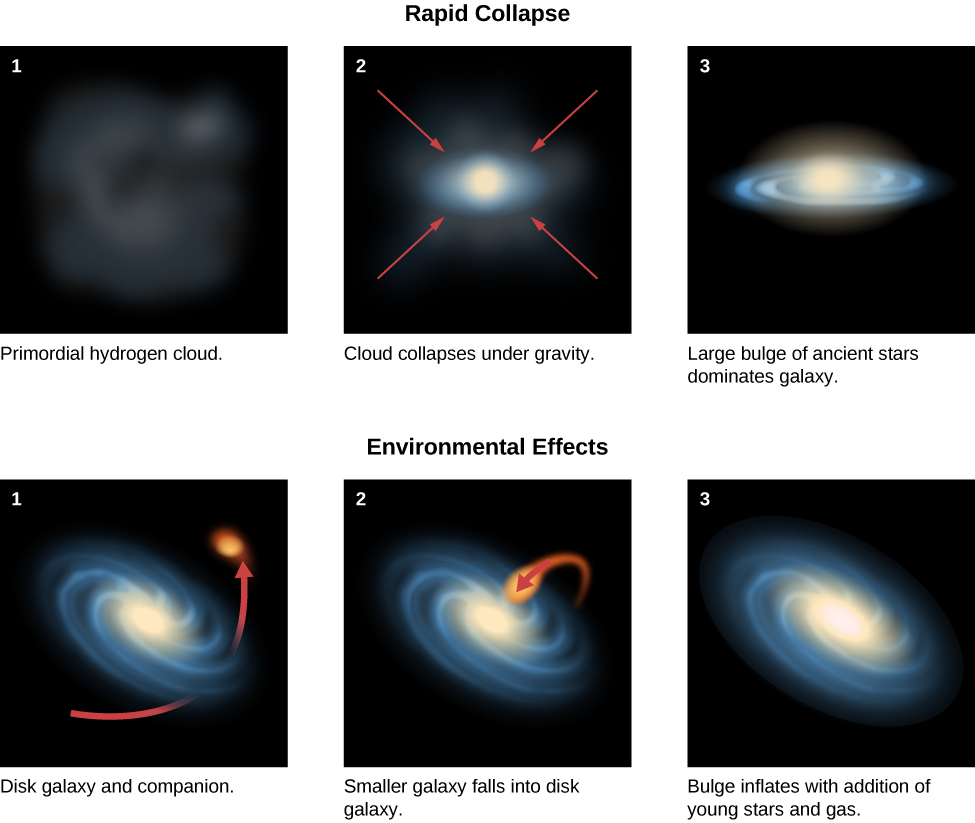
There was a time when astronomers thought that elliptical galaxies were young and would eventually turn into spirals, an idea we now know is not true. In fact, as we saw above, it’s more likely the other way around: two spirals that crash together under their mutual gravity can turn into an elliptical.
Despite these advances in our understanding of how galaxies form and evolve, many questions remain. For example, it’s even possible, given current evidence, that spiral galaxies could lose their spiral arms and disks in a merger event, making them look more like an elliptical or irregular galaxy, and then regain the disk and arms again later if enough gas remains available. The story of how galaxies assume their final shapes is still being written as we learn more about galaxies and their environment.
Forming Galaxy Clusters, Superclusters, Voids, and Filaments
If individual galaxies seem to grow mostly by assembling smaller pieces together gravitationally over cosmic time, what about the clusters of galaxies and larger structures such as those seen in Figure 28.21? How do we explain the large-scale maps that show galaxies distributed on the walls of huge sponge- or bubble-like structures spanning hundreds of millions of light-years?
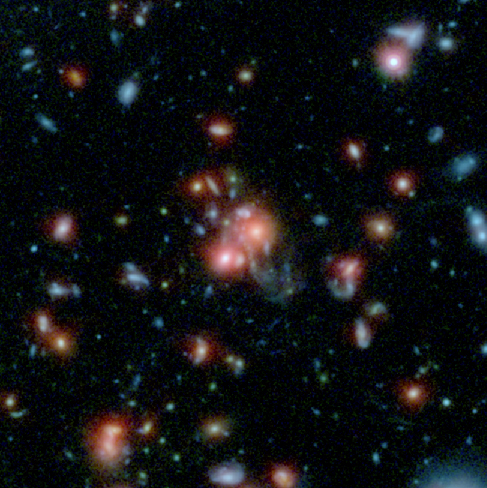
As we saw, observations have found increasing evidence for concentrations, filaments, clusters, and superclusters of galaxies when the universe was less than 3 billion years old (Figure 28.28). This means that large concentrations of galaxies had already come together when the universe was less than a quarter as old as it is now.
Almost all the currently favored models of how large-scale structure formed in the universe tell a story similar to that for individual galaxies: tiny dark matter “seeds” in the hot cosmic soup after the Big Bang grew by gravity into larger and larger structures as cosmic time ticked on (Figure 28.29). The final models we construct will need to be able to explain the size, shape, age, number, and spatial distribution of galaxies, clusters, and filaments—not only today, but also far back in time. Therefore, astronomers are working hard to measure and then to model those features of large-scale structure as accurately as possible. So far, a mixture of 5% normal atoms, 27% cold dark matter, and 68% dark energy seems to be the best way to explain all the evidence currently available (see The Big Bang).
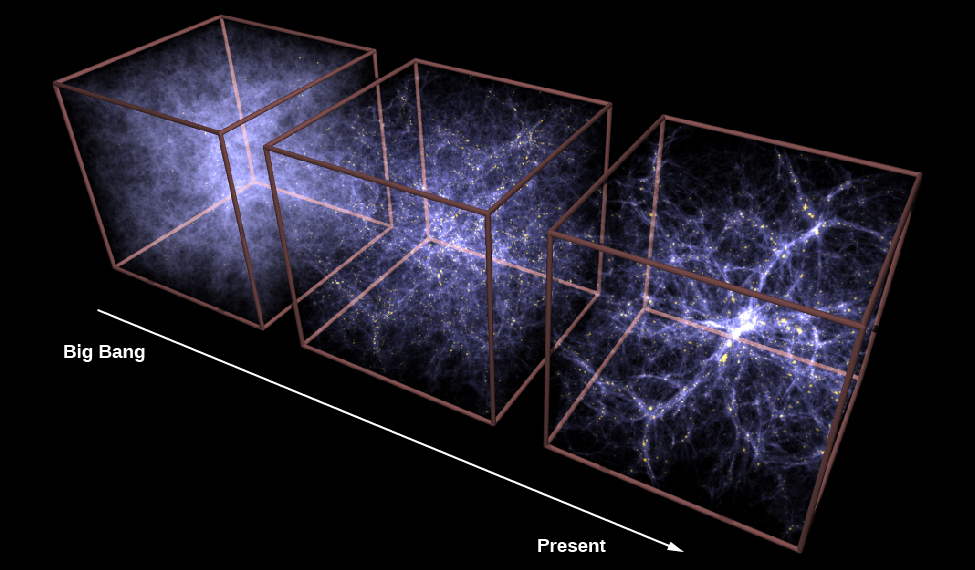
Scientists even have a model to explain how a nearly uniform, hot “soup” of particles and energy at the beginning of time acquired the Swiss-cheese-like structure that we now see on the largest scales. As we will see in The Big Bang, when the universe was only a few hundred thousand years old, everything was at a temperature of a few thousand degrees. Theorists suggest that at that early time, all the hot gas was vibrating, much as sound waves vibrate the air of a nightclub with an especially loud band. This vibrating could have concentrated matter into high-density peaks and created emptier spaces between them. When the universe cooled, the concentrations of matter were “frozen in,” and galaxies ultimately formed from the matter in these high-density regions.
The Big Picture
To finish this chapter, let’s put all these ideas together to tell a coherent story of how the universe came to look the way it does. Initially, as we said, the distribution of matter (both luminous and dark) was nearly, but not quite exactly, smooth and uniform. That “not quite” is the key to everything. Here and there were lumps where the density of matter (both luminous and dark) was ever so slightly higher than average.
Initially, each individual lump expanded because the whole universe was expanding. However, as the universe continued to expand, the regions of higher density acquired still more mass because they exerted a slightly larger than average gravitational force on surrounding material. If the inward pull of gravity was high enough, the denser individual regions ultimately stopped expanding. They then began to collapse into irregularly shaped blobs (that’s the technical term astronomers use!). In many regions the collapse was more rapid in one direction, so the concentrations of matter were not spherical but came to resemble giant clumps, pancakes, and rope-like filaments—each much larger than individual galaxies.
These elongated clumps existed throughout the early universe, oriented in different directions and collapsing at different rates. The clumps provided the framework for the large-scale filamentary and bubble-like structures that we see preserved in the universe today.
The universe then proceeded to “build itself” from the bottom up. Within the clumps, smaller structures formed first, then merged to build larger ones, like Lego pieces being put together one by one to create a giant Lego metropolis. The first dense concentrations of matter that collapsed were the size of small dwarf galaxies or globular clusters—which helps explain why globular clusters are the oldest things in the Milky Way and most other galaxies. These fragments then gradually assembled to build galaxies, galaxy clusters, and, ultimately, superclusters of galaxies.
According to this picture, small galaxies and large star clusters first formed in the highest density regions of all—the filaments and nodes where the pancakes intersect—when the universe was about two percent of its current age. Some stars may have formed even before the first star clusters and galaxies came into existence. Some galaxy-galaxy collisions triggered massive bursts of star formation, and some of these led to the formation of black holes. In that rich, crowded environment, black holes found constant food and grew in mass. The development of massive black holes then triggered quasars and other active galactic nuclei whose powerful outflows of energy and matter shut off the star formation in their host galaxies. The early universe must have been an exciting place!
Clusters of galaxies then formed as individual galaxies congregated, drawn together by their mutual gravitational attraction (Figure 28.30). First, a few galaxies came together to form groups, much like our own Local Group. Then the groups began combining to form clusters and, eventually, superclusters. This model predicts that clusters and superclusters should still be in the process of gathering together, and observations do in fact suggest that clusters are still gathering up their flocks of galaxies and collecting more gas as it flows in along filaments. In some instances we even see entire clusters of galaxies merging together.
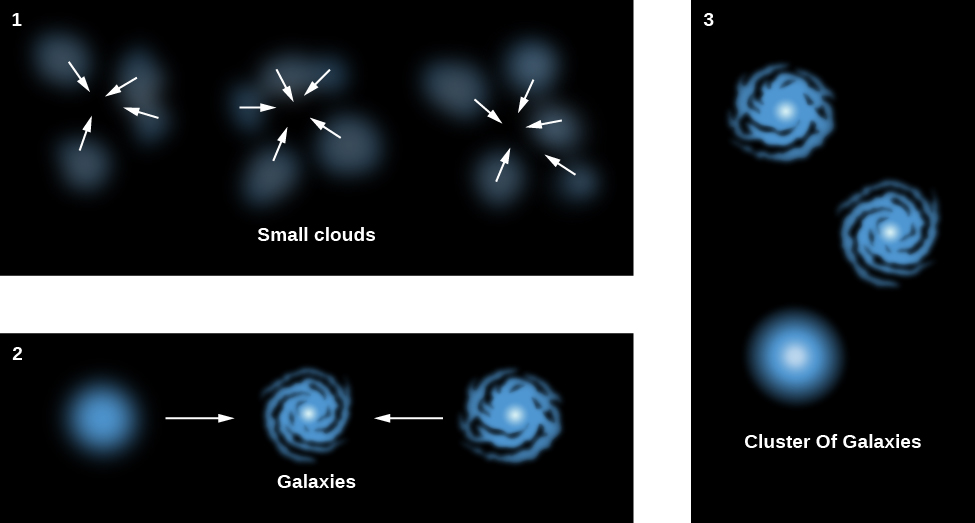
Most giant elliptical galaxies formed through the collision and merger of many smaller fragments. Some spiral galaxies may have formed in relatively isolated regions from a single cloud of gas that collapsed to make a flattened disk, but others acquired additional stars, gas, and dark matter through collisions, and the stars acquired through these collisions now populate their halos and bulges. As we have seen, our Milky Way is still capturing small galaxies and adding them to its halo, and probably also pulling fresh gas from these galaxies into its disk.
Key Concepts and Summary
Initially, luminous and dark matter in the universe was distributed almost—but not quite—uniformly. The challenge for galaxy formation theories is to show how this “not quite” smooth distribution of matter developed the structures—galaxies and galaxy clusters—that we see today. It is likely that the filamentary distribution of galaxies and voids was built in near the beginning, before stars and galaxies began to form. The first condensations of matter were about the mass of a large star cluster or a small galaxy. These smaller structures then merged over cosmic time to form large galaxies, clusters of galaxies, and superclusters of galaxies. Superclusters today are still gathering up more galaxies, gas, and dark matter. And spiral galaxies like the Milky Way are still acquiring material by capturing small galaxies near them.
For Further Exploration
Articles
Bakich, M. “How to Build a Galaxy.” Astronomy (January 2021): 28. How galaxies formed and evolved.
Coe, D. & Larson, R. “JWST Reveals the Early Universe.” Sky & Telescope (October 2023): 12. What the infrared telescope’s first observations show us about galaxies during the first billion years after the Big Bang.
Croswell, K. “Ring Galaxies.” Sky & Telescope (November 2025): 14. On how the collision of galaxies can produce dramatic-looking structures.
Croswell, K. “Spendthrift Spirals.” Sky & Telescope (April 2019): 14. On our modern understanding of the complex evolution of spiral galaxies.
Croswell, K. “The Void Next Door.” Sky & Telescope (October 2018): 12. A look at the large-scale structure of the galaxy clusters and groups around us.
Diego, J. & Willner, S. “Gravitational Lensing: Ancient Lights Magnified by Cosmic Lenses.” Sky & Telescope (October 2024): 36. Using galaxy clusters as lenses to examine even more distant galaxies.
Faber, S., et al. “Staring Back to Cosmic Dawn.” Sky & Telescope (June 2014): 18. Program to see the most distant and earliest galaxies with the Hubble.
Falk, D. “The New 3D Atlas of Cosmic History.” Sky & Telescope, (February 2024): 20. On the work of the Dark Energy Spectroscopic Instruments survey measuring the distribution of galaxies.
Geach, J. “The First Galaxies.” Sky & Telescope (April 2018): 14. On examining and understanding the most distant galaxies space telescopes can see.
Hooper, D. “Dark Matter in the Discovery Age.” Sky & Telescope (January 2013): 26. On experiments looking for the nature of dark matter.
James, C. R. “The Hubble Deep Field: The Picture Worth a Trillion Stars.” Astronomy (November 2015): 44. Detailed history and results, plus the Hubble Ultra-Deep Field.
Kruesi, L. “All about our Local Supercluster.” Astronomy (March 2019): 32. On the Virgo supercluster of galaxies.
Kruesi, L. “What Do We Really Know about Dark Matter?” Astronomy (November 2009): 28. Focuses on what dark matter could be and experiments to find out.
Lea, R. “Dark Matter: The Unusual Suspects.” Astronomy (September 2021): 16. Ideas on what dark matter might consist of, and experiments to find dark matter locally.
Libeskind, N. & Hoffman, Y. “Cosmic Mariners.” Sky & Telescope (October 2019): 14. Mapping the superclusters and voids among galaxies to find the large-scale structure of the universe.
Mihos, C. “Life in a Galaxy Cluster.” Sky & Telescope (January 2025): 12. Observations and development of galaxy groups and clusters.
Nadis, S. “Exploring the Galaxy-Black Hole Connection.” Astronomy (May 2010): 28. About the role of massive black holes in the evolution of galaxies.
Nadis, S. “Astronomers Reveal the Universe’s Hidden Structure.” Astronomy (September 2013): 44. How dark matter is the scaffolding on which the visible universe rests.
Naeye, R. “How to Grow a Black Hole.” Astronomy (March 2021): 16. How the first supermassive black holes grew in early galaxies.
Parks, J. “At the Edge of the Universe.” Astronomy (March 2019): 49. On mapping the large-scale structure of galaxies.
Schilling, G. “Untangling the Cosmic Web.” Sky & Telescope (January 2022): 34. On the filamentary structure astronomers find at the scale of superclusters of galaxies.
Schilling, G. “Hubble Goes the Distance.” Sky & Telescope (January 2015): 20. Using gravitational lensing with HST to see the most distant galaxies.
new line: Sutter, P. “Untangling the Cosmic Web.” Astronomy (June 2026): 18. How astronomers are untangling the large-scale structure of the universe.
Villard, R. “How Gravity’s Grand Illusion Reveals the Universe.” Astronomy (January 2013): 44. On gravitational lensing and what it teaches us.
Wenz, J. “Secrets of Interacting Galaxies.” Astronomy (March 2019): 54. On galaxy mergers and their role in galaxy evolution.
West, M. “Why Do Galaxies Align.” Astronomy (May 2018): 46. Why we have cosmic filaments and webs.
Young, M. “Where do Spirals Come From.” Sky & Telescope (March 2023): 14. Nice review of recent observations and theories on how galaxies form spiral structure.
Websites
Brief History of Gravitational Lensing: http://www.einstein-online.info/spotlights/grav_lensing_history. From Einstein OnLine website, discussing the theory and observations.
Cosmic Structures: http://skyserver.sdss.org/dr1/en/astro/structures/structures.asp. Brief review page on how galaxies are organized, from the Sloan Survey.
The Dark Energy Survey: https://www.darkenergysurvey.org/the-des-project/overview/. This new survey project looks even more deeply into the universe than the Sloan Digital Survey.
Galaxies Over Time: https://science.nasa.gov/mission/webb/galaxies-over-time/. A brief introduction to the evolution of galaxies and the role of the James Webb Space Telescope.
The Final Frontier: https://www.youtube.com/watch?v=nvcRhBlF-50. 2016 HubbleCast episode on the Frontier Fields project on the Hubble, studying large clusters of galaxies and the gravitational lenses they form (6:23).
Galaxies Gone Wild: https://www.youtube.com/watch?v=tNGasc3h4Ss HubbleCast #16: A tour through and explanation of 59 Hubble images of galaxy mergers (9:04).
Gravitational Lensing Discoveries from the Hubble Space Telescope: https://esahubble.org/news/?search=%22gravitational+lensing%22. A chronological list of news releases and images from the Hubble showing lensing.
How are Distant Galaxies Magnified through Gravitational Lensing: https://www.youtube.com/watch?v=2krcAJobiKk. Basic video on how JWST will use gravitational lensing to look for the earliest galaxies in the history of the universe (2:10).
Local Group of Galaxies: http://www.atlasoftheuniverse.com/localgr.html. Clickable map from the Atlas of the Universe project. See also their Virgo Cluster page: http://www.atlasoftheuniverse.com/galgrps/vir.html.
Sloan Digital Sky Survey Website: https://classic.sdss.org/home.php and https://www.sdss.org/. This survey of the sky has been carried out in many parts, each of which has its own web pages. These pages include nontechnical and technical parts, but the maps and overviews are worth searching out.
Spyglasses into the Universe: https://esahubble.org/science/gravitational_lensing/. Hubble page on gravitational lensing; includes links to videos.
Virgo Cluster of Galaxies: http://messier.seds.org/more/virgo.html. A page with brief information and links to maps, images, etc.
Videos
Cosmic Simulations: http://www.tapir.caltech.edu/~phopkins/Site/Movies_cosmo.html. Beautiful short computer simulations of how galaxies form, from the FIRE group (various lengths).
Cosmology of the Local Universe: http://irfu.cea.fr/cosmography. Narrated flythrough of maps of galaxies showing the closer regions of the universe (17:35).
Gravitational Lensing: https://www.youtube.com/watch?v=4Z71RtwoOas. Video from Fermilab, with Dr. Don Lincoln explaining gravitational lenses in theory and in the universe (7:14).
How Galaxies Were Cooked from the Primordial Soup: https://www.youtube.com/watch?v=wqNNCm7SNyw. A 2013 public talk by Dr. Sandra Faber about the evolution of galaxies; part of the Silicon Valley Astronomy Lecture Series (1:19:33).
Hubble Ultra-Deep Field: Looking Out into Space, Looking Back into Time: https://www.youtube.com/watch?v=K6K1pmTzhaY. 2021 video with music and captions takes viewers into the Ultra-deep Field and explains what it tells us (6:03).
Introduction to the Sloan Digital Sky Survey: https://www.youtube.com/watch?v=9vfOqVHyohw. A concise overview of the project (3:07). A similar video is at: https://www.youtube.com/watch?v=1RXpHiCNsKU (4:26).
Looking Deeply into the Universe in 3-D: https://www.youtube.com/watch?v=GsEQ7bcU0n4. ESOCast #72, about using the Very Large Telescopes to explore the properties of galaxies in the Hubble Deep Field South (5:11).
Shedding Light on Dark Matter: https://www.youtube.com/watch?v=bZW_B9CC-gI. 2008 TED talk on galaxies and dark matter by physicist Patricia Burchat (17:08).
Sky Merger Yields Sparkling Dividends: https://www.youtube.com/watch?v=gEAcKOYb86g. HubbleCast #31: Images of NGC 2623, the result of two spirals colliding, yielding bursts of star formation. The object was observed by telescopes sensitive to different wavelength bands to see how mergers affect galaxy evolution (5:25).
Virtual Universe: https://www.youtube.com/watch?v=SY0bKE10ZDM. A video showing a complex MIT model of a section of universe evolving, with dark matter included (4:11).
Collaborative Group Activities
- Suppose you developed a theory to account for the evolution of New York City. Have your group discuss whether it would resemble the development of structure in the universe (as we have described it in this chapter). What elements of your model for NYC resemble the astronomers’ model for the growth of structure in the universe? Which elements do not match?
- Most astronomers believe that dark matter exists and is a large fraction of the total matter in the universe. At the same time, most astronomers do not believe that UFOs are evidence that we are being visited by aliens from another world. Yet astronomers have never actually seen either dark matter or a UFO. Why do you think one idea is widely accepted by scientists and the other is not? Which idea do you think is more believable? Give your reasoning.
- Someone in your group describes the redshift surveys of galaxies to a friend, who says he’s never heard of a bigger waste of effort. Who cares, he asks, about the large-scale structure of the universe? What is your group’s reaction, and what reasons could you come up with for putting money into figuring out how the universe is organized?
- The leader of a small but very wealthy country is obsessed by maps. She has put together a fabulous collection of Earth maps, purchased all the maps of other planets that astronomers have assembled, and now wants to commission the best possible map of the entire universe. Your group is selected to advise her. What sort of instruments and surveys should she invest in to produce a good map of the cosmos? Be as specific as you can.
- Download a high-resolution image of a rich galaxy cluster from the Hubble Space Telescope (see the list of gravitational lens news stories in the “For Further Exploration” section). See if your group can work together to identify gravitational arcs, the images of distant background galaxies distorted by the mass of the cluster. How many can you find? Can you identify any multiple images of the same background galaxy? (If anyone in the group gets really interested, there is a Citizen Science project called Spacewarps, where you can help astronomers identify gravitational lenses on their images: https://spacewarps.org.)
- You get so excited about gravitational lensing that you begin to talk about it with an intelligent friend who has not yet taken an astronomy course. After hearing you out, this friend starts to worry. He says, “If gravitational lenses can distort quasar images, sometimes creating multiple, or ghost, images of the same object, then how can we trust any point of light in the sky to be real? Maybe many of the stars we see are just ghost images or lensed images too!” Have your group discuss how to respond. (Hint: Think about the path that the light of a quasar took on its way to us and the path the light of a typical star takes.)
- The 8.4-meter telescope at the Vera C. Rubin Observatory, currently under construction atop Cerro Pachón, a mountain in northern Chile, will survey the entire sky with its 3.2-gigapixel camera every few days, looking for transient, or temporary, objects that make a brief appearance in the sky before fading from view, including asteroids and Kuiper belt objects in our solar system, and supernovae and other explosive high-energy events in the distant universe. When it’s fully operating sometime after 2021, the LSST will produce up to 30 terabytes of data every night. (A terabyte is 1000 gigabytes, which is the unit you probably use to rate your computer or memory stick capacity.) With your group, consider what you think might be some challenges of dealing with that quantity of data every night in a scientifically productive but efficient way. Can you propose any solutions to those challenges?
- Quasars are rare now but were much more numerous when the universe was about one-quarter of its current age. The total star formation taking place in galaxies across the universe peaked at about the same redshift. Does your group think this is a coincidence? Why or why not?
- One way to see how well the ideas in astronomy (like those in this chapter) have penetrated popular culture is to see whether you can find astronomical words in the marketplace. A short web search for the term “dark matter” turns up both a brand of coffee and a brand of “muscle growth accelerator” with that name. How many other terms used in this chapter can your group find in the world of products? (What’s a really popular type of Android cell phone, for example?)
- What’s your complete address in the universe? Group members should write out their full address, based on the information in this chapter (and the rest of the book). After your postal code and country, you may want to add continent, planet, planetary system, galaxy, etc. Then each group member should explain this address to a family member or student not taking astronomy.
Review Questions
How are distant (young) galaxies different from the galaxies that we see in the universe today?
What is the evidence that star formation began when the universe was only a few hundred million years old?
Describe the evolution of an elliptical galaxy. How does the evolution of a spiral galaxy differ from that of an elliptical?
Explain what we mean when we call the universe homogeneous and isotropic. Would you say that the distribution of elephants on Earth is homogeneous and isotropic? Why?
Describe the organization of galaxies into groupings, from the Local Group to superclusters.
What is the evidence that a large fraction of the matter in the universe is invisible?
When astronomers make maps of the structure of the universe on the largest scales, how do they find the superclusters of galaxies to be arranged?
How does the presence of an active galactic nucleus in a starburst galaxy affect the starburst process?
Thought Questions
Describe how you might use the color of a galaxy to determine something about what kinds of stars it contains.
Suppose a galaxy formed stars for a few million years and then stopped (and no other galaxy merged or collided with it). What would be the most massive stars on the main sequence after 500 million years? After 10 billion years? How would the color of the galaxy change over this time span? (Refer to Evolution from the Main Sequence to Red Giants.)
Given the ideas presented here about how galaxies form, would you expect to find a giant elliptical galaxy in the Local Group? Why or why not? Is there in fact a giant elliptical in the Local Group?
Can an elliptical galaxy evolve into a spiral? Explain your answer. Can a spiral turn into an elliptical? How?
If we see a double image of a quasar produced by a gravitational lens and can obtain a spectrum of the galaxy that is acting as the gravitational lens, we can then put limits on the distance to the quasar. Explain how.
The left panel of Figure 27.1 shows a cluster of yellow galaxies that produces several images of blue galaxies through gravitational lensing. Which are more distant—the blue galaxies or the yellow galaxies? The light in the galaxies comes from stars. How do the temperatures of the stars that dominate the light of the cluster galaxies differ from the temperatures of the stars that dominate the light of the blue-lensed galaxy? Which galaxy’s light is dominated by young stars?
Suppose you are standing in the center of a large, densely populated city that is exactly circular, surrounded by a ring of suburbs with lower-density population, surrounded in turn by a ring of farmland. From this specific location, would you say the population distribution is isotropic? Homogeneous?
Astronomers have been making maps by observing a slice of the universe and seeing where the galaxies lie within that slice. If the universe is isotropic and homogeneous, why do they need more than one slice? Suppose they now want to make each slice extend farther into the universe. What do they need to do?
Human civilization is about 10,000 years old as measured by the development of agriculture. If your telescope collects starlight tonight that has been traveling for 10,000 years, is that star inside or outside our Milky Way Galaxy? Is it likely that the star has changed much during that time?
Given that only about 5% of the galaxies visible in the Hubble Deep Field are bright enough for astronomers to study spectroscopically, they need to make the most of the other 95%. One technique is to use their colors and apparent brightnesses to try to roughly estimate their redshift. How do you think the inaccuracy of this redshift estimation technique (compared to actually measuring the redshift from a spectrum) might affect our ability to make maps of large-scale structures such as the filaments and voids shown in Figure 28.21?
Figuring for Yourself
Using the information from Example 28.1, how much fainter an object will you have to be able to measure in order to include the same kinds of galaxies in your second survey? Remember that the brightness of an object varies as the inverse square of the distance.
Using the information from Example 28.1, if galaxies are distributed homogeneously, how many times more of them would you expect to count on your second survey?
Using the information from Example 28.1, how much longer will it take you to do your second survey?
Galaxies are found in the “walls” of huge voids; very few galaxies are found in the voids themselves. The text says that the structure of filaments and voids has been present in the universe since shortly after the expansion began 13.8 billion years ago. In science, we always have to check to see whether some conclusion is contradicted by any other information we have. In this case, we can ask whether the voids would have filled up with galaxies in roughly 14 billion years. Observations show that in addition to the motion associated with the expansion of the universe, the galaxies in the walls of the voids are moving in random directions at typical speeds of 300 km/s. At least some of them will be moving into the voids. How far into the void will a galaxy move in 14 billion years? Is it a reasonable hypothesis that the voids have existed for 14 billion years?
Calculate the velocity, the distance, and the look-back time of the most distant galaxies in Figure 28.21 using the Hubble constant given in this text and the redshift given in the diagram. Remember the Doppler formula for velocity and the Hubble law (v = H × d, where d is the distance to a galaxy). For these low velocities, you can neglect relativistic effects.
Assume that dark matter is uniformly distributed throughout the Milky Way, not just in the outer halo but also throughout the bulge and in the disk, where the solar system lives. How much dark matter would you expect there to be inside the solar system? Would you expect that to be easily detectable? Hint: For the radius of the Milky Way’s dark matter halo, use R = 300,000 light-years; for the solar system’s radius, use 100 AU; and start by calculating the ratio of the two volumes.
The simulated box of galaxy filaments and superclusters shown in Figure 28.29 stretches across 1 billion light-years. If you were to make a scale model where that box covered the core of a university campus, say 1 km, then how big would the Milky Way Galaxy be? How far away would the Andromeda galaxy be in the scale model?
The first objects to collapse gravitationally after the Big Bang might have been globular cluster-size galaxy pieces, with masses around 106 solar masses. Suppose you merge two of those together, then merge two larger pieces together, and so on, Lego-style, until you reach a Milky Way mass, about 1012 solar masses. How many merger generations would that take, and how many original pieces? (Hint: Think in powers of 2.)