Learning Objectives
By the end of this section, you will be able to:
- Explain how and why massive stars evolve much more rapidly than lower-mass stars like our Sun
- Discuss the origin of the elements heavier than carbon within stars
- Explain why the chemical composition of globular clusters is different from that of open clusters
If what we have described so far were the whole story of the evolution of stars and elements, we would have a big problem on our hands. We will see in later chapters that in our best models of the first few minutes of the universe, everything starts with the two simplest elements—hydrogen and helium (plus a tiny bit of lithium). All the predictions of the models imply that no heavier elements were produced at the beginning of the universe. Yet when we look around us on Earth, we see lots of other elements besides hydrogen and helium. These elements must have been made (fused) somewhere in the universe, and the only place hot enough to make them is inside stars. One of the fundamental discoveries of twentieth-century astronomy is that the stars are the source of most of the chemical richness that characterizes our world and our lives.
We have already seen that carbon, oxygen, and some other elements are made inside lower-mass stars during the red-giant stage. But where do the heavier elements we know and love (such as the silicon and iron inside Earth, and the gold and silver in our jewelry) come from? The kinds of stars we have been discussing so far never get hot enough at their centers to make these elements. It turns out that these heavier elements are formed later in the lives more massive stars, as well as during explosions that can mark the end of the lives of some stars.
Making New Elements in Massive Stars
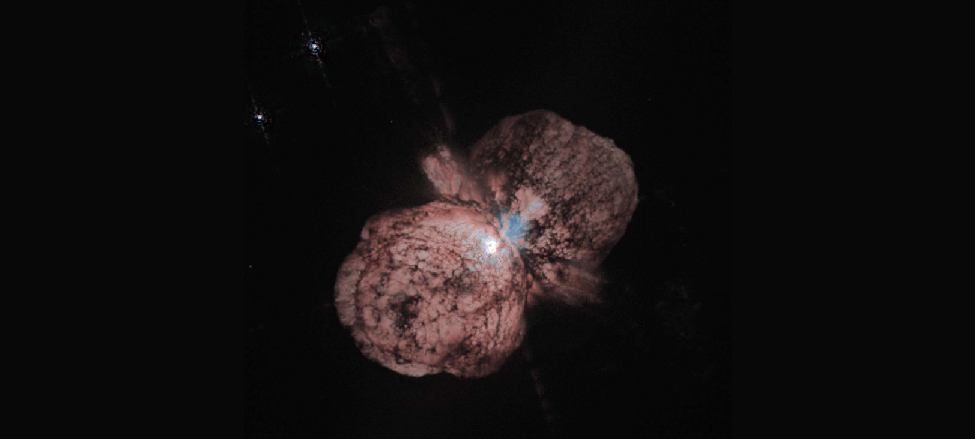
Massive stars evolve in much the same way that the Sun does (but always more quickly)—up to the formation of a carbon-oxygen core. One difference is that for stars with more than about twice the mass of the Sun, helium begins fusion more gradually, rather than with a sudden flash. Also, when more massive stars become red giants, they become so bright and large that we call them supergiants. Such stars can expand until their outer regions become as large as the orbit of Jupiter, which is precisely what the Hubble Space Telescope has shown for the star Betelgeuse (see Figure 22.4). They also lose mass very effectively, producing dramatic winds and outbursts as they age. Figure 22.20 shows a wonderful image of the very massive star Eta Carinae, with a great deal of ejected material clearly visible.
But the crucial way that massive stars diverge from the story we have outlined is that they can start additional kinds of fusion in their centers and in the shells surrounding their central regions. The outer layers of a star with a mass greater than about 8 solar masses have a weight that is enough to compress the carbon-oxygen core until it becomes hot enough to ignite fusion of carbon nuclei. Carbon can fuse into still more oxygen, and at still higher temperatures, oxygen and then neon, magnesium, and finally silicon can build even heavier elements. Iron is, however, the endpoint of this process. The fusion of iron atoms produces products that are more massive than the nuclei that are being fused and therefore the process requires energy, as opposed to releasing energy, which all fusion reactions up to this point have done. This required energy comes at the expense of the star itself, which is now on the brink of death (Figure 22.21). What happens next will be described in the chapter on The Death of Stars.
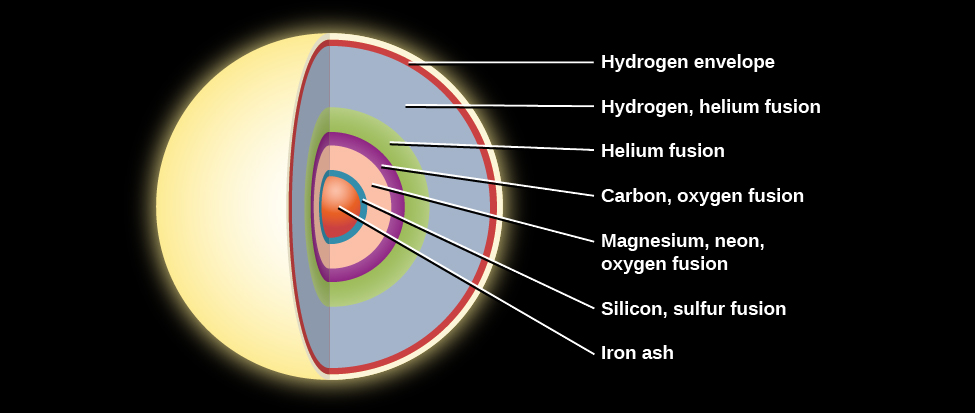
Physicists have now found nuclear pathways whereby virtually all chemical elements of atomic weights up to that of iron can be built up by this nucleosynthesis (the making of new atomic nuclei) in the centers of the more massive red giant stars. This still leaves the question of where elements heavier than iron come from. We will see in the next chapter that when massive stars finally exhaust their nuclear fuel, they most often die in a spectacular explosion—a supernova. Heavier elements can be synthesized in the stunning violence of such explosions.
Not only can we explain in this way where the elements that make up our world and others come from, but our theories of nucleosynthesis inside stars are even able to predict the relative abundances with which the elements occur in nature. The way stars build up elements during various nuclear reactions really can explain why some elements (oxygen, carbon, and iron) are common and others are quite rare (gold, silver, and uranium).
Elements in Globular Clusters and Open Clusters Are Not the Same
The fact that the elements are made in stars over time explains an important difference between globular and open clusters. Hydrogen and helium, which are the most abundant elements in stars in the solar neighborhood, are also the most abundant constituents of stars in both kinds of clusters. However, the abundances of the elements heavier than helium are very different.
In the Sun and most of its neighboring stars, the combined abundance (by mass) of the elements heavier than hydrogen and helium is 1–4% of the star’s mass. Spectra show that most open-cluster stars also have 1–4% of their matter in the form of heavy elements. Globular clusters, however, are a different story. The heavy-element abundance of stars in typical globular clusters is found to be only 1/10 to 1/100 that of the Sun. A few very old stars not in clusters have been discovered with even lower abundances of heavy elements.
The differences in chemical composition are a direct consequence of the formation of a cluster of stars. The very first generation of stars initially contained only hydrogen and helium. We have seen that these stars, in order to generate energy, created heavier elements in their interiors. In the last stages of their lives, they ejected matter, now enriched in heavy elements, into the reservoirs of raw material between the stars. Such matter was then incorporated into a new generation of stars.
This means that the relative abundance of the heavy elements must be less and less as we look further into the past. We saw that the globular clusters are much older than the open clusters. Since globular-cluster stars formed much earlier (that is, they are an earlier generation of stars) than those in open clusters, they have only a relatively small abundance of elements heavier than hydrogen and helium.
As time passes, the proportion of heavier elements in the “raw material” that makes new stars and planets increases. This means that the first generation of stars that formed in our Galaxy would not have been accompanied by a planet like Earth, full of silicon, iron, and many other heavy elements. Earth (and the astronomy students who live on it) was possible only after generations of stars had a chance to make and recycle their heavier elements.
Now the search is on for true first-generation stars, made only of hydrogen and helium. Theories predict that such stars should be very massive, live fast, and die quickly. They should have lived and died long ago. The place to look for them is in very distant galaxies that formed when the universe was only a few hundred million years old, but whose light is only arriving at Earth now.
Approaching Death
Compared with the main-sequence lifetimes of stars, the events that characterize the last stages of stellar evolution pass very quickly (especially for massive stars). As the star’s luminosity increases, its rate of nuclear fuel consumption goes up rapidly—just at that point in its life when its fuel supply is beginning to run down.
After the prime fuel—hydrogen—is exhausted in a star’s core, we saw that other sources of nuclear energy are available to the star in the fusion of, first, helium, and then of other more complex elements. But the energy yield of these reactions is much less than that of the fusion of hydrogen to helium. And to trigger these reactions, the central temperature must be higher than that required for the fusion of hydrogen to helium, leading to even more rapid consumption of fuel. Clearly this is a losing game, and very quickly the star reaches its end. As it does so, however, some remarkable things can happen, as we will see in The Death of Stars.
Key Concepts and Summary
In stars with masses higher than about 8 solar masses, nuclear reactions involving carbon, oxygen, and still heavier elements can build up nuclei as heavy as iron. The creation of new chemical elements is called nucleosynthesis. The late stages of evolution occur very quickly. Ultimately, all stars must use up all of their available energy supplies. In the process of dying, most stars eject some matter, enriched in heavy elements, into interstellar space where it can be used to form new stars. Each succeeding generation of stars therefore contains a larger proportion of elements heavier than hydrogen and helium. This progressive enrichment explains why the stars in open clusters (which formed more recently) contain more heavy elements than do those in ancient globular clusters, and it tells us where most of the atoms on Earth and in our bodies come from.
For Further Exploration
Articles
Bryant, G. “The Allure of Wolf-Rayet Stars.” Sky & Telescope (February 2023): 13. On the later evolution of really massive stars.
Calderwood, T. “The Great Dimming of Betelgeuse.” Sky & Telescope (March 2021): 14. On the variability of this red giant star.
Garlick, M. “The Fate of the Earth.” Sky & Telescope (October 2002): 30. What will happen when our Sun becomes a red giant.
Harris, W. & Webb, J. “Life Inside a Globular Cluster.” Astronomy (July 2014): 18. What would night sky be like there?
Hattenbach, J. “Cluster Mystery: Ancient Star Polluters.” Sky & Telescope (July 2026): 14. On globular clusters that have unexpected abundances of various elements.
Kalirai, J. “New Light on Our Sun’s Fate.” Astronomy (February 2014): 44. What will happen to stars like our Sun between the main sequence and the white dwarf stages.
Kruijssen, J. “Relics of a Distant Past.” Sky & Telescope (July 2021): 14. On globular clusters, and what recent observations are showing us about their origin and evolution.
Kwok, S. “What Is the Real Shape of the Ring Nebula?” Sky & Telescope (July 2000): 33. On seeing planetary nebulae from different angles.
Tyson, P. “The Allure of Betelgeuse.” Sky & Telescope (May 2019): 34. On the red supergiant star that will end its life as a supernova.
Websites
Eta Carinae: https://www.aavso.org/vsots_etacar. An information page from the American Association of Variable Star Observers.
Measuring the Age of a Star Cluster: https://www.e-education.psu.edu/astro801/content/l7_p6.html. From Penn State.
Nebulae as Seen with the Hubble Space Telescope: https://esahubble.org/images/archive/category/nebulae/.
Nebulae as Seen with the James Webb Space Telescope: https://esawebb.org/images/archive/category/nebulae/.
Nebulae as Seen with the Telescopes of NOIRLab (formerly the National Optical Astronomy Observatories): https://noirlab.edu/public/images/archive/category/nebulae/.
Star Clusters as Seen with the Hubble Space Telescope: https://esahubble.org/images/archive/category/starclusters/.
Star Clusters as Seen with the James Webb Space Telescope: https://esawebb.org/images/archive/category/stars/.
Star Clusters as Seen with the Telescopes of NOIRLab (formerly National Optical Astronomy Observatories): https://noirlab.edu/public/images/archive/category/starclusters/.
Star Clusters (from Encyclopedia Britannica, written by astronomers): https://www.britannica.com/science/star-cluster.
The Sky’s Top 10 Colorful Planetary Nebulae (from Astronomy Magazine): https://www.astronomy.com/observing/the-skys-top-10-colorful-planetary-nebulae/.
What Is Betelgeuse? (NASA Science): https://science.nasa.gov/universe/what-is-betelgeuse-inside-the-strange-volatile-star/.
Videos
A Tour of Planetary Nebula NGC 5189: https://www.youtube.com/watch?v=1D2cwiZld0o. Brief Hubblecast episode with Joe Liske, explaining planetary nebulae in general and one example in particular (5:22).
Celestial Fireworks: Star Cluster Westerlund 2: https://www.youtube.com/watch?v=dtY44sPNHcU. Simulation, flying through some nebulosity and then into an open star cluster (0:58).
Evolution of Stars in a Dwarf Galaxy: http://www.spacetelescope.org/videos/heic1211a/. Animation traces how stars evolve with time on the H–R diagram (0:52).
Exploring the Structure of the Ring Nebula: https://www.youtube.com/watch?v=_a94pl2lrYM. Narrated fly-through of this famous planetary nebula, with good explanations of the shape we see and the colors in the Hubble image (1:45).
H–R diagram for Globular Cluster Omega Centauri: http://www.spacetelescope.org/videos/heic1017b/. Narrated animation of how the stars on a Hubble image are plotted and related to stellar evolution (1:39).
Life Cycle of Stars: https://www.youtube.com/watch?v=PM9CQDlQI0A. Short summary of stellar evolution from the Institute of Physics in Great Britain, with astronomer Tim O’Brien (4:58).
NASA Missions Take an Unparalleled Look into Superstar Eta Carinae: https://www.youtube.com/watch?v=0rJQi6oaZf0. NASA Goddard video about observations in 2014 and what we know about the pair of stars in this complicated system (4:00).
Planetary Nebulas: A Three-Minute Introduction: https://www.youtube.com/watch?v=QAzZc_LOB6s. Narrated by astronomer and popular writer David Darling (3:18).
Star Clusters: Open and Globular Clusters: https://www.youtube.com/watch?v=rGPRLxrYbYA. Three Short Hubblecast Videos from 2007–2008 on discoveries involving star clusters (12:24).
Zooming in to Terzan 5. https://www.youtube.com/watch?v=jtQOAtiJq3o. Takes us from the Milky Way at large to a globular cluster seen with the Hubble (0:50).
Collaborative Group Activities
- Have your group take a look at the list of the brightest stars in the sky in Appendix J. What fraction of them are past the main-sequence phase of evolution? The text says that stars spend 90% of their lifetimes in the main-sequence phase of evolution. This suggests that if we have a fair (or representative) sample of stars, 90% of them should be main-sequence stars. Your group should brainstorm why 90% of the brightest stars are not in the main-sequence phase of evolution.
- Reading an H–R diagram can be tricky. Suppose your group is given the H–R diagram of a star cluster. Stars above and to the right of the main sequence could be either red giants that had evolved away from the main sequence or very young stars that are still evolving toward the main sequence. Discuss how you would decide which they are.
- In the chapter on Life in the Universe, we discuss some of the efforts now underway to search for radio signals from possible intelligent civilizations around other stars. Our present resources for carrying out such searches are very limited and there are many stars in our Galaxy. Your group is a committee set up by the International Astronomical Union to come up with a list of the best possible stars with which such a search should begin. Make a list of criteria for choosing the stars on the list, and explain the reasons behind each entry (keeping in mind some of the ideas about the life story of stars and timescales that we discuss in the present chapter.)
- Have your group make a list of the reasons why a star that formed at the very beginning of the universe (soon after the Big Bang) could not have a planet with astronomy students reading astronomy textbooks (even if the star has the same mass as that of our Sun).
- Since we are pretty sure that when the Sun becomes a giant star, all life on Earth will be wiped out, does your group think that we should start making preparations of any kind? Let’s suppose that a political leader who fell asleep during large parts of his astronomy class suddenly hears about this problem from a large donor and appoints your group as a task force to make suggestions on how to prepare for the end of Earth. Make a list of arguments for why such a task force is not really necessary.
- Use star charts to identify at least one open cluster visible at this time of the year. (Such charts can be found in Sky & Telescope and Astronomy magazines each month and their websites; see Appendix B.) The Pleiades and Hyades are good autumn subjects, and Praesepe is good for springtime viewing. Go out and look at these clusters with binoculars and describe what you see.
- Many astronomers think that planetary nebulae are among the most attractive and interesting objects we can see in the Galaxy. In this chapter, we could only show you a few examples of the pictures of these objects taken with the Hubble or large telescopes on the ground. Have members of your group search further for planetary nebula images online, and make a “top ten” list of your favorite ones (do not include more than three that were featured in this chapter.) Make a report (with images) for the whole class and explain why you found your top five especially interesting. (You may want to check Figure 22.19 in the process.)
Review Questions
Compare the following stages in the lives of a human being and a star: prenatal, birth, adolescence/adulthood, middle age, old age, and death. What does a star with the mass of our Sun do in each of these stages?
What is the first event that happens to a star with roughly the mass of our Sun that exhausts the hydrogen in its core and stops the generation of energy by the nuclear fusion of hydrogen to helium? Describe the sequence of events that the star undergoes.
Astronomers find that 90% of the stars observed in the sky are on the main sequence of an H–R diagram; why does this make sense? Why are there far fewer stars in the giant and supergiant region?
Describe the evolution of a star with a mass similar to that of the Sun, from the protostar stage to the time it first becomes a red giant. Give the description in words and then sketch the evolution on an H–R diagram.
Describe the evolution of a star with a mass similar to that of the Sun, from just after it first becomes a red giant to the time it exhausts the last type of fuel its core is capable of fusing.
A star is often described as “moving” on an H–R diagram; why is this description used and what is actually happening with the star?
On which edge of the main sequence band on an H–R diagram would the zero-age main sequence be?
How do stars typically “move” through the main sequence band on an H–R diagram? Why?
Certain stars, like Betelgeuse, have a lower surface temperature than the Sun and yet are more luminous. How do these stars produce so much more energy than the Sun?
Gravity always tries to collapse the mass of a star toward its center. What mechanism can oppose this gravitational collapse for a star? During what stages of a star’s life would there be a “balance” between them?
Why are star clusters so useful for astronomers who want to study the evolution of stars?
Would the Sun more likely have been a member of a globular cluster or open cluster in the past?
Suppose you were handed two H–R diagrams for two different clusters: diagram A has a majority of its stars plotted on the upper left part of the main sequence with the rest of the stars off the main sequence; and diagram B has a majority of its stars plotted on the lower right part of the main sequence with the rest of the stars off the main sequence. Which diagram would be for the older cluster? Why?
Referring to the H–R diagrams in Review Questions, which diagram would more likely be the H–R diagram for an association?
The nuclear process for fusing helium into carbon is often called the “triple-alpha process.” Why is it called as such, and why must it occur at a much higher temperature than the nuclear process for fusing hydrogen into helium?
Pictures of various planetary nebulae show a variety of shapes, but astronomers believe a majority of planetary nebulae have the same basic shape. How can this paradox be explained?
Describe the two “recycling” mechanisms that are associated with stars (one during each star’s life and the other connecting generations of stars).
In which of these star groups would you mostly likely find the least heavy-element abundance for the stars within them: open clusters, globular clusters, or associations?
Explain how an H–R diagram of the stars in a cluster can be used to determine the age of the cluster.
Where did the carbon atoms in the trunk of a tree on your college campus come from originally? Where did the neon in the fabled “neon lights of Broadway” come from originally?
What is a planetary nebula? Will we have one around the Sun?
Thought Questions
Is the Sun on the zero-age main sequence? Explain your answer.
How are planetary nebulae comparable to a fluorescent light bulb in your classroom?
Which of the planets in our solar system have orbits that are smaller than the photospheric radius of Betelgeuse listed in Table 22.2?
Would you expect to find an earthlike planet (with a solid surface) around a very low-mass star that formed right at the beginning of a globular cluster’s life? Explain.
In the H–R diagrams for some young clusters, stars of both very low and very high luminosity are off to the right of the main sequence, whereas those of intermediate luminosity are on the main sequence. Can you offer an explanation for that? Sketch an H–R diagram for such a cluster.
If the Sun were a member of the cluster NGC 2264, would it be on the main sequence yet? Why or why not?
If all the stars in a cluster have nearly the same age, why are clusters useful in studying evolutionary effects (different stages in the lives of stars)?
Suppose a star cluster were at such a large distance that it appeared as an unresolved spot of light through the telescope. What would you expect the overall color of the spot to be if it were the image of the cluster immediately after it was formed? How would the color differ after 1010 years? Why?
Suppose an astronomer known for joking around told you she had found a type-O main-sequence star in our Milky Way Galaxy that contained no elements heavier than helium. Would you believe her? Why?
Stars that have masses approximately 0.8 times the mass of the Sun take about 18 billion years to turn into red giants. How does this compare to the current age of the universe? Would you expect to find a globular cluster with a main-sequence turnoff for stars of 0.8 solar mass or less? Why or why not?
Automobiles are often used as an analogy to help people better understand how more massive stars have much shorter main-sequence lifetimes compared to less massive stars. Can you explain such an analogy using automobiles?
Figuring for Yourself
The text says a star does not change its mass very much during the course of its main-sequence lifetime. While it is on the main sequence, a star converts about 10% of the hydrogen initially present into helium (remember it’s only the core of the star that is hot enough for fusion). Look in earlier chapters to find out what percentage of the hydrogen mass involved in fusion is lost because it is converted to energy. By how much does the mass of the whole star change as a result of fusion? Were we correct to say that the mass of a star does not change significantly while it is on the main sequence?
The text explains that massive stars have shorter lifetimes than low-mass stars. Even though massive stars have more fuel to burn, they use it up faster than low-mass stars. You can check and see whether this statement is true. The lifetime of a star is directly proportional to the amount of mass (fuel) it contains and inversely proportional to the rate at which it uses up that fuel (i.e., to its luminosity). Since the lifetime of the Sun is about 1010 y, we have the following relationship:
where T is the lifetime of a main-sequence star, M is its mass measured in terms of the mass of the Sun, and L is its luminosity measured in terms of the Sun’s luminosity.
- Explain in words why this equation works.
- Use the data in Table 18.3 to calculate the ages of the main-sequence stars listed.
- Do low-mass stars have longer main-sequence lifetimes?
- Do you get the same answers as those in Table 22.1?
You can use the equation in Figuring for Yourself to estimate the approximate ages of the clusters in Figure 22.10, Figure 22.12, and Figure 22.13. Use the information in the figures to determine the luminosity of the most massive star still on the main sequence. Now use the data in Table 18.3 to estimate the mass of this star. Then calculate the age of the cluster. This method is similar to the procedure used by astronomers to obtain the ages of clusters, except that they use actual data and model calculations rather than simply making estimates from a drawing. How do your ages compare with the ages in the text?
You can estimate the age of the planetary nebula in image (c) in Figure 22.18. The diameter of the nebula is 600 times the diameter of our own solar system, or about 0.8 light-year. The gas is expanding away from the star at a rate of about 25 mi/s. Considering that , calculate how long ago the gas left the star if its speed has been constant the whole time. Make sure you use consistent units for time, speed, and distance.
If star A has a core temperature T, and star B has a core temperature 3T, how does the rate of fusion of star A compare to the rate of fusion of star B?
Glossary
- nucleosynthesis
- the building up of heavy elements from lighter ones by nuclear fusion