Learning Objectives
By the end of this section, you will be able to:
- Describe the two theories of planetary ring formation
- Compare the major rings of Saturn and explain the role of the moon Enceladus in the formation of the E ring
- Explain how the rings of Uranus and Neptune differ in composition and appearance from the rings of Saturn
- Describe how ring structure is affected by the presence of moons
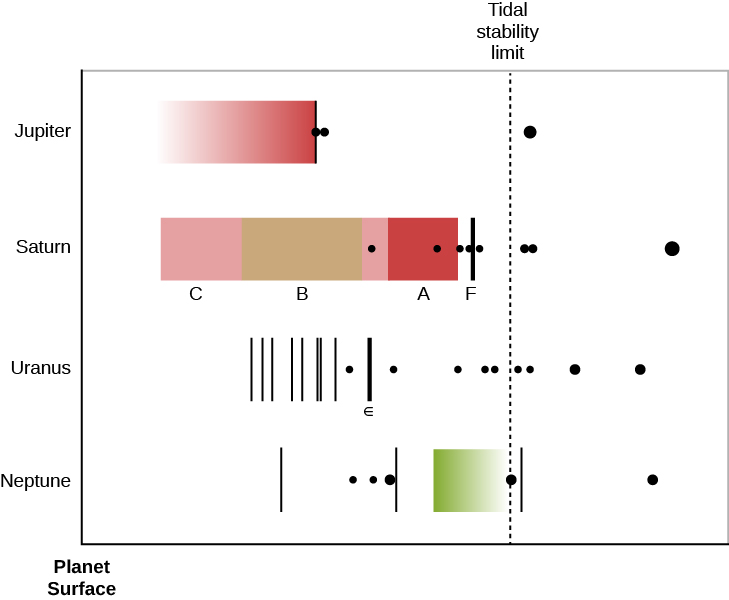
In addition to their moons, all four of the giant planets have rings, with each ring system consisting of billions of small particles or “moonlets” orbiting close to their planet. Each of these rings displays a complicated structure that is related to interactions between the ring particles and the larger moons. However, the four ring systems are very different from each other in mass, structure, and composition, as outlined in Table 12.2.
| Properties of the Ring Systems | ||||
|---|---|---|---|---|
| Planet | Outer Radius (km) | Outer Radius (Rplanet) | Mass (kg) | Reflectivity (%) |
| Jupiter | 128,000 | 1.8 | 1010(?) | ? |
| Saturn | 140,000 | 2.3 | 1019 | 60 |
| Uranus | 51,000 | 2.2 | 1014 | 5 |
| Neptune | 63,000 | 2.5 | 1012 | 5 |
A table titled “Properties of the ring systems” with five columns and five rows. The first row is a header row and labels each column “Planet” “Outer radius (km)”, “Outer Radius (R planet)”, “Mass (kg)”, and Reflectivity (%)”. The second row reads “Jupiter”, “128,000”, “1.8”, “1010” (?), and “(?)”. The third row reads “Saturn,” “140,000”, “2.3”, “1019”, and “60”. The fourth row reads “Uranus”, “51,000”, “2.2”, “1014”, and “5”. The fifth row reads “Neptune”, “63,000”, “2.5”, “1012”, and “5”.
Saturn’s large ring system is made up of icy particles spread out into several vast, flat rings containing a great deal of fine structure. The Uranus and Neptune ring systems, on the other hand, are nearly the reverse of Saturn’s: they consist of dark particles confined to a few narrow rings with broad empty gaps in between. Jupiter’s ring and at least one of Saturn’s are merely transient dust bands, constantly renewed by dust grains eroded from small moons. In this section, we focus on the two most massive ring systems, those of Saturn and Uranus.
We should mention that the four giant planets are not the only worlds in the solar system now known to have rings. Recently, rings have been discovered around the dwarf planets Haumea and Quaoar (distant worlds that are discussed in The Origin and Fate of Comets and Related Objects) and at least one asteroid.
What Causes Rings?
A ring is a collection of vast numbers of particles, each like a tiny moon obeying Kepler’s laws as it follows its own orbit around the planet. Thus, the inner particles revolve faster than those farther out, and the ring as a whole does not rotate as a solid body. In fact, it is better not to think of a ring rotating at all, but rather to consider the revolution (or motion in orbit) of its individual moonlets.
If the ring particles were widely spaced, they would move independently, like separate moonlets. However, in the main rings of Saturn and Uranus the particles are close enough to exert mutual gravitational influence, and occasionally even to rub together or bounce off each other in low-speed collisions. Because of these interactions, we see phenomena such as waves that move across the rings—just the way water waves move over the surface of the ocean.
There are two basic ideas of how such rings come to be. First is the breakup hypothesis, which suggests that the rings are the remains of a shattered moon. A passing comet or asteroid might have collided with the moon, breaking it into pieces. Tidal forces then pulled the fragments apart, and they dispersed into a disk. The second hypothesis, which takes the reverse perspective, suggests that the rings are made of particles that were unable to come together to form a moon in the first place.
In either theory, the gravity of the planet plays an important role. Close to the planet (see Figure 12.25), tidal forces can tear bodies apart or inhibit loose particles from coming together. We do not know which explanation holds for any given ring, although many scientists have concluded that at least a few of the rings are relatively young and must therefore be the result of breakup.
Rings of Saturn
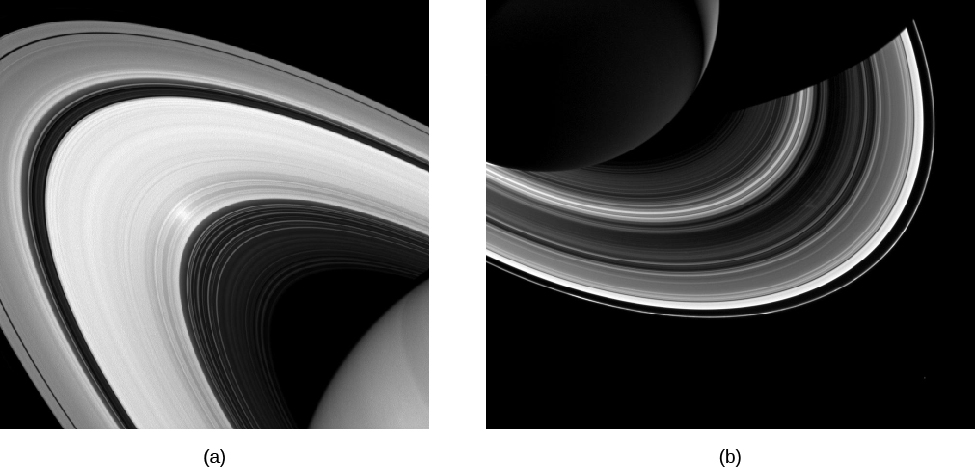
Saturn’s rings are one of the most beautiful sights in the solar system (Figure 12.26). From outer to inner, the three brightest rings are labeled with the extremely unromantic names of A, B, and C Rings. Table 12.3 gives the dimensions of the rings in both kilometers and units of the radius of Saturn, RSaturn. The B Ring is the brightest and has the most closely packed particles, whereas the A and C Rings are translucent.
The total mass of the B Ring, which is probably close to the mass of the entire ring system, is about equal to that of an icy moon 250 kilometers in diameter (suggesting that the ring could have originated in the breakup of such a moon). Between the A and B Rings is a wide gap named the Cassini Division after Gian Domenico Cassini, who first glimpsed it through a telescope in 1675 and whose name planetary scientists also gave to the Cassini spacecraft that explored the Saturn system.
| Selected Features in the Rings of Saturn | |||
|---|---|---|---|
| Ring Name[1] | Outer Edge (RSaturn) | Outer Edge (km) | Width (km) |
| F | 2.324 | 140,180 | 90 |
| A | 2.267 | 136,780 | 14,600 |
| Cassini Division | 2.025 | 122,170 | 4590 |
| B | 1.949 | 117,580 | 25,580 |
| C | 1.525 | 92,000 | 17,490 |
A table titled “Selected Features in the Rings of Saturn” with four columns and six rows. The first row is a header row and labels the columns “Ring Name “, “Outer Edge (RSaturn)”, “Outer Edge (km)”, and “Width (km)”. The second row reads “F”, “2.324”, “140,180”, and “90”. The third row reads “A”, “2.267”, “136,780”, and “14,600”. The fourth row reads “Cassini Division”, “2.025”, “122,170”, and “4590”. The fifth row reads “B”, “1.949”, “117,580”, and “25,580”. The sixth row reads “C”, “1.525”, “92,000”, and “17,490”.
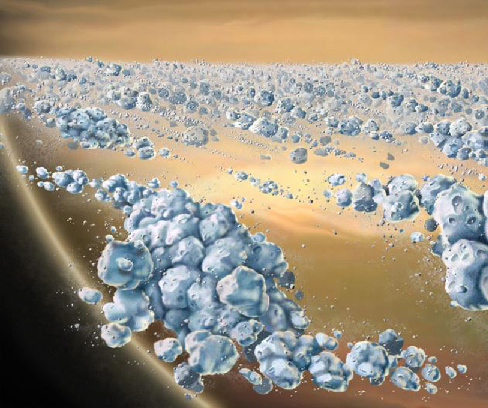
Saturn’s rings are very broad and very thin. The width of the main rings is 70,000 kilometers, yet their average thickness is only 20 meters. If we made a scale model of the rings out of paper, we would have to make them 1 kilometer across. On this scale, Saturn itself would loom as high as an 80-story building. The ring particles are composed primarily of water ice, and they range from grains the size of sand up to house-sized boulders. An insider’s view of the rings would probably resemble a bright cloud of floating snowflakes and hailstones, with a few snowballs and larger objects, many of them loose aggregates of smaller particles (Figure 12.27).
In addition to the broad A, B, and C Rings, Saturn has a handful of very narrow rings no more than 100 kilometers wide. The most substantial of these, which lies just outside the A Ring, is called the F Ring; its surprising appearance is discussed below. In general, Saturn’s narrow rings resemble the rings of Uranus and Neptune.
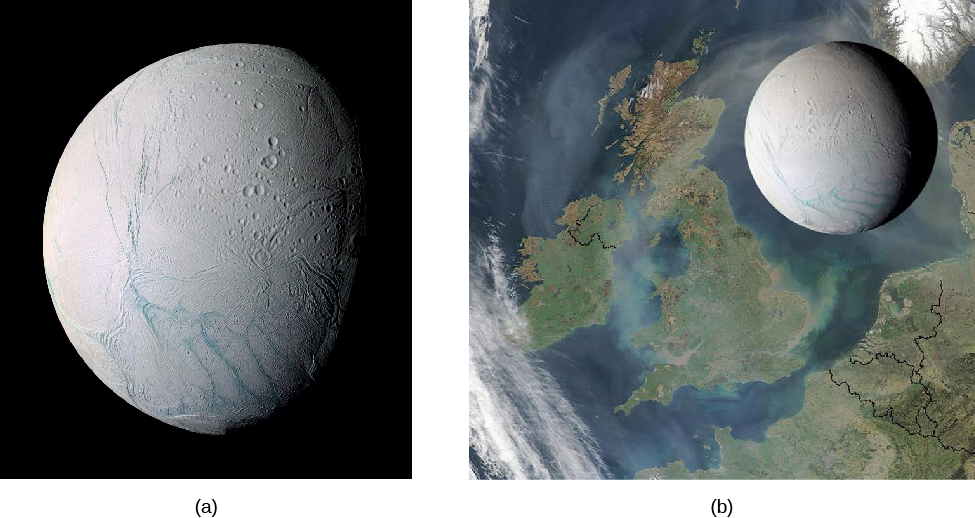
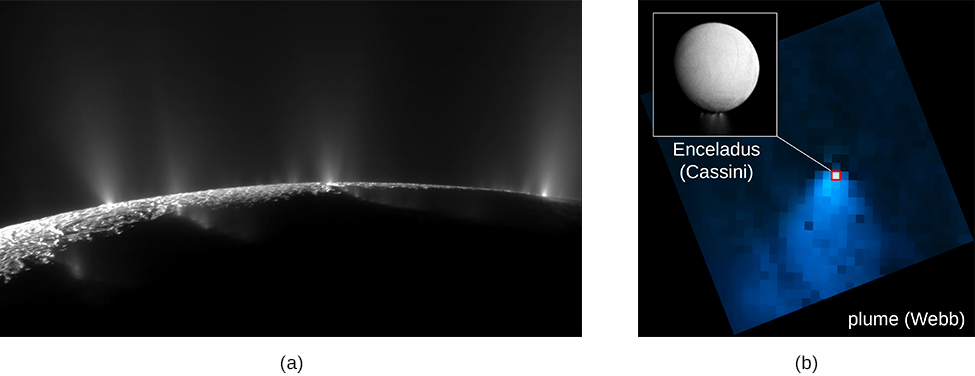
There is also a very faint, tenuous ring, called the E Ring, associated with Saturn’s small icy moon Enceladus. The particles in the E Ring are very small and composed of water ice. Since such a tenuous cloud of ice crystals will tend to dissipate, the ongoing existence of the E Ring strongly suggests that it is being continually replenished by a source at Enceladus. This icy moon is very small—only 500 kilometers in diameter—but the Voyager images showed that the craters on about half of its surface have been erased, indicating geological activity sometime in the past few million years. It was with great anticipation that the Cassini scientists maneuvered the spacecraft orbit to allow multiple close flybys of Enceladus starting in 2005.
Those awaiting the Cassini flyby results were not disappointed. High-resolution images showed long, dark stripes of smooth ground near its south pole, which were soon nicknamed “tiger stripes” (Figure 12.28). Infrared measurements revealed that these tiger stripes are warmer than their surroundings. Best of all, dozens of cryovolcanic vents on the tiger stripes were seen to be erupting geysers of salty water and ice (Figure 12.29). Estimates suggested that 200 kilograms of material were shooting into space each second—not a lot, but enough for the spacecraft to sample.
When Cassini was directed to fly into the plumes, it measured their composition and found them to be similar to material we see liberated from comets (see Comets and Asteroids: Debris of the Solar System). The vapor and ice plumes consisted mostly of water, but with trace amounts of nitrogen, ammonia, methane, and other hydrocarbons. Minerals found in the geysers in trace amounts included ordinary salt, meaning that the geyser plumes were high-pressure sprays of salt water.
Based on the continuing study of Enceladus’ bulk properties and the ongoing geysers, in 2015 the Cassini mission scientists tentatively identified a subsurface ocean of water feeding the geysers. These discoveries suggested that in spite of its small size, Enceladus should be added to the list of worlds that we would like to explore for possible life. Since its subsurface ocean is conveniently escaping into space, it might be much easier to sample than the ocean of Europa, which is deeply buried below its thick crust of ice. Additional analyses of Cassini data in 2023 indicated the presence in the plumes of hydrogen cyanide, a key chemical compound for the origin of life.
Rings of Uranus and Neptune
Uranus’ rings are narrow and black, making them almost invisible from Earth. The nine main rings were discovered in 1977 from observations made of a star as Uranus passed in front of it. We call such a passage of one astronomical object in front of another an occultation. During the 1977 occultation, astronomers expected the star’s light to disappear as the planet moved across it. But in addition, the star dimmed briefly several times before Uranus reached it, as each narrow ring passed between the star and the telescope. Thus, the rings were mapped out in detail even though they could not be seen or photographed directly, like counting the number of cars in a train at night by watching the blinking of a light as the cars successively pass in front of it. When Voyager approached Uranus in 1986, it was able to study the rings at close range; the spacecraft also photographed two new rings (Figure 12.30).
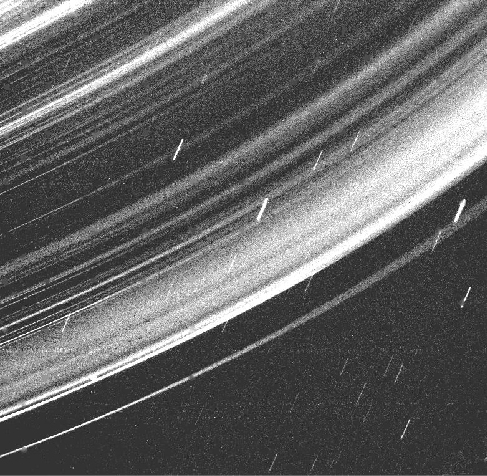
The outermost and most massive of Uranus’ rings is called the Epsilon Ring. It is only about 100 kilometers wide and probably no more than 100 meters thick (similar to the F Ring of Saturn). The Epsilon Ring encircles Uranus at a distance of 51,000 kilometers, about twice the radius of Uranus. This ring probably contains as much mass as all of Uranus’ other ten rings combined; most of them are narrow ribbons less than 10 kilometers wide, just the reverse of the broad rings of Saturn.
The individual particles in the uranian rings are nearly as black as lumps of coal. While astronomers do not understand the composition of this material in detail, it seems to consist in large part of carbon and hydrocarbon compounds. Organic material of this sort is rather common in the outer solar system. Many of the asteroids and comets are also composed of dark, tarlike materials. In the case of Uranus, its ten small inner moons have a similar composition, suggesting that one or more moons might have broken up to make the rings.
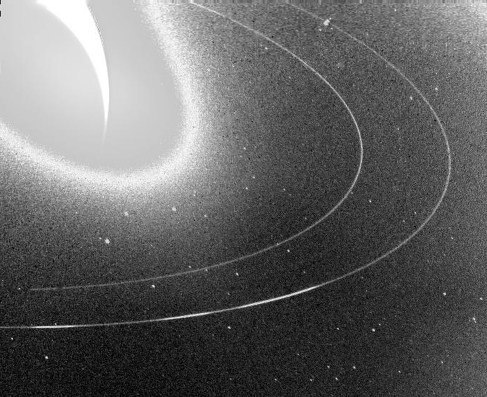
Neptune’s rings are generally similar to those of Uranus but even more tenuous (Figure 12.31). There are only four of them, and the particles are not uniformly distributed along their lengths. Because these rings are so difficult to investigate from Earth, it will probably be a long time before we understand them very well.
Mark Showalter (of the SETI Institute) and his colleagues maintain the NASA’s Planetary Ring Node website. It is full of information about the rings and their interactions with moons; check out their press-release images of the Saturn ring system, for example. And Showalter gives an entertaining illustrated talk about Saturn’s ring and moon system.
Using the occultations of stars by the rings of Saturn, astronomers have been able to measure details in the ring structure to a resolution of 10 km. This is a much higher resolution than can be obtained in a conventional photo of the rings. Let’s figure out what angular resolution (in arcsec) a space telescope in Earth orbit would have to achieve to obtain equal resolution.
Solution
To solve this problem, we use the “small-angle formula” to relate angular and linear diameters in the sky. For angles in the sky that are small, the formula is usually written as
where angular diameter is expressed in arcsec. The distance of Saturn near opposition is about
. Substituting in the above formula and solving for the angular resolution, we get
which is about arcsec, or a milliarcsec. This is not possible for our telescopes to achieve. For comparison, the best resolution from either the Hubble Space Telescope or ground-based telescopes is about 0.1 arcsec, or 100 times worse than what we would need. This is why such occultation measurements are so useful for astronomers.
Check Your Learning
How close to Saturn would a spacecraft have to be to make out detail in its rings as small as 20 km, if its camera has an angular resolution of 5 arcsec?
Using our formula,
we get
So, the distance is about 825,000 km.
Interactions between Rings and Moons
Much of our fascination with planetary rings is a result of their intricate structures, most of which owe their existence to the gravitational effect of moons, without which the rings would be flat and featureless. Indeed, it is becoming clear that without moons there would probably be no rings at all because, left to themselves, thin disks of small particles gradually spread and dissipate.
Most of the gaps in Saturn’s rings, and also the location of the outer edge of the A Ring, result from gravitational resonances with small inner moons. A resonance takes place when two objects have orbital periods that are exact ratios of each other, such as 1:2 or 2:3. For example, any particle in the gap at the inner side of the Cassini Division of Saturn’s rings would have a period equal to one-half that of Saturn’s moon Mimas. Such a particle would be nearest Mimas in the same part of its orbit every second revolution. The repeated gravitational tugs of Mimas, acting always in the same direction, would perturb it, forcing it into a new orbit outside the gap. In this way, the Cassini Division became depleted of ring material over long periods of time.
The Cassini mission revealed a great deal of fine structure in Saturn’s rings. Unlike the earlier Voyager flybys, Cassini was able to observe the rings for more than a decade, revealing a remarkable range of changes, on time scales from a few minutes to several years. Many of the features newly seen in Cassini data indicated the presence of condensations or small moons only a few tens of meters across imbedded in the rings. As each small moon moves, it produces waves in the surrounding ring material like the wake left by a moving ship. Even when the moon is too small to be resolved, its characteristic waves could be photographed by Cassini.
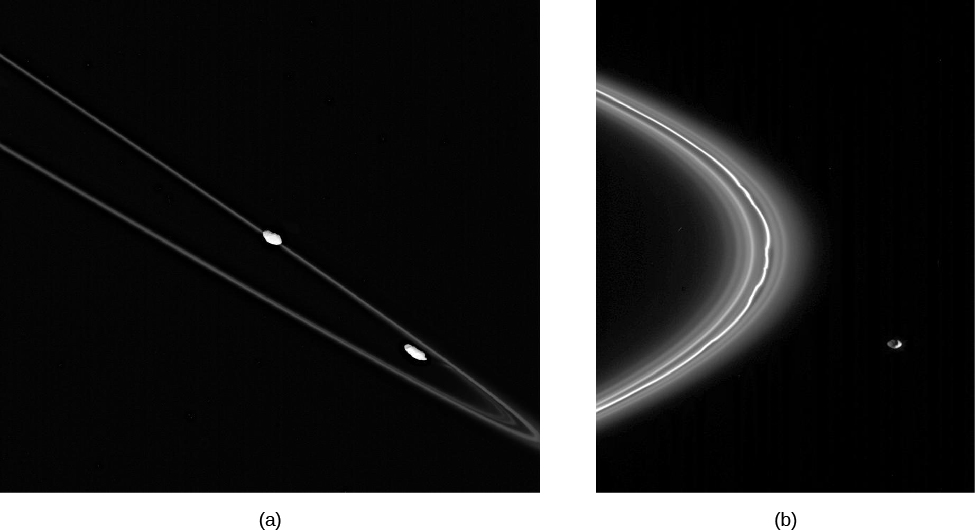
One of the most interesting rings of Saturn is the narrow F Ring, which contains several apparent ringlets within its 90-kilometer width. In places, the F Ring breaks up into two or three parallel strands that sometimes show bends or kinks. Most of the rings of Uranus and Neptune are also narrow ribbons like the F Ring of Saturn. Clearly, the gravity of some objects must be keeping the particles in these thin rings from spreading out.
As we have seen, the largest features in the rings of Saturn are produced by gravitational resonances with the inner moons, while much of the fine structure is caused by smaller embedded moons. In the case of Saturn’s F Ring, close-up images revealed that it is bounded by the orbits of two moons, called Pandora and Prometheus (Figure 12.32). These two small moons (each about 100 kilometers in diameter) are referred to as shepherd moons, since their gravitation serves to “shepherd” the ring particles and keep them confined to a narrow ribbon. A similar situation applies to the Epsilon Ring of Uranus, which is shepherded by the moons Cordelia and Ophelia. These two shepherds, each about 50 kilometers in diameter, orbit about 2000 kilometers inside and outside the ring.
You can download a movie showing the two shepherd moons on either side of Saturn’s F ring.
Theoretical calculations suggest that the other narrow rings in the uranian and neptunian systems should also be controlled by shepherd moons, but none has been located. The calculated diameter for such shepherds (about 10 kilometers) was just at the limit of detectability for the Voyager cameras, so it is impossible to say whether they are present or not. (Given all the narrow rings we see, some scientists still hope to find another more satisfactory mechanism for keeping them confined.)
One of the outstanding problems with understanding the rings is determining their ages. Have the giant planets always had the ring systems we see today, or might these be a recent or temporary, feature of the solar system? Most of the research on this problem concerns the rings of Saturn, which have been intensively studied, thanks to data from the Cassini mission that orbited Saturn for 13 years. The mass of these rings is about the same as that of the inner moon Mimas, suggesting that they could have been formed by the break-up of a similar icy moon. Such a violent event would have been more likely early in the history of the solar system, when there was more debris orbiting the Sun. However, recent analyses of Cassini data indicate that the rings may be relatively young, less than a few hundred million years old. The evidence is based on estimates of the inflow of dark, carbon-rich dust into the Saturn system, which would gradually darken the icy ring particles. Yet the rings of Saturn actually reflect light very well, meaning they are not particularly dark. The origin and age of the ring systems thus remains one of the intriguing mysteries of the solar system.
Key Concepts and Summary
Rings are composed of vast numbers of individual particles orbiting so close to a planet that its gravitational forces could have broken larger pieces apart or kept small pieces from gathering together. Saturn’s rings are broad, flat, and nearly continuous, except for a handful of gaps. The particles are mostly water ice, with typical dimensions of a few centimeters. One Saturn moon, Enceladus, is today erupting geysers of water to maintain the tenuous E Ring, which is composed of very small ice crystals. The rings of Uranus are narrow ribbons separated by wide gaps and contain much less mass. Neptune’s rings are similar but contain even less material. Much of the complex structure of the rings is due to waves and resonances induced by moons within the rings or orbiting outside them. The origin and age of each of these ring systems is still a mystery.
For Further Exploration
Articles
Moons
Cable, M. & Spilker, L. “The Enigma of Enceladus.” Astronomy (September 2019): 50. On the evidence for oceans and possible life.
Cable, M. “What Does Titan Smell Like.” Sky & Telescope (September 2020): 28. On the conditions and chemistry there.
Carroll, M. “Titan: What We’ve Learned about a Strange New World.” Sky & Telescope (March 2010): 30. Nice review of Cassini mission results.
Carroll, M. “Voyage to the Bottom of an Alien Sea.” Sky & Telescope (July 2018): 44. Exploring Europa and Titan with submarines.
Consolmagno, G. & Graney, C. “Slipping on Jupiter’s Moons.” Sky & Telescope (October 2020): 34. A history of how we discovered the properties of Europa, Ganymede, and Callisto.
Davies, A. “Io, the Volcanic Rosetta Stone.” Sky & Telescope (July 2020): 14. Good review of what we know about Jupiter’s innermost large moon.
Elliot, J. “The Warming Wisps of Triton.” Sky & Telescope (February 1999): 42. About Neptune’s intriguing moon.
Hayes, A., “Secrets from Titan’s Seas.” Sky & Telescope (October 2015): 24. Good review of what we now know and what puzzles us about the hydrocarbon lakes of Titan.
Horst, S. “Titan’s Veil.” Sky & Telescope (February 2019): 22. What the Cassini/Huygens mission revealed about conditions on the giant moon.
Johnson-Groh, M. “How We Might Find Life on Europa.” Sky & Telescope (September 2019): 30. On why we think there might be life there and how future missions will look for it.
Lopes, R. “Ice Volcanoes.” Sky & Telescope (August 2020): 32. Survey of several giant planet moons.
Redd, N. “What Lies Beneath Triton’s Ice.” Sky & Telescope (September 2019): 56. On the geysers on this moon and what they might tell us about a possible ocean.
Robertson, D. “Where Goes the Rain?” Sky & Telescope (March 2013): 26. About the methane weather cycle on Titan and what Cassini experiments are telling us.
Scharf, C. “A Universe of Dark Oceans.” Sky & Telescope (December 2014): 20. Subsurface oceans on Europa, Ganymede, Enceladus, and Titan.
Showalter, M. “How to Catch a Moon (or Two) of Pluto.” Sky & Telescope Beat (December 2012): https://www.asppublications.org/37RYL62T/astrobeat/ab2012-106.pdf. On the discovery of small moons around Pluto, written by the person who discovered two of them.
Skuse, B. “Ocean Underworlds.” Sky & Telescope (April 2022): 14. About the large moons that may have an underground ocean, like Europa and Ganymede.
Spencer, J. “Galileo’s Closest Look at Io.” Sky & Telescope (May 2001): 40.
Talcott, R. “Cassini Flies through Enceladus’ Geysers.” Sky & Telescope (March 2009): 32.
Pluto
Nimmo, F. “Life’s Prospects on Pluto.” Sky & Telescope (September 2019): 62. On whether Pluto might be a habitable world, possibly with a subsurface ocean.
Stern, A. “Pluto: Up Close and Personal.” Sky & Telescope (July 2015): 22. Good summary of the history of understanding Pluto and our current knowledge on the eve of the New Horizons encounter.
Stern, A. “Return to Pluto.” Sky & Telescope (December 2019): 20. A bit about New Horizons and then discussion of possible future missions.
Stern, A. “The Pluto System Explored.” Sky & Telescope (November 2015): 24. Fine review of what the team learned from the first few data downloads from New Horizons.
Tombaugh, C. “How I Found Pluto.” Sky & Telescope Beat (May 2009): https://www.asppublications.org/37RYL62T/astrobeat/ab2009-23.pdf.
Rings
Beatty, J. “Saturn’s Amazing Rings.” Sky & Telescope (May 2013): 18. Good 7-page summary of what we know.
Elliot, J., et al. “Discovering the Rings of Uranus.” Sky & Telescope (June 1977): 412.
Esposito, L. “The Changing Shape of Planetary Rings.” Sky & Telescope (September 1987): 6.
Sheehan, W. “Seeing Saturn’s Ring Spokes.” Sky & Telescope (August 2022): 28. History of observations of ring structure from the ground and space.
Tiscareno, M. “Ringworld Revelations.” Sky & Telescope (February 2007): 32. Cassini results about the rings of Saturn.
Websites
Moon
Cassini Mission to Saturn: https://science.nasa.gov/mission/cassini/ and https://www.esa.int/Science_Exploration/Space_Science/Cassini-Huygens and https://ciclops.org
Jupiter’s Moons, at JPL: https://science.nasa.gov/jupiter/moons/
NASA’s Europa Clipper Mission: https://europa.nasa.gov/
Neptune’s Moons, at JPL: https://science.nasa.gov/neptune/moons/
Saturn’s Moons, at JPL: https://science.nasa.gov/saturn/moons/
The JUICE Mission to Explore Jupiter’s icy moons, at the European Space Agency: https://www.esa.int/Science_Exploration/Space_Science/Juice
The Planetary Society’s “Worlds” web pages include a page about Pluto, Io, Europa, Enceladus, Titan, and Triton: https://www.planetary.org/worlds
The proposed Dragonfly Mission to fly a rotorcraft that explores Titan: https://dragonfly.jhuapl.edu/
Uranus’ Moons, at JPL: https://science.nasa.gov/uranus/moons/
Pluto
History of Pluto (Lowell Observatory): https://lowell.edu/discover/history-of-pluto/
New Horizons Mission to Pluto: https://pluto.jhuapl.edu. Provides information and images from the Pluto encounter, plus lots of background information.
Pluto and the Developing Landscape of our Solar System: https://www.iau.org/public/themes/pluto/. Information and explanation from the International Astronomical Union, the “U.N. of astronomy,” which reclassified Pluto as a dwarf planet.
Pluto, at JPL: https://science.nasa.gov/dwarf-planets/pluto/
Rings
NASA Rings Node: https://pds-rings.seti.org/. Most of this website is technical, for scientists, but if you use the menu at left to go to each ring-moon system, you can find images and press releases from the relevant exploratory missions.
NASA Science Site on Saturn’s Rings: https://science.nasa.gov/mission/cassini/science/rings/
Videos
Moons
Amazing Moons: https://www.youtube.com/watch?v=CQjZf2bW9XQ. 2016 NASA video on intriguing moons in our solar system, such as Enceladus, Titan, Europa, and Io (4:16).
Briny Breath of Enceladus: https://www.youtube.com/watch?v=OZsU75Eit-E. Brief film on the geysers of Enceladus and what is emerging from within the moon (2:36).
Could a Saturn Moon Harbor Life: https://www.youtube.com/watch?v=TRQdHrGuVgI. Carolyn Porco gives a brief, personal introduction at TED to the geysers her team discovered on Enceladus (3:26).
Europa: Ocean World: https://www.youtube.com/watch?v=kz9VhCQbPAk. Planetary scientist Kevin Hand explains why Europa is so interesting for future exploration (4:12).
Juno Mission Flies Past the Moon Ganymede and Jupiter: https://www.youtube.com/watch?v=CC7OJ7gFLvE. Flyover movie from Juno data, with captions and music, showing remarkable details (3:59).
Ocean Worlds: https://www.youtube.com/watch?v=gw_bX0ZQOy0. Science@NASA video discusses moons with possible underground oceans in the outer solar system: Europa, Ganymede, Callisto, Enceladus, Ceres, and more (5:50).
Phase Changes: Triton Geysers: https://www.youtube.com/watch?v=0eeoQlfNo0A. Nice student video explaining the geysers on Neptune’s moon Triton; with a brief experiment that demonstrates a crucial part of the story (3:39).
Soaring Over Titan: https://www.youtube.com/watch?v=RrGPtCdItBw. Colorized movie from Cassini images: a flyover of the hydrocarbon lakes (1:27).
Titan: https://www.youtube.com/watch?v=iTrOFefYxFg. A video from Open University in England, with interviews, animations, images from the Cassini/Huygens exploration of Saturn’s moon (8:11).
Titan Approach Movie: https://www.youtube.com/watch?v=TMxL3ZhO8A8. Narrated tour, with the images taken by Cassini and Huygens (3:23).
What Huygens Saw on Titan: https://www.youtube.com/watch?v=9L471ct7YDo. A reprocessed and improved 2015 video showing images recorded during the descent of the Huygens Probe and explaining conditions on Titan (4:49).
Pluto
Charon Flyover Movie: https://www.youtube.com/watch?v=f0Q7O7TZ7Ks. New Horizons images are made into a silent animation of the terrain on Pluto’s large moon (1:05).
How I Killed Pluto and Why It Had It Coming: https://www.youtube.com/watch?v=7pbj_llmiMg. Silicon Valley Astronomy Lecture by Michael Brown on the “demotion” of Pluto to a dwarf planet, which his discoveries helped bring about (1:27:13).
New Horizons Discoveries Keep Coming: https://www.youtube.com/watch?v=r8PEhLDDGeM. Reviews New Horizon mission Pluto discoveries and previews its flyby of MU69 (now called Arrokoth) (4:00).
New Horizons Flyover of Pluto: https://www.youtube.com/watch?v=g1fPhhTT2Oo. New Horizons images are made into a dramatic animation of what the spacecraft cameras saw on Pluto; no narration (1:59).
Pluto in a Minute Video Series: https://www.youtube.com/playlist?list=PLiuUQ9asub3RUlLBXMFGq8aFEPS5yONT2. Each of these brief 1–2-minute videos, hosted by science writer and space historian, Amy Shira Teitel, illuminates one aspect of the New Horizons mission to Pluto and its five moons. There are 32 videos in total.
Reflections on Clyde Tombaugh: https://www.youtube.com/watch?v=Crbi2in-PHc. Video remembering the discoverer of Pluto, featuring his children (7:41).
Seeking Pluto’s Frigid Heart: https://www.youtube.com/watch?v=jIxQXGTl_mo. Dramatic New York Times production of a flight over Pluto and Charon, narrated by their astronomy reporter Dennis Overbye. Has VR option. (7:43).
Rings
F Ring Shepherd Moons: https://photojournal.jpl.nasa.gov/catalog/PIA07712. A very brief movie sequence showing the two moons on either side of Saturn’s F ring and the waves they raise in the ring’s structure.
Saturn’s Restless Rings: https://www.youtube.com/watch?v=X5zcrEze8L4. 2013 talk by Mark Showalter in the Silicon Valley Astronomy Lecture Series (1:30:59).
Saturn’s Rings May be a Recent Addition: https://ca.pbslearningmedia.org/resource/nvtps-sci-saturnrings/how-saturns-rings-formed-the-planets-saturn/. Interviews with key scientists describe why the Cassini mission results imply that Saturn’s rings look surprisingly fresh and young. (3:22)
Collaborative Group Activities
- Imagine it’s the distant future and humans can now travel easily among the planets. Your group is a travel agency, with the task of designing a really challenging tour of the Galilean moons for a group of sports enthusiasts. What kinds of activities are possible on each world? How would rock climbing on Ganymede, for example, differ from rock climbing on Earth? (If you design an activity for Io, you had better bring along very strong radiation shielding. Why?)
- In the same spirit as Activity A, have your agency design a tour that includes the seven most spectacular sights of any kind on all the moons or rings covered in this chapter. What are the not-to-be-missed destinations that future tourists will want to visit and why? Which of the sights you pick are going to be spectacular if you are on the moon’s surface or inside the ring, and which would look interesting only from far away in space?
- In this chapter we could cover only a few of the dozens of moons in the outer solar system. Using the Internet or your college library, organize your group into a research team and find out more about one of the moons we did not cover in detail. Our favorites include Uranus’ Miranda, with its jigsaw puzzle surface; Saturn’s Mimas, with a “knockout” crater called Herschel; and Saturn’s Iapetus, whose two hemispheres differ significantly. Prepare a report to attract tourists to the world you selected.
- In a novel entitled 2010, science fiction writer Arthur C. Clarke, inspired by the information coming back from the Voyager spacecraft, had fun proposing a life form under the ice of Europa that was evolving toward intelligence. Suppose future missions do indeed find some sort of life (not necessarily intelligent but definitely alive) under the ice of Europa—life that evolved completely independently from life on Earth. Have your group discuss what effect such a discovery would have on humanity’s view of itself. What should be our attitude toward such a life form? Do we have an obligation to guard it against contamination by our microbes and viruses? Or, to take an extreme position, should we wipe it out before it becomes competitive with Earth life or contaminates our explorers with microorganisms we are not prepared to deal with? Who should be in charge of making such decisions?
- In the same spirit as Activity D, your group may want to watch the 2013 science fiction film Europa Report. The producers tried to include good science in depicting what it would be like for astronauts to visit that jovian moon. How well does your group think they did?
- A number of modern science fiction writers (especially those with training in science) have written short stories that take place on the moons of Jupiter and Saturn. There is a topical listing of science fiction stories with good astronomy at http://bit.ly/astroscifi. Members of your group can look under “Jupiter” or “Saturn” and find a story that interests you and then report on it to the whole class.
- Work together to make a list of all the reasons it is hard to send a mission to Pluto. What compromises had to be made so that the New Horizons mission was affordable? How would you design a second mission to learn more about the Pluto system?
- Your group has been asked by NASA to come up with one or more missions to learn about Europa. Review what we know about this moon so far and then design a robotic mission that would answer some of the questions we have. You can assume that budget is not a factor, but your instruments have to be realistic. (Bear in mind that Europa is cold and far from the Sun.)
- Imagine your group is the first landing party on Pluto (let’s hope you remembered to bring long underwear!). You land in a place where Charon is visible in the sky and you observe Charon for one Earth week. Describe what Charon will look like during that week. Now you move your camp to the opposite hemisphere of Pluto. What will Charon look like there during the course of a week?
- When, in 2006, the International Astronomical Union (IAU) decided that Pluto should be called a dwarf planet and not a planet, they set up three criteria that a world must meet to be called a planet. Your group should use the Internet to find these criteria. Which of them did Pluto not meet? Read a little bit about the reaction to the IAU’s decision among astronomers and the public. How do members of your group feel about Pluto’s new classification? (After you have discussed it within the group, you may want to watch The Great Planet Debate video recommended in “For Further Exploration.”)
Review Questions
What are the moons of the outer planets made of, and how is their composition different from that of our Moon?
Compare the geology of Callisto, Ganymede, and Titan.
What is the evidence for a liquid water ocean on Europa, and why is this interesting to scientists searching for extraterrestrial life?
Explain the energy source that powers the volcanoes of Io.
Compare the properties of Titan’s atmosphere with those of Earth’s atmosphere.
How was Pluto discovered? Why did it take so long to find it?
How are Triton and Pluto similar?
Describe and compare the rings of Saturn and Uranus, including their possible origins.
Why were the rings of Uranus not observed directly from telescopes on the ground on Earth? How were they discovered?
List at least three major differences between Pluto and the terrestrial planets.
The Hubble Space Telescope images of Pluto in 2002 showed a bright spot and some darker areas around it. Now that we have the close-up New Horizons images, what did the large bright region on Pluto turn out to be?
Saturn’s E ring is broad and thin, and far from Saturn. It requires fresh particles to sustain itself. What is the source of new E-ring particles?
Thought Questions
Why do you think the outer planets have such extensive systems of rings and moons, while the inner planets do not?
Ganymede and Callisto were the first icy objects to be studied from a geological point of view. Summarize the main differences between their geology and that of the rocky terrestrial planets.
Compare the properties of the volcanoes on Io with those of terrestrial volcanoes. Give at least two similarities and two differences.
Would you expect to find more impact craters on Io or Callisto? Why?
Why is it unlikely that humans will be traveling to Io? (Hint: Review the information about Jupiter’s magnetosphere in The Giant Planets.)
Why do you suppose the rings of Saturn are made of bright particles, whereas the particles in the rings of Uranus and Neptune are black?
Suppose you miraculously removed all of Saturn’s moons. What would happen to its rings?
We have a lot of good images of the large moons of Jupiter and Saturn from the Galileo and Cassini spacecraft missions (check out NASA’s Planetary Photojournal site, at http://photojournal.jpl.nasa.gov, to see the variety). Now that the New Horizons mission has gone to Pluto, why don’t we have as many good images of all sides of Pluto and Charon?
In the Star Wars movie Star Wars Episode VI: Return of the Jedi, a key battle takes place on the inhabited “forest moon” Endor, which supposedly orbits around a gas giant planet. From what you have learned about planets and moons of the solar system, why would this be an unusual situation?
Figuring for Yourself
Which would have the longer orbital period: a moon 1 million km from the center of Jupiter, or a moon 1 million km from the center of Earth? Why?
How close to Uranus would a spacecraft have to get to obtain the same resolution as in Example 12.1 with a camera that has an angular resolution of 2 arcsec?
Saturn’s A, B, and C Rings extend 75,000 to 137,000 km from the center of the planet. Use Kepler’s third law to calculate the difference between how long a particle at the inner edge and a particle at the outer edge of the three-ring system would take to revolve about the planet.
Use the information in Appendix G to calculate what you would weigh on Titan, Io, and Uranus’ moon Miranda.
The average distance of Enceladus from Saturn is 238,000 km; the average distance of Titan from Saturn is 1,222,000 km. How much longer does it take Titan to orbit Saturn compared to Enceladus?
Glossary
- resonance
- an orbital condition in which one object is subject to periodic gravitational perturbations by another, most commonly arising when two objects orbiting a third have periods of revolution that are simple multiples or fractions of each other