Electromagnetic fields exist at frequencies from DC (0 Hz) to at least \(10^{20}\) Hz – that’s at least 20 orders of magnitude!
At DC, electromagnetics consists of two distinct disciplines: electrostatics, concerned with electric fields; and magnetostatics, concerned with magnetic fields.
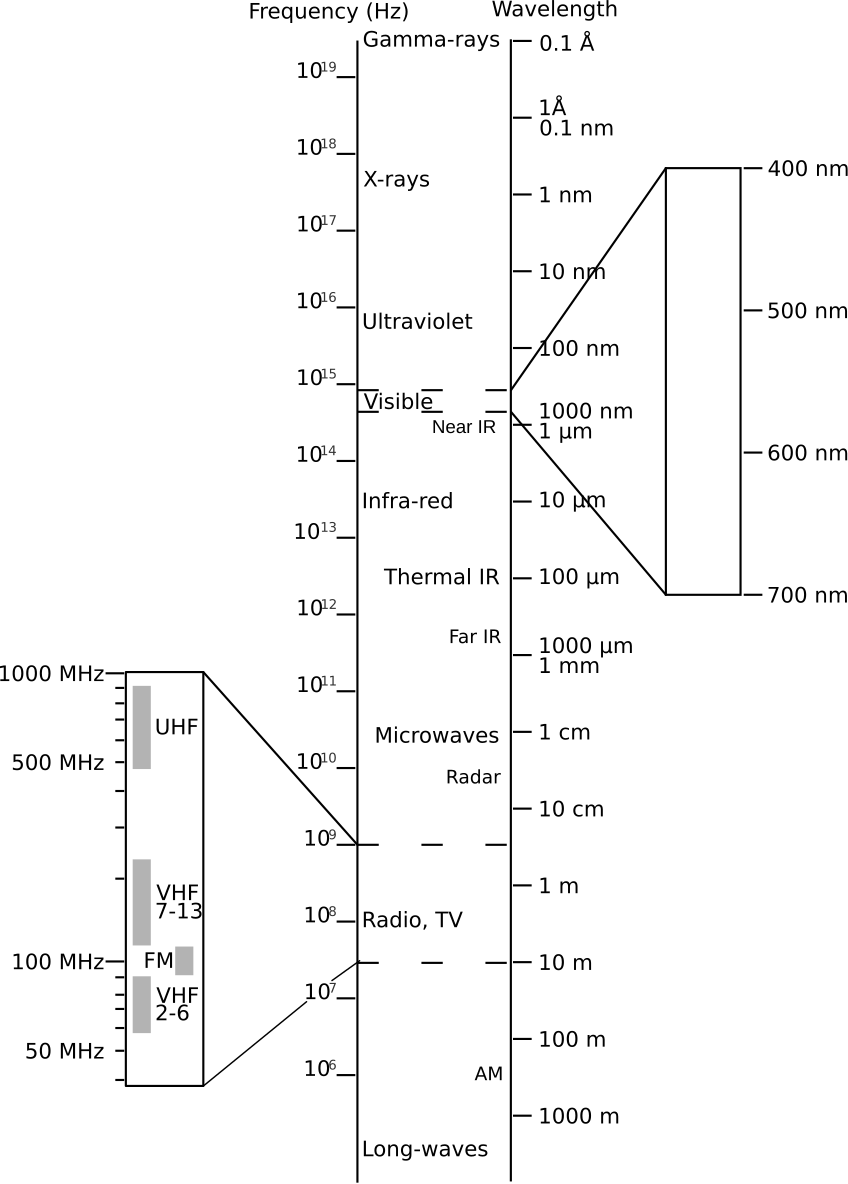
At higher frequencies, electric and magnetic fields interact to form propagating waves. Waves having frequencies within certain ranges are given names based on how they manifest as physical phenomena. These names are (in order of increasing frequency): radio, infrared (IR), optical (also known as “light”), ultraviolet (UV), X-rays, and gamma rays (\(\gamma\)-rays). See Table 1.1 and Figure 1.1 for frequency ranges and associated wavelengths.
The term electromagnetic spectrum refers to the various forms of electromagnetic phenomena that exist over the continuum of frequencies.
| Regime | Frequency Range | Wavelength Range |
| \(\gamma\)-Ray | \(>3\times 10^{19}\) Hz | \(<0.01\) nm |
| X-Ray | \(3\times 10^{16}\) Hz – \(3\times 10^{19}\) Hz | 10–0.01 nm |
| Ultraviolet (UV) | \(2.5\times 10^{15}\) – \(3\times 10^{16}\) Hz | 120–10 nm |
| Optical | \(4.3\times 10^{14}\) – \(2.5\times 10^{15}\) Hz | 700–120 nm |
| Infrared (IR) | 300 GHz – \(4.3\times 10^{14}\) Hz | 1 mm – 700 nm |
| Radio | 3 kHz – 300 GHz | 100 km – 1 mm |
The speed (properly known as “phase velocity”) at which electromagnetic fields propagate in free space is given the symbol \(c\), and has the value \(\cong 3.00 \times 10^8\) m/s. This value is often referred to as the “speed of light.” While it is certainly the speed of light in free space, it is also speed of any electromagnetic wave in free space. Given frequency \(f\), wavelength is given by the expression
Table 1.1 shows the free space wavelengths associated with each of the regions of the electromagnetic spectrum.
This book presents a version of electromagnetic theory that is based on classical physics. This approach works well for most practical problems. However, at very high frequencies, wavelengths become small enough that quantum mechanical effects may be important. This is usually the case in the X-ray band and above. In some applications, these effects become important at frequencies as low as the optical, IR, or radio bands. (A prime example is the photoelectric effect; see “Additional References” below.) Thus, caution is required when applying the classical version of electromagnetic theory presented here, especially at these higher frequencies.
Theory presented in this book is applicable to DC, radio, IR, and optical waves, and to a lesser extent to UV waves, X-rays, and \(\gamma\)-rays. Certain phenomena in these frequency ranges – in particular quantum mechanical effects – are not addressed in this book.
The radio portion of the electromagnetic spectrum alone spans 12 orders of magnitude in frequency (and wavelength), and so, not surprisingly, exhibits a broad range of phenomena. This is shown in Figure 1.1. For this reason, the radio spectrum is further subdivided into bands as shown in Table 1.2. Also shown in Table 1.2 are commonly-used band identification acronyms and some typical applications.
| Band | Frequencies | Wavelengths | Typical Applications |
| EHF | 30-300 GHz | 10–1 mm | 60 GHz WLAN, Point-to-point data links |
| SHF | 3–30 GHz | 10–1 cm | Terrestrial & Satellite data links, Radar |
| UHF | 300–3000 MHz | 1–0.1 m | TV broadcasting, Cellular, WLAN |
| VHF | 30–300 MHz | 10–1 m | FM & TV broadcasting, LMR |
| HF | 3–30 MHz | 100–10 m | Global terrestrial comm., CB Radio |
| MF | 300–3000 kHz | 1000–100 m | AM broadcasting |
| LF | 30–300 kHz | 10–1 km | Navigation, RFID |
| VLF | 3–30 kHz | 100–10 km | Navigation |
Similarly, the optical band is partitioned into the familiar “rainbow” of red through violet, as shown in Figure 1.1 and Table 1.3. Other portions of the spectrum are sometimes similarly subdivided in certain applications.
| Band | Frequencies | Wavelengths |
| Violet | 668–789 THz | 450–380 nm |
| Blue | 606–668 THz | 495–450 nm |
| Green | 526–606 THz | 570–495 nm |
| Yellow | 508–526 THz | 590–570 nm |
| Orange | 484–508 THz | 620–590 nm |
| Red | 400–484 THz | 750–620 nm |
Additional Reading:
“Electromagnetic spectrum” on Wikipedia.
“Photoelectric effect” on Wikipedia.