Problem 7-1: Simple pendulum
The pendulum in Figure 7-1 is composed of a mass \(m\) attached to a mass-less rigid rod of the length \(l\). The pendulum can swing in the xy-plane.

a)Choose suitable generalized coordinates and write the Hamiltonian for the system in terms of the generalized coordinates and their conjugate momenta
b)Use the canonical equations to obtain the equations of motion for the generalized coordinates and their conjugate momenta
c)Repeat parts a) and b) to obtain the equations of motion for the case where the rod has a mass \(M\)
Problem 7-2: Moving pendulum
The pendulum in Figure 7-2 is composed of a mass \(m\) attached to a mass-less rigid rod of the length \(l\). The pendulum can swing in the xy-plane. The pivot point of the bar moves downwards at a fixed, known, speed \(v\).
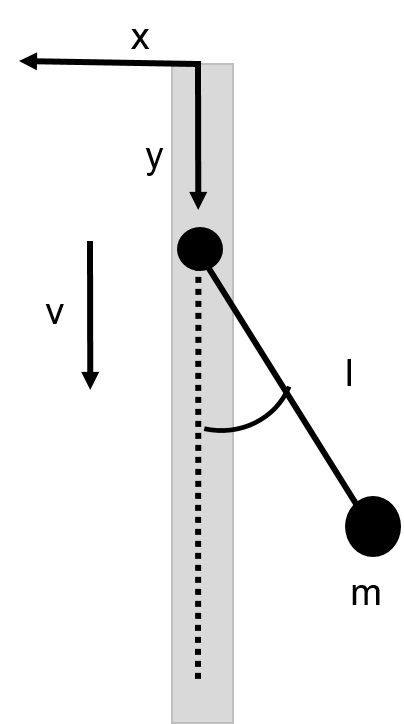
a)Choose suitable generalized coordinates and write the Hamiltonian for the system in terms of the generalized coordinates and their conjugate momenta
b)Use the canonical equations to obtain the equations of motion for the generalized coordinates and their conjugate momenta
Problem 7-3: Two masses and two springs
Figure 7-3 shows two masses, \(m_1\) and \(m_2\), each connected to two springs with spring constants \(k_1\) and \(k_2\). Mass \(m_1\) is constrained to slide without friction along the x-axis, whereas mass \(m_2\) is constrained to move in the vertical direction, constrained by a massless frictionless vertical rod that is attached to \(m_1\). Both springs have a resting length of \(l\).
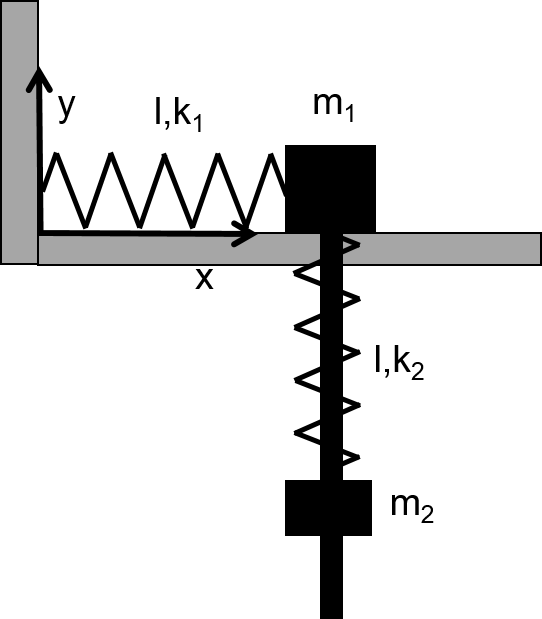
a)Choose suitable generalized coordinates and write the Hamiltonian for the system in terms of the generalized coordinates and their conjugate momenta
b)Use the canonical equations to obtain the equations of motion for the generalized coordinates and their conjugate momenta
Problem 7-4: Pendulum with a spring
Figure 7-4 shows a bead of mass, \(m\), that can slide freely along a long mass-less rail which has one end fixed at the origin, forming a pendulum. The mass is connected to the pivot point at the origin by a mass-less spring of resting length, \(l\), and spring constant \(k\). The motion is constrained to be in the vertical plane (gravity pointing downwards in the figure).
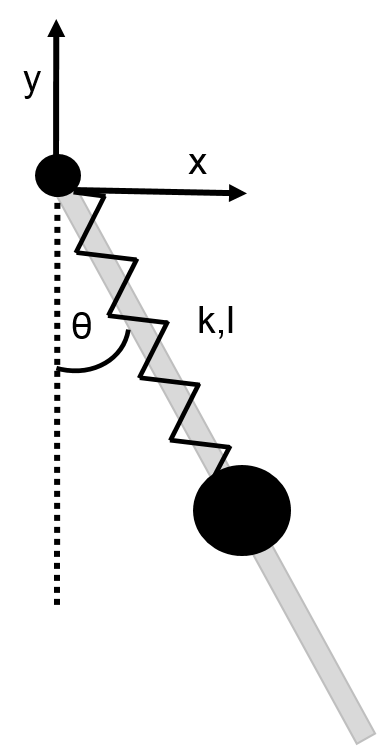
a)Choose suitable generalized coordinates and write the Hamiltonian for the system in terms of the generalized coordinates and their conjugate momenta
b)Use the canonical equations to obtain the equations of motion for the generalized coordinates and their conjugate momenta
Problem 7-5: Phase space trajectory of a vertically thrown ball
a) Show that in phase space, the trajectory of a ball thrown vertically is a parabola. Assume that there is only one degree of freedom (in the vertical direction) and that gravity acts downwards with acceleration \(g\).
b) Sketch the velocity lines of the corresponding phase space fluid (i.e. sketch the trajectory in phase space for different initial positions in phase space).
Problem 7-6: Harmonic oscillator trajectory in phase space
In phase space, the one-dimensional simple harmonic oscillator trajectory is an ellipse. The size of the ellipse depends on the initial conditions, or alternatively on the energy of the system. Show that that the time for a system to go around the ellipse in phase space is independent of energy.
Problem 7-7: Poisson Bracket Properties
Prove the following relations from equation 7.37:
Problem 7-8: Angular momentum and rotation
a) Show that the Poisson Brackets between the cartesian coordinates and the components of angular momentum give the coefficients corresponding to the infinitesimal rotation about that axis of angular momentum.
b) Show that the Poisson Brackets of angular momentum components satisfy:
where \(\epsilon_{ijk}\) is the Levi-Cevita symbol (\(+1\) for even permutations of the indices, \(-1\) for odd permutations, and zero if two indices or more are equal).
Problem 7-9: Transformation of the Hamiltonian
Show that under the transformation:
The Hamiltonian transforms to:
Problem 7-10: Hamiltonian for a charged particle
Given the Lagrangian for a charged particle:
find equations for the generalized momenta and write the Hamiltonian for the system. Show that the canonical equations for Hamilton give the expected result.
Problem 7-11: Poisson’s theorem
Show that if \(F(q_i,p_i,t)\) and \(G(q_i,p_i,t)\) are two constants of motion, then the Poisson Bracket:
is also a constant of motion.
Problem 7-12: Poisson brackets and conserved quantities
Use Poisson Brackets to show that, given the following Hamiltonian:
the product of \(q_1q_2\) is conserved.