We start by considering “continuous transformations” of coordinates. Transformations of coordinates are continuous if they depend on a parameter, \(\epsilon\) that can be varied continuously:
\begin{align}
q_i'&=q_i'(q_1,\dots ,q_n,\dot{q}_1,\dots ,\dot{q}_n, t, \epsilon)\\
t'&=t'(q_1,\dots ,q_n,\dot{q}_1,\dots ,\dot{q}_n, t, \epsilon)
\tag{5.3}\end{align}
where we have included the possibility that time can also be transformed. Since \(\epsilon\) can be varied continuously, the transformations can be built up as the sum of infinitesimal transformations. It is intended that when \(\epsilon=0\) then \(q_i'=q_i\). For an infinitesimal transformation, we can introduce functions \(f\) and \(g\) and write:
\begin{align}
q_i'&=q_i+\delta q_i=q_i+f_i(q_1,\dots ,q_n,\dot{q}_1,\dots ,\dot{q}_n, t)\delta\epsilon\\
t'&=t+\delta t=t+g(q_1,\dots ,q_n,\dot{q}_1,\dots ,\dot{q}_n, t)\delta\epsilon\\
\delta q_i&=q_i'-q_i=f_i(q_1,\dots ,q_n,\dot{q}_1,\dots ,\dot{q}_n, t)\delta\epsilon\\
\delta t&=t'-t=g(q_1,\dots ,q_n,\dot{q}_1,\dots ,\dot{q}_n, t)\delta\epsilon
\tag{5.4}\end{align}
Example 5-2
Determine the infinitesimal form of a continuous transformation corresponding to a translation along the x-axis of a distance \(\epsilon\)
Using cartesian coordinates as the generalized coordinates, the transformation equations are:
\begin{align*}
x'&=x+\epsilon\\
y'&=y\\
z'&=z\\
t'&=t
\end{align*}
The infinitesimal version is thus:
\begin{align*}
x'&=x+\delta\epsilon\\
y'&=y\\
z'&=z\\
t'&=t
\end{align*}
and we have \(f_1=f_x=1\), and all the other \(f_i\) and \(g\) are equal to zero.
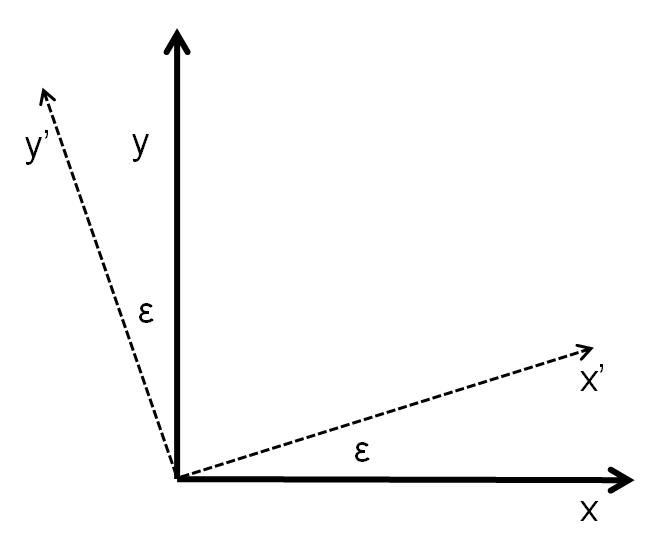
Example 5-3
Determine the infinitesimal form of a continuous transformation corresponding to an infinitesimal rotation about the z-axis by angle \(\epsilon\).
Figure 5.1 Infinitesimal rotation of the axes by an angle \(\epsilon\) around the z-axis
In cartesian coordinates, we have:
\begin{align*}
x'&=x\cos\epsilon -y\sin\epsilon\\
y'&=x\sin\epsilon +y\cos\epsilon
\end{align*}
For the infinitesimal version, \(\delta\epsilon\) is small, so we have:
\begin{align*}
\cos\delta\epsilon &\sim 1\\
\sin\delta\epsilon &\sim \delta\epsilon\\
\therefore x'&=x-y\delta\epsilon\\
\therefore y'&=y+x\delta\epsilon
\end{align*}
Thus we have, with \(q_1=x\) and \(q_2=y\):
\begin{align*}
f_1&=-y\\
f_2&=x
\end{align*}
and \(g=0\).