Problem 4-1: The Atwood Machine
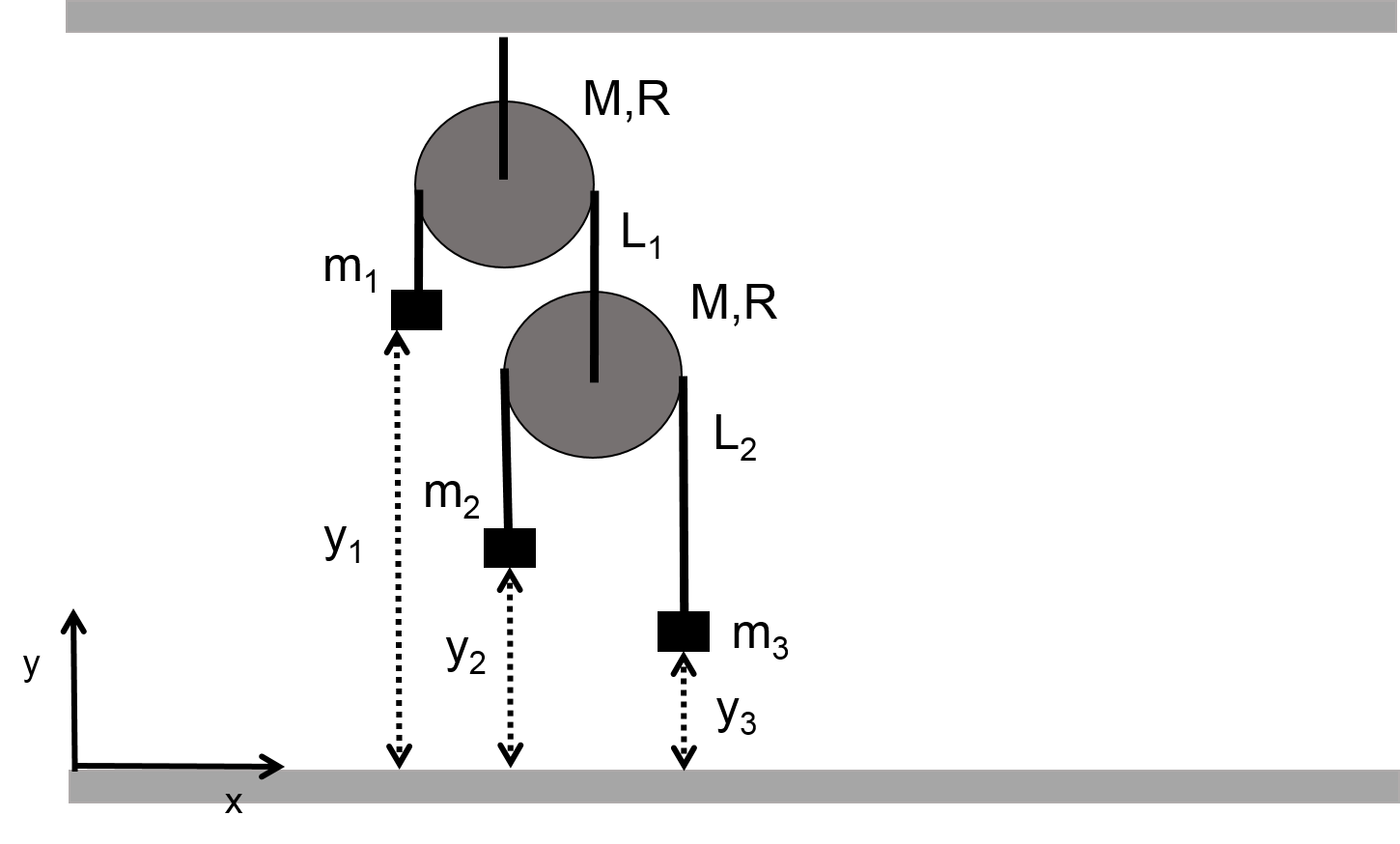
Figure 4-1 shows three point masses, \(m_1\), \(m_2\), and \(m_3\) that are part of an Atwood machine with two pulleys. The pulleys are both solid disks of mass \(M\) and radius \(R\). The ropes slide slide without slipping on the pulleys. The top rope has a total length \(L_1\) and the bottom rope has a total length \(L_2\).
a)Choose suitable generalized coordinates and write the Lagrangian for the system in terms of the generalized coordinates
b)Use the Lagrangian to obtain the equations of motion for the generalized coordinates
Problem 4-2: Simple pendulum
The pendulum in Figure 4-2 is composed of a mass \(m\) attached to a mass-less rigid rod of the length \(L\). The pendulum can swing in the xy-plane.

a)Choose suitable generalized coordinates and write the Lagrangian for the system in terms of the generalized coordinates
b)Use the Lagrangian to obtain the equations of motion for the generalized coordinates
c)Repeat parts a) and b) to obtain the equations of motion for the case where the rod has a mass \(M\)
Problem 4-3: Moving pendulum
The pendulum in Figure 4-3 is composed of a mass \(m\) attached to a mass-less rigid rod of the length \(L\). The pendulum can swing in the xy-plane. The pivot point of the bar moves downwards at a fixed, known, speed \(v\).
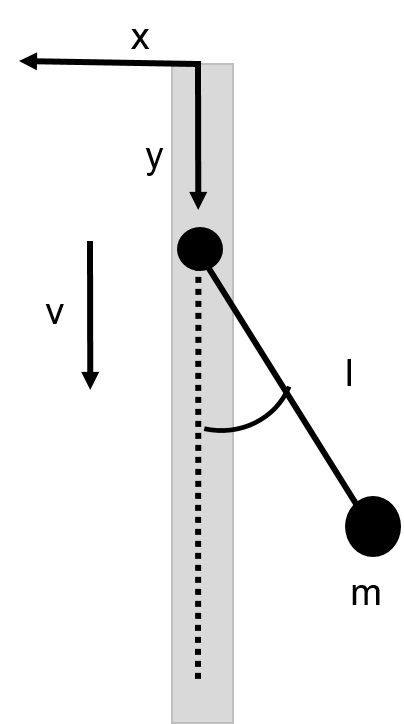
a)Choose suitable generalized coordinates and write the Lagrangian for the system in terms of the generalized coordinates
b)Use the Lagrangian to obtain the equations of motion for the generalized coordinates.
Problem 4-4: Two masses and two springs
The figure shows two masses, \(m_1\) and \(m_2\), each connected to two springs with spring constants \(k_1\) and \(k_2\). Mass \(m_1\) is constrained to slide without friction along the x-axis, whereas mass \(m_2\) is constrained to move in the vertical direction, constrained by a massless frictionless vertical rod that is attached to \(m_1\). Both springs have a resting length of \(L\).
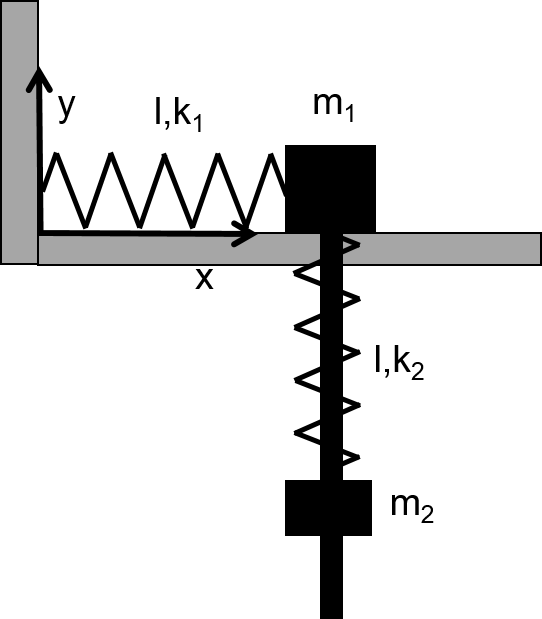
a)Choose suitable generalized coordinates and write the Lagrangian for the system in terms of the generalized coordinates
b)Use the Lagrangian to obtain the equations of motion for the generalized coordinates.
Problem 4-5: Pendulum with a spring
The figure shows a bead of mass, \(m\), that can slide freely along a long massless rail which has one end fixed at the origin, forming a pendulum. The mass is connected to the pivot point at the origin by a massless spring of resting length, \(L\), and spring constant \(k\). The motion is constrained to be in the vertical plane (gravity pointing downwards in the figure).
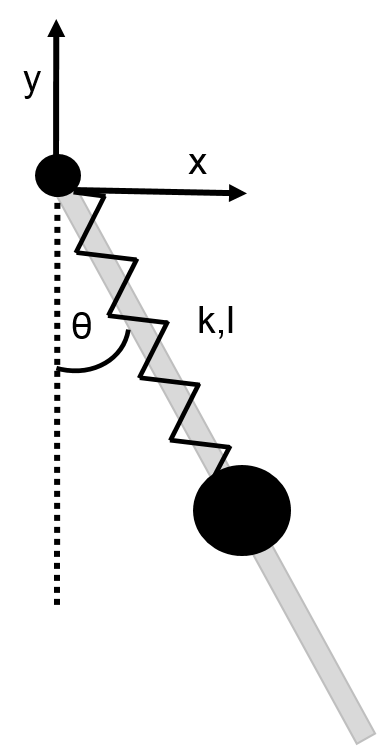
a)Choose suitable generalized coordinates and write the Lagrangian for the system in terms of the generalized coordinates
b)Use the Lagrangian to obtain the equations of motion for the generalized coordinates.
Problem 4-6: Compound pendulum
The figure shows two beads of mass, \(m_1\) and \(m_2\), that form a compound pendulum. Mass \(m_1\) is connected by a massless rigid rod of length \(L_1\) to a fixed pivot point at the origin. Mass \(m_@\) is connected to mass \(m_1\) by a massless rigid rod of length \(L_2\). The motion is constrained to be in the vertical plane

a)Choose suitable generalized coordinates and write the Lagrangian for the system in terms of the generalized coordinates
b)Use the Lagrangian to obtain the equations of motion for the generalized coordinates.
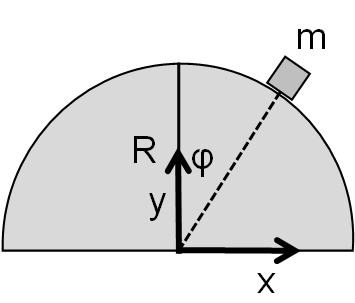
Problem 4-7: Block on a hemisphere
Find the Lagrangian for a block of mass \(m\) sliding under the influence of gravity without friction along a hemisphere of radius R (Figure 4-7). Use the method of Lagrange multipliers to determine the normal force exerted by the hemisphere on the block. Find the point at which the block will fall off the hemisphere if it started at rest at the top.
Problem 4-8: Sphere on a hemisphere
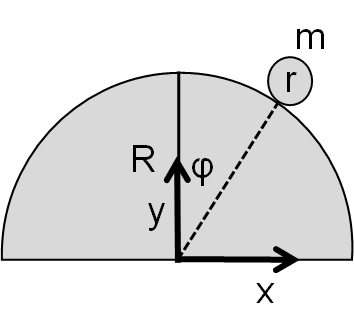
Find the Lagrangian for a sphere of mass \(m\) and radius \(r\) that is rolling without slipping along a hemisphere of radius \(R\) (Figure 4-8). Use the method of Lagrange multipliers to determine the forces exerted by the hemisphere on the sphere. Find the point at which the sphere will fall off the hemisphere if it started at rest at the top.
Problem 4-9: Sliding blocks
The block of mass \(m\) in Figure 4-9 can slide without friction on the wedge of mass \(M\) that itself can slide without friction on the ground. The dimensions of the small block can be assumed to be negligible, the dimensions of the wedge are shown in the figure, and the motion is constrained to be in the xy-plane.
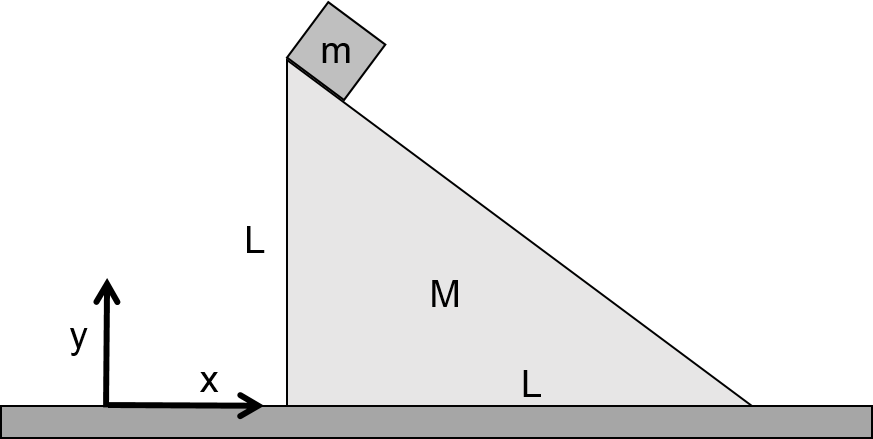
a)Choose suitable generalized coordinates and write the Lagrangian for the system in terms of the generalized coordinates
b)Use the Lagrangian to obtain the equations of motion for the generalized coordinates.
Problem 4-10: Sphere on a wedge
The sphere of mass \(m\) and radius \(r\) in Figure 4-10 can roll without slipping on the wedge of mass \(M\) that itself can slide without friction on the ground. The dimensions of the wedge are shown in the figure, and the motion is constrained to be in the xy-plane.
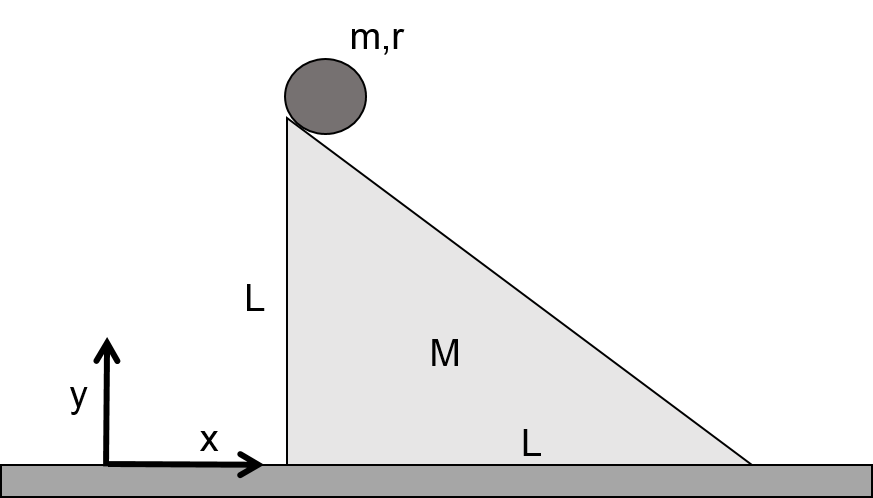
a)Choose suitable generalized coordinates and write the Lagrangian for the system in terms of the generalized coordinates
b)Use the Lagrangian to obtain the equations of motion for the generalized coordinates.
Problem 4-11: Sliding blocks with a spring
The block of mass \(m\) in Figure 4-11 can slide without friction on the wedge of mass \(M\) that itself can slide without friction on the ground. The dimensions of the small block can be assumed to be negligible, the dimensions of the wedge are shown in the figure, and the motion is constrained to be in the xy-plane. The small block is attached to a spring with rest length \(d\) and spring constant \(k\).
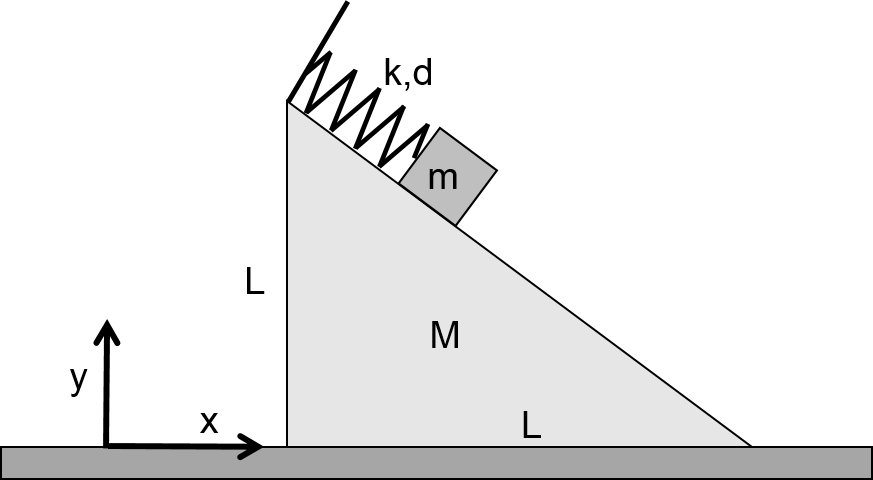
a)Choose suitable generalized coordinates and write the Lagrangian for the system in terms of the generalized coordinates
b)Use the Lagrangian to obtain the equations of motion for the generalized coordinates.
Problem 4-12: Routhian and a spherical pendulum
A spherical pendulum is constructed by using a mass \(m\) and a mass-less rod of length \(L\) as seen in in Figure 4-12 .
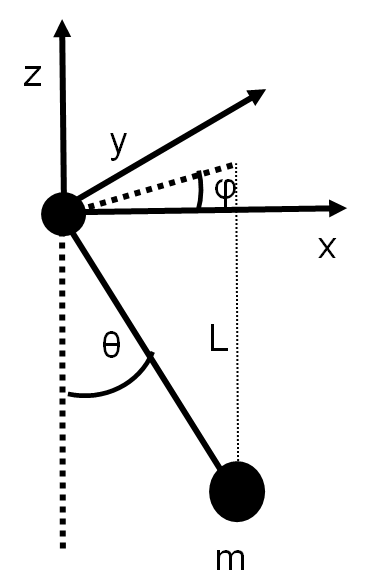
a)Write out the Lagrangian for the spherical pendulum using \(\theta\) and \(\phi\) as the generalized coordinates
b)Write out expressions for any conserved quantities.
c)Show that the system is described by the following Routhian: