Problem 3-1: Suspension system
The mass \(m\) is sitting on top of two massless rods of length \(L\). The left rod is fixed at point A and free to rotate about that point. The two rods are joined by a hinge at point B, and the rod on the right is free to slide without friction along the ground at point C. A spring with spring constant \(k\) is pushing horizontally against the rods at point C. When no mass is present, the system is in equilibrium with \(\theta= \theta_0\) (that is, \(\theta_0\) corresponds to the case when the spring is not compressed, since the rods are massless).
Find the angle \(\theta\) when the mass \(m\) is present. If you cannot solve for \(\theta\) directly, give an equation that can be solved for the angle.

Problem 3-2: Masses on a scale
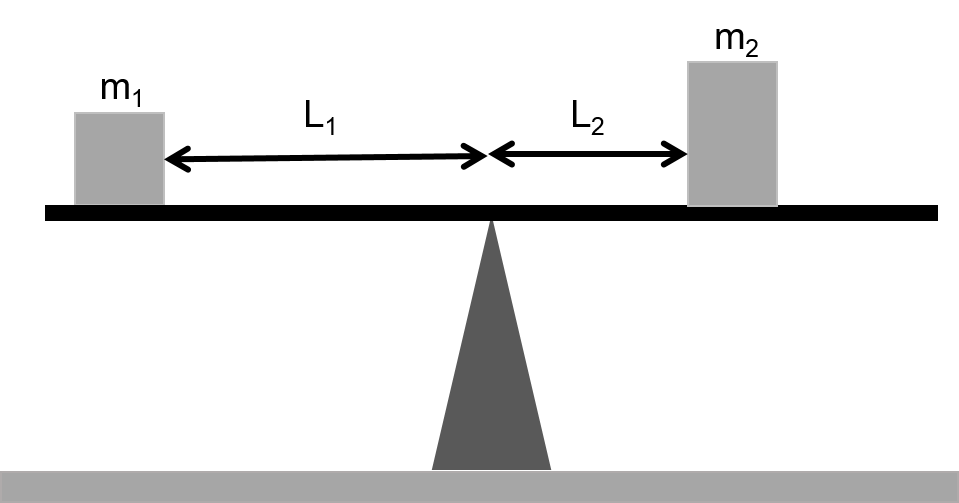
A simple scale is constructed with a massless plank and two masses \(m_1\) and \(m_2\) (see figure). If \(m_1\), \(L_1\), and \(L_2\) are known, use the principle of virtual work to express \(m_2\) in terms of the known quantities.
Problem 3-3: Kinetic energy in generalized coordinates
Evaluate the terms \(A_{jk}\), \(B_{k}\), and \(C\) from equation 3.29. For example, the term \(A_{jk}\) is given by:
Problem 3-4: Generalized kinetic energy
A free particle has a kinetic energy \(T=\frac{1}{2}m(\dot x^2+\dot y^2+\dot z^2)\) when expressed in Cartesian coordinates in a fixed reference system. Write the kinetic energy of the particle using the following systems of coordinates:
a) Polar(\(r\), \(\phi\), \(z\))
b) Spherical (\(r\), \(\phi\), \(\theta\))
c) A Cartesian coordinate system (\(x'\), \(y'\), \(z'\)) that is rotating about the z-axis with angular speed \(\omega\) (assume that at \(t=0\) the xyz axes of the moving system coincided with that of the fixed coordinate system)
d) A polar coordinate system (\(r'\), \(\phi'\), \(z'\)) that is rotating about the z-axis with angular speed \(\omega\) (assume that at \(t=0\) the xyz axes of the moving system coincided with that of the fixed coordinate system)
Problem 3-5: Moving pendulum
The pendulum in Figure 3-5 is composed of a mass \(m\) attached to a mass-less rigid rod of length \(L\). The pendulum can swing in the xy-plane. The pivot point of the bar moves downwards at a fixed, known, speed \(v\).
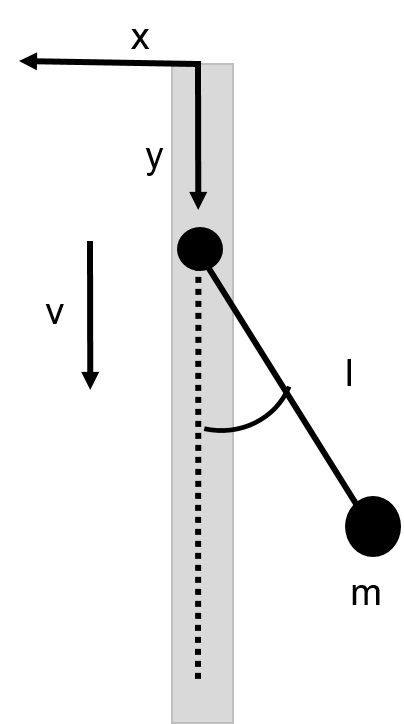
a)Choose suitable generalized coordinates and write the kinetic energy in terms of the generalized coordinates
b)Use D’Alembert’s principle to write the equations of motion in terms of the generalized coordinates.
Problem 3-6: Two masses and two springs
The figure shows two masses, \(m_1\) and \(m_2\), each connected to two springs with spring constants \(k_1\) and \(k_2\). Mass \(m_1\) is constrained to slide without friction along the x-axis, whereas mass \(m_2\) is constrained to move in the vertical direction, constrained by a massless frictionless vertical rod that is attached to \(m_1\). Both springs have a resting length of \(L\).
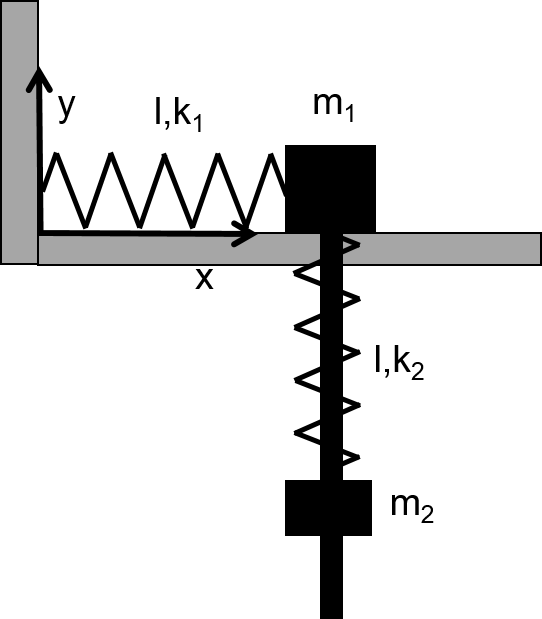
a) Choose suitable generalized coordinates, and write out the kinetic energy of the system in terms of those coordinates
b) Use D’Alembert’s principle to write out the equations of motion for the generalized coordinates
Problem 3-7: Pendulum with a spring
The figure shows a bead of mass, \(m\), that can slide freely along a long massless rail which has one end fixed at the origin, forming a pendulum. The mass is connected to the pivot point at the origin by a massless spring of resting length, \(L\), and spring constant \(k\). The motion is constrained to be in the vertical plane (gravity pointing downwards in the figure).
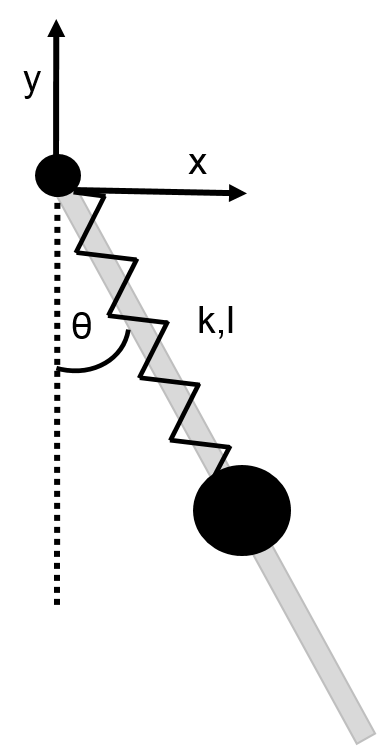
a) Choose suitable generalized coordinates, and write out the kinetic energy of the system in terms of those coordinates
b) Use D’Alembert’s principle to write out the equations of motion for the generalized coordinates