In principle, if one is constrained into an elevator, it is impossible to distinguish whether the elevator is stationary in a gravitational field \(-\vec{g}\) or whether it is in free space and accelerating “upwards” with an acceleration \(\vec{g}\). This is illustrated in Figure 3.6, where a frame of reference (x’,y’) is shown relative to an “absolute fixed inertial frame of reference” (x,y). Measurements performed in the moving frame of reference are denoted with primes (’). The origin of the moving frame of reference is at a position \(\vec{C}\) as measured in the absolute frame of reference.
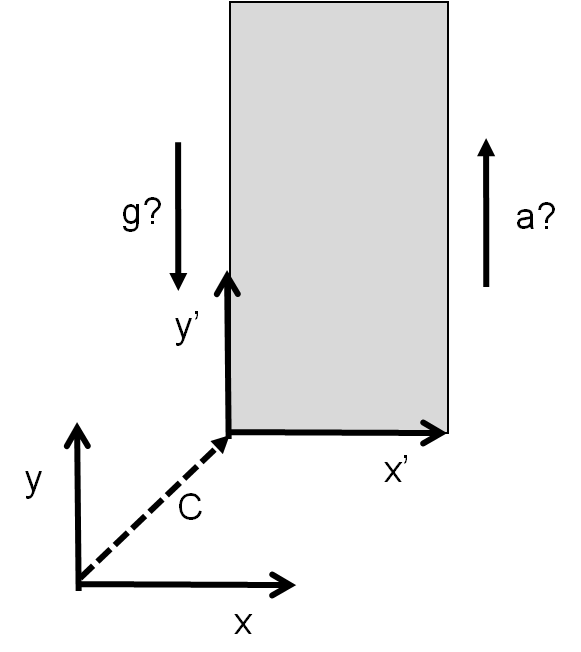
If the position of a particle is described by a vector \(\vec{r'}\) in the moving frame of reference, then in the absolute frame of reference it is given by:
If the velocities and acceleration in the moving reference are given by \(\dot{\vec{r'}}\), \(\ddot{\vec{r'}}\), respectively, then, in the absolute frame of reference, they are given by:
If we now consider D’Alembert’s principle, we have:
where we have an “apparent inertial force”, \(-m\ddot{\vec{C}}\), that is applied in addition to the inertial force, \(-m\ddot{\vec{r'}}\). It is impossible to tell if one is in a system with a real force \(-m\ddot{\vec{C}}\) or whether one is in an accelerated system with an apparent inertial force \(-m\ddot{\vec{C}}\). The fact that this inertial force is proportional to the same mass as that which appears in the gravitational force forms the basis of the “equivalence principle” that leads to the General Theory of Relativity.
We also have the result that it is possible to choose a reference frame where a particle is at rest (possibly introducing an apparent force). This blurs the line of what we mean when referring to “inertial frames of reference”. We do however recover Gallileo’s relativity principle that there is no “absolute” reference frame, and that the description of a system between inertial frames of references is unchanged. By inertial frame of reference, we mean frames of reference that move with respect to each other in a straight line at a constant velocity. The forces that are apparent in a rotating frame of reference can be derived in a similar fashion, resulting in the apparent Coriolis force.